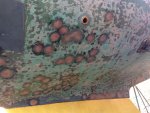
Viewing a boat with Osmosis

Arun class lifeboats soaked up water, enough to slow them down. Not osmosis though.
https://en.wikipedia.org/wiki/Arun-class_lifeboat

That Wiki reference says "....The GRP hulls were moulded in blue material in the outer skin. After a while it was found that water was accumulating in the fibreglass which added up to two tons to the weight...."

Unless they were foam or balsa cored and the cores were compromised and sodden that figure absolutely must be wrong. GRP simply cannot absorb more than maybe 4% at worst water, usually much much less. Absorbing 2 tons of water at 4% would mean a hull (just hull, not engines, tankage, superstructure fittings etc) of 100 tons on a 51 ft planing boat.

If it says Wiki don't take it as gospel.
 
I simply do not understand the strip and re-apply epoxy argument. A really bad case of the pox may affect ~5% of the actual GRP underwater surface, yet stripping removes 100%, and no matter how well you prepare it, the epoxy you put back on will be not dissimilar to a coat of paint applied to an old wooden door, albeit with better keying from a raw glass mat surface, but the moulded bond of the original gel to the glass is lost forever.

There is IMHO no way you will achieve anything like the original moulded bond for the 95% of the hull surface not affected. This is possibly why repeat failures of epoxy coats are common after ~ 10 - 15 years when the process likely will require repeating, especially if ANY moisture is bound within the new epoxy layer.

So will the surface have deteriorated much further in the said 10 - 15 years if you simply do nothing or just prick the worst of the blisters occasionally and smear over some araldite to those worse pox spots ? I would suggest anything less than 5mm diameter is best ignored.

As for surveyors, well ...
 
Last edited:
That Wiki reference says "....The GRP hulls were moulded in blue material in the outer skin. After a while it was found that water was accumulating in the fibreglass which added up to two tons to the weight...."

Unless they were foam or balsa cored and the cores were compromised and sodden that figure absolutely must be wrong. GRP simply cannot absorb more than maybe 4% at worst water, usually much much less. Absorbing 2 tons of water at 4% would mean a hull (just hull, not engines, tankage, superstructure fittings etc) of 100 tons on a 51 ft planing boat.

If it says Wiki don't take it as gospel.

I remember at the time they were withdrawn for drying because they lost so much speed, or so we heard. Is that 4% gospel? 4% by weight or volume? Certainly my FV hull was completely soaked and reckoned to be several tons overweight at 12.5 for a 32 footer.
 
I remember at the time they were withdrawn for drying because they lost so much speed, or so we heard. Is that 4% gospel? 4% by weight or volume? Certainly my FV hull was completely soaked and reckoned to be several tons overweight at 12.5 for a 32 footer.

Weight or volume makes little difference as there's not that much variation in specific gravity between them. The usual water absorbtion amount for GRP quoted by authoritative sources (eg du Plessis) is 2-3% absorption. The stories you hear about boats floating inches higher on their waterline after a "full osmosis treatment" is nothing to do with removing tons of water, but the fact that the gelcoat removal usually extends a bit above the waterline, and the new boot top is painted higher to mask the gelcoat/epoxy border.

Getting back to the OP - should he view?

Is it an older boat, especially a really heavily built one? If so you almost expect some blisters, and I really would not worry that much. I did once buy a 1968 built GRP boat with maybe 300+ 10p sized blisters. Ground out, filled and ten years later sold the boat with just a few new blisters.

Not all older GRP boats are really heavily built, as mine was. There were some built quite cheaply and lightly. Many however (eg Nicholsons/Halmatic/Tyler etc) from the 60s and 70s were massively overbuilt by modern standards. By the 80s oil prices had risen and many production boatbuilders were starting to cut back on GRP thicknesses.

If on a newish production boat, I would worry - as I would if I found blisters on my 2005 Jeanneau. Hulls are thinner now, though on the whole the design calculations are better - no-one can now afford to just bung on a few extra layers of glass to be quite sure it's strong enough.

I am not a fan of total gelstrips: you are replacing a chemically integral part of the hull with a "glued on" replacement. I have seen too many "osmosis treatments" fail.
 
I suggest the real concern is economic - as you doubtless appreciate. Outlay for you now in repairs and low market value when you come to sell; it seems to me the second hand market is well lubricated now - any other deals in the yard that appeal?

PWG
 
I am not a fan of total gelstrips: you are replacing a chemically integral part of the hull with a "glued on" replacement. I have seen too many "osmosis treatments" fail.

Agreed. I decided that 99.9% of my gel was still attached, and spot treatment would be best, I never got round to it. 1976 hull was spot treated in the early 80's, had evident osmosis in 1992, and sold with it in 2018. I should have treated a section every lift out, wouldn't have been too onerous between other jobs, lsuch as watching paint/flocoat dry.
 
I had heavy osmosis on my Westerly and by heavy i mean delamination of the outer fiberglass skin!
IMG_0491.jpg
So if i had only removed the gelcoat it would have been done for no reason. Instead, i opened everything with the angle grinder and the vinegar was squirting out. I beveled every problematic aereas until healthy laminate was clearly visible without moisture. I opened 150 points which then i had to laminate.. So i did patched them all ( i did fiberglassing for a lifetime lol)..

My question is what is the 8k offer for? Opening gelcoat blisters and just fairing them with epoxy? grinding out the damaged areas and relaminating? To my humble opinion, first it should be an investigation of the damage to be able to make a plan on the type of the repair. For relaminating 8k sounds good. But for just opening some gelcoat blisters and fairing them with putty this is a huge amount. You must know excactly the level of damage so you can figure out what kind of repair is needed, and what is a resonable cost for this!


Regards
 
Last edited:
Hi all

Thanks for your replies. We viewed the boat and made an offer which has been accepted subject to survey etc. From the previous survey if it hasn't got much worse we can live with it and get it done later.

Thanks again

David
 
Congratulations, digging those lumps out and filling with epoxy seems to work well in a lot of cases. I might do a bit every year.

Do put up some snaps of the boat.
 
I have a survey on my boat from 1989, it says the toilet bowl is showing early signs of osmosis. As it is ceramic I am not going to act with too much haste.

My survey talked about a 3 cylinder VP 2030! In fact it is a 4 cylinder uVP MD22
 
My survey talked about a 3 cylinder VP 2030! In fact it is a 4 cylinder uVP MD22

I sold a boat in spite of a survey saying that the VHF aerial was not tested. Not surprising since there wasn't one.

BTW, congratulations to David on the new boat. If you want a new name, try 'Reckless of Deben'.
 
Top