
VHF/AIS cable, antenna and connections

GTom

Well-Known Member
Joined
12 Jun 2017
Messages
954
Visit site
Planning to shop for an AIS and as the 13m tall mast is down at the moment, thinking on replacing my corroding venerable RG58 cable. Couple of questions:

- Is it wiser to get an antenna that has a cable already joined? Regarding cable, is the 2dB difference between RG213 (10mm diameter) and RG58 relevant on about 18m (60') distance at sea? RG213 is much more difficult to handle being twice thicker.

- Where shall I put the splitter? I thought about right next to the deck gland where the cable enters? Yearly mast unstepping is much easier if all cables have a connector at the mast base.
 
The thing to bear in mind with coax with "RG" designations is that it's not a very tight specification and mostly refers to cable dimensions. It doesn't say much about the electrical properties. A cheap poorly made cable will perform a lot worse than a well made one from a reputable manufacturer.

I would recommend using Hyperflex 10 coax which although it is the same thickness as RG213 is much more flexible, and has much lower loss. Remember that every 3dB loss means you are losing half your power. That makes quite a difference for transmitting.

Hyperflex 10 has about 5dB/100m attenuation at marine VHF frequency. Belden RG213 has about 8dB/100m and RG58 could be upwards of 14dB/100m depending on type.

It's definitely worth using a better coax than RG58, which often gets supplied with aerials because it's cheap.
 
If fitting a splitter, i always try to fit them close to the VHF set and have the coax long enough to reach the VHF. That way, if the splitter fails, you can connect the coax to the VHF and still use the radio.
 
The thing to bear in mind with coax with "RG" designations is that it's not a very tight specification and mostly refers to cable dimensions. It doesn't say much about the electrical properties. A cheap poorly made cable will perform a lot worse than a well made one from a reputable manufacturer.
I would recommend using Hyperflex 10 coax which although it is the same thickness as RG213 is much more flexible, and has much lower loss. Remember that every 3dB loss means you are losing half your power. That makes quite a difference for transmitting.
Hyperflex 10 has about 5dB/100m attenuation at marine VHF frequency. Belden RG213 has about 8dB/100m and RG58 could be upwards of 14dB/100m depending on type.
It's definitely worth using a better coax than RG58, which often gets supplied with aerials because it's cheap.

Thanks for the figures, the question is, am I going to experience real performance decrease on a tiny boat with 13m mast? True, I loose about 40% power compared to the Hyperflex, but that means still 15W equivalent remains. Is that difference perceivable in realistic scenarios? (e.g boat to coastal station = 50NM) Just asking to justify the drilling the thicker cable needs in various positions of the boat.
Also looking at antennae readily supplied with RG8X (7mm) cable, which is indeed not as high performance as the top candidates but I might get away without drilling and be better than the old RG58.

Take a look at Salty John's website - he offers quality coax, antennas etc: https://www.saltyjohn.com/product/rg8x-coax-per-metre/
Thanks!

If fitting a splitter, i always try to fit them close to the VHF set and have the coax long enough to reach the VHF. That way, if the splitter fails, you can connect the coax to the VHF and still use the radio.

Good idea, it also reduces the cable amount in the boat :encouragement:
 
Last edited:
You have probably read about not everyone getting on with splitters, if you haven't you should! I returned my splitter and got my money back from a very popular online chandlery. I have ended up with an antenna on the pushpit and an antenna to be mounted on the mast next time I have the mast down, it is currently on the other side on the pushpit. Both Salty John's finest. If you are going to drop your mast annually and disconnect the cable you are introducing some vulnerability and having a single antenna is all your eggs in one basket.
 
You have probably read about not everyone getting on with splitters, if you haven't you should! I returned my splitter and got my money back from a very popular online chandlery. I have ended up with an antenna on the pushpit and an antenna to be mounted on the mast next time I have the mast down, it is currently on the other side on the pushpit. Both Salty John's finest. If you are going to drop your mast annually and disconnect the cable you are introducing some vulnerability and having a single antenna is all your eggs in one basket.

Interesting idea, the mast is down at the moment but I don't intend to unstep it every year. Also true, that a splitter costs 2x as an antenna kit with 20m RG8X cable!
 
Remember that the better coax not only increases your transmit performance, but also you receive performance. I swapped mine out for the RG213 and I am happy with the results.

I added a a second antenna to a 3m pole on the back of the pushpit, for AIS and for use if the main antennae ever fails. I find the extra performance of the main raidio reassuring, I do not really care much about the AIS performance beyond 5 miles, as traffic further away than that is not of any importance.
 
Remember that the better coax not only increases your transmit performance, but also you receive performance. I swapped mine out for the RG213 and I am happy with the results.

I added a a second antenna to a 3m pole on the back of the pushpit, for AIS and for use if the main antennae ever fails. I find the extra performance of the main radio reassuring, I do not really care much about the AIS performance beyond 5 miles, as traffic further away than that is not of any importance.

Which type of cable did you have before? High quality RG8X or just an RG58?
 
Should you go to the trouble of using low loss cable or not. That is the question. The purists would say definitely yes. Indeed the larger coax may be more robust against corrosion etc simply being bigger. However the loss of performance may never be noticed. Essentially radio signal strength works on a logarithmic scale so half power is barely noticed.
Re splitters yes definitely fit an AIS antenna on the stern rail rather than a splitter. Performance is very adequate for AIS and gives you a standby antenna in case of top antenna failure or loss of mast. ol'will
 
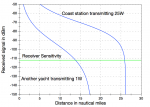
A couple dB is probably not that critical to range as it's usually limited by the curvature of the earth. Here's a graph of path loss versus range which I prepared earlier (full article on the CA website):

vhf_range_1.png

As can be seen, a 2dB change in attenuation makes rather little difference to the range, hence I think the thicker and thus less flexible cable isn't actually that important.
 
A couple dB is probably not that critical to range as it's usually limited by the curvature of the earth. Here's a graph of path loss versus range which I prepared earlier (full article on the CA website):

View attachment 80509

As can be seen, a 2dB change in attenuation makes rather little difference to the range, hence I think the thicker and thus less flexible cable isn't actually that important.

And @William: thank you.

As I understand, for normal boat to boat communications (combined radio horizons <20NM) it should not make a difference. Question is, what is the case when communicating with coastal stations installed on e.g. 100m tall cliffs or SAR planes?

Other question is the ideal antenna gain (=length?), but it seems to me that the usual 3dBi should be fine.
 
A couple dB is probably not that critical to range as it's usually limited by the curvature of the earth. Here's a graph of path loss versus range which I prepared earlier (full article on the CA website):

View attachment 80509

As can be seen, a 2dB change in attenuation makes rather little difference to the range, hence I think the thicker and thus less flexible cable isn't actually that important.

But, if you are replacing the cable, and the cost difference is minimal, why would you not use it? You are correct, in good conditions, it may not make much difference, however in marginal conditions, it could be the difference between being intelligble and not.

Remember, our radios are FM, not AM/SSB ... there is a very sharp cut-off point at which the FM discriminator is unable to resolve the signal and it goes from being slightly hissy to a bag of crackles. 2dB here could make a lot of difference. On an SSB signal, it just gets a proportionally weaker with respect to the noise, on FM there is a sudden and quite severe change.

I appreciate that in *most* circumstances it will make little difference, but in marginal conditions it could be the difference between your distress call being intelligible and not, and for the sake of a couple of extra quid on the rable run, I'll take it.
 
Last edited:
But, if you are replacing the cable, and the cost difference is minimal, why would you not use it? You are correct, in good conditions, it may not make much difference, however in marginal conditions, it could be the difference between being intelligble and not.

Remember, our radios are FM, not AM/SSB ... there is a very sharp cut-off point at which the FM discriminator is unable to resolve the signal and it goes from being slightly hissy to a bag of crackles. 2dB here could make a lot of difference. On an SSB signal, it just gets a proportionally weaker with respect to the noise, on FM there is a sudden and quite severe change.

I appreciate that in *most* circumstances it will make little difference, but in marginal conditions it could be the difference between your distress call being intelligible and not, and for the sake of a couple of extra quid on the rable run, I'll take it.

Well exactly - you want to minimise losses as best you can. If you have the opportunity to minimise losses, unless there is a good reason not to (ie you can't physically fit it), then it would seem to me that it is prudent to do so. If you take the attitude that "it's only a few dB", and apply it to every stage in the chain - cheap antenna with slightly worse performance, cheap coax with slightly more attenuation, cheap connectors with slightly higher insertion loss etc, you can quite quickly end up with a quite large difference in performance.

It's really a cost/benefit trade-off. If you only ever sail up the coast and back and use VHF mainly for talking to marinas you probably won't notice any difference. If you travel further afield and want to have the best possible reliable coverage, especially for AIS, then it's worth taking the time and spending a little extra to get the best out of your equipment.
 
Well exactly - you want to minimise losses as best you can. If you have the opportunity to minimise losses, unless there is a good reason not to (ie you can't physically fit it), then it would seem to me that it is prudent to do so. If you take the attitude that "it's only a few dB", and apply it to every stage in the chain - cheap antenna with slightly worse performance, cheap coax with slightly more attenuation, cheap connectors with slightly higher insertion loss etc, you can quite quickly end up with a quite large difference in performance.

It's really a cost/benefit trade-off. If you only ever sail up the coast and back and use VHF mainly for talking to marinas you probably won't notice any difference. If you travel further afield and want to have the best possible reliable coverage, especially for AIS, then it's worth taking the time and spending a little extra to get the best out of your equipment.

Hmm, I'm not 100% convinced (and I have spent my life doing RF engineering, where we say that any RF engineer would sell his grandmother for a dB). My reason is that I've looked at quite a few VHF installations and have really very often found 20 or more dB of excess loss due to decaying antenna matching components, poorly made up connectors and/or chafe (especially bad around the mast base and where the cable passes through a deck-gland and so the connector has been taken off and on a few times for mast removal), and bad grounding and supply to the sets themselves,.

Inline connectors usually BNC, are nearly always accompanied by dry-joins if the BNC is the solder type, or shoddy connections and discontinuous grounds where the BNC is a crimp type since nobody (even yards) ever have the proper crimping tool.

So as a 'triage' I'd put use of RG-58' rather low down the list of reasons for poor performance. Of course it's better to use better cable, and I use RG-8X on my boat (not RG-8U as it's so hard to make connections if doing it up the mast while in a bosun's chair except when using one of these http://shakespeare-ce.com/marine/product/style-pl-258-cp-g-connector/ into which RG-8X fits but not RG-8U).
 
Last edited:
It's surprisingly common for radio systems to work better with a little bit of loss between antenna and transceiver.
As jdc says, you're missing the point if you use 'good' cable then ruin it with poor connections.
The biggest crime is allowing any trace of damp to get into the coax, you can get 10dB of loss before you know it, or worse!
 
Planning to shop for an AIS and as the 13m tall mast is down at the moment, thinking on replacing my corroding venerable RG58 cable. Couple of questions:

- Is it wiser to get an antenna that has a cable already joined? Regarding cable, is the 2dB difference between RG213 (10mm diameter) and RG58 relevant on about 18m (60') distance at sea? RG213 is much more difficult to handle being twice thicker.

- Where shall I put the splitter? I thought about right next to the deck gland where the cable enters? Yearly mast unstepping is much easier if all cables have a connector at the mast base.

At the end of the day, in the real world, I used RG58 cable, has it impacted on my connecting to whoever I wanted to? Nah!
 
It's surprisingly common for radio systems to work better with a little bit of loss between antenna and transceiver.
As jdc says, you're missing the point if you use 'good' cable then ruin it with poor connections.
The biggest crime is allowing any trace of damp to get into the coax, you can get 10dB of loss before you know it, or worse!

Agreed, decided to take a few precautions. As for connections, I'll keep the cable in one piece at least until the splitter. Likely going with RG8X, just received word that the antenna kit I was interested in has 12dB/100m loss on the RG8X cable. Obviously with a 30m mast serving a significantly larger horizon, I'd go with something much better.

Still undecided regarding splitter: I like simplicity and found an AIS with integrated splitter, which sounds appealing. Obviously some losses can be expected here as well compared to having an individual antenna.

If you travel further afield and want to have the best possible reliable coverage, especially for AIS, then it's worth taking the time and spending a little extra to get the best out of your equipment.

If I go further, I get HF gear and a satphone... I don't nurture high hopes about beyond-horizon communications on VHF.
 
Last edited:
Top