Vacuum gauge problem

martinriches

Well-Known Member
Joined
8 Jun 2005
Messages
346
Location
London
Visit site
I fitted a vacuum gauge between the secondary filter and the injection pump over the winter. It took me a while to bleed all the air out of the system but eventually got going. I have just had a run out into the estuary and the engine packed up after about 10 minutes. I bled the injection pump and also clamped the tube going to the vacuum gauge incase there was a problem there. Engine started and got back to my berth, now I'm trying to figure out what's going on. Could it be air in the system somewhere from the work I did that's eventually worked it's way around, or maybe the vacuum gauge and piping. The gauge shows 0 even at 2000 revs , the engine is fed from a day tank that's about a foot higher so I was thinking that's why it's not registering. I've checked all the connections I made and they seem OK, no deisel leaking. Should the gauge show some movement ?

Martin
 
Did you really put the gauge just before the injection pump, or do you mean the lift pump? In a typical engine the lift pump supplies the fuel to the injection pump under slight pressure, so a vacuum gauge will never read anything.

The term "secondary filter" is also a bit vague - regardless of what it officially means, different people use "primary" and "secondary" in opposite ways.

It would be helpful if you could describe the parts of your system in order from the tank pick-up to the injectors, just so we're all talking about the same things.

Pete
 
Last edited:
By secondary I ment the one nearest the engine. So from the day tank into the Racor filter then to the top of the secondary filter, then from the bottom of the secondary filter through a tee one branch to vacuum gauge another to the back of the injection pump. By injection pump I mean the one where the lines go direct to the injectors.

I have a feeling I have got this wrong.
I've tried to add a photo but can't get it to work. I'll keep trying.

Martin
 
Your description doesn't include a lift pump, but you mention a day tank - does this mean the system is gravity feed, from a raised tank?

If so, every part of it is under positive pressure and a vacuum gauge is no use anywhere :)

On the other hand, with a gravity system any leaks will leak diesel out instead of air in, so even if you did make a bad joint in fitting the gauge the worst case is a weep or drip of diesel and the engine should still run just as well.

Pete
 
Yes it is fed from the day tank which is higher than the engine. I was thinking that if the filters got blocked it would then have pull the fuel through which would register on the gauge. Not sure about a lift pump, the day tank is probably not original equipment. No sign of any fuel leaks.

Martin
 

Attachments

  • IMG_20180331_152124.jpg
    IMG_20180331_152124.jpg
    423 KB · Views: 2
Yes it is fed from the day tank which is higher than the engine. I was thinking that if the filters got blocked it would then have pull the fuel through which would register on the gauge. Not sure about a lift pump, the day tank is probably not original equipment. No sign of any fuel leaks.

Martin

If you have no lift pump and it is entirely gravity fed, as has already been said, you will never get a vacuum reading on the gauge.

Www.solocoastalsailing.co.uk
 
I would remove the vacuum gauge and return the system to what it was originally. Unfortunately, it can't be used on your set up. I had similar with a VP MD1 which was bled purely with pressure head from elevated fuel tank.
 
There's a knob you unscrew you can the pump fuel through the system. It's the silver disc beside the injection pump in the photo.

Martin
 
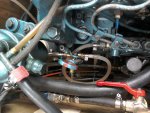
I've looked at the drawing for the injector pump and it shows a fuel delivery pump attached to it. As I said the day tank isn't part of the original setup, so I'm wondering if it has a delivery pump after all and the reason the gauge isn't working is because it's on the wrong fuel line. Can anyone tell from the photo if it's in the right place? I can't work out what the line from the base of the filter to the back of the injection pump is for.

Martin
 
I'm a bit troubled by the grey/translucent hose prominent in the pic, which looks as though it's carrying fuel to the injectors.

That material is certainly not 'fire resistant' and may not even cope with a hot engine without melting. May I recommend you consider replacing it with something which meets ISO 7840 '2 minutes resistant' standard....? That's a cheap and easy job while you're working on your fuel system.
 
I'm a bit troubled by the grey/translucent hose prominent in the pic, which looks as though it's carrying fuel to the injectors.

That material is certainly not 'fire resistant' and may not even cope with a hot engine without melting. May I recommend you consider replacing it with something which meets ISO 7840 '2 minutes resistant' standard....? That's a cheap and easy job while you're working on your fuel system.

It came from ASAP it is discribed as ''Nylon tubing suitable for use as a small marine fuel line.'' it doesn't give any ISO standard though.

Martin
 
It came from ASAP it is discribed as ''Nylon tubing suitable for use as a small marine fuel line.'' it doesn't give any ISO standard though.

I see it offered, on page 184 of their current catalogue.... 'for low pressure applications only'. Its working pressure is advertised as 320 - 450 PSI, and temperature range '...to +80°C'.

I'm fairly confident that, Martin, should there be a fuel weep around there ( quite common ) and that ignite, the local temperature would swiftly exceed the given limit and the nylon hose would melt, feeding the fire. It costs but an email with photo to query ASAP.

They're USUALLY good, but not infallible, and I'd be surprised if they maintain the product is OK in that role. If so, may I also recommend you keep a copy of their reply.... for your insurance loss adjuster.
 
I'm a bit troubled by the grey/translucent hose prominent in the pic, which looks as though it's carrying fuel to the injectors.

That material is certainly not 'fire resistant' and may not even cope with a hot engine without melting. May I recommend you consider replacing it with something which meets ISO 7840 '2 minutes resistant' standard....? That's a cheap and easy job while you're working on your fuel system.

The pipes carrying high pressure fuel to the injectors are the metal pipes coming off the top of the pump Two of four visible in the picture.

The hose you are referring to I think must be the delivery hose to the pump or a spill back hose , but there are so many small hoses its impossible to tell what's what in the picture. I'm not even sure which one you are looking at.
 
Last edited:
The hose you are referring to I think must be the delivery hose to the pump or a spill back hose..... I'm not even sure which one you are looking at.

It's this one, looping around the dipstick.....


27294530268_af3c044bf4_z.jpg


You're right. It's probably a Fuel Return or 'spill back' hose. If it's carrying fuel in any direction, the concern remains.

There appears to be a T-piece in the centre of that grey/opaque looped hose, with a smaller-diameter tube running off, in the direction of the red stop cock handle. Could that be connected to the vacuum gauge?
 
Top