Using Speedi-Sleeve with a Volvo shaft seal

Poey50

Well-Known Member
Joined
26 Apr 2016
Messages
2,319
Location
Chichester
Visit site
Having shelled out for a new prop shaft I wasn't too pleased when a 'friend' told me I could have repaired the damage with a Speedi-Sleeve. Annoyingly I know about them having used one successfully on the shaft of my raw water pump last year. Has anyone used them with a Volvo shaft seal or similar? Obviously, having parted with my hard-earned, I'm hoping there is a convincing argument against (possibly the seal not coping with the different diameters between the shaft and the point where the lips bear) but it may be better to know.

I should add that it wasn't possible to move the shaft a bit either forwards (already at minimum distance from cutlass bearing) or aft (the prop only just clears the skeg).
 
Last edited:
Having shelled out for a new prop shaft I wasn't too pleased when a 'friend' told me I could have repaired the damage with a Speedi-Sleeve. Annoyingly I know about them having used one successfully on the shaft of my raw water pump last year. Has anyone used them with a Volvo shaft seal or similar? Obviously, having parted with my hard-earned, I'm hoping there is a convincing argument against (possibly the seal not coping with the different diameters between the shaft and the point where the lips bear) but it may be better to know.

I should add that it wasn't possible to move the shaft a bit either forwards (already at minimum distance from cutlass bearing) or aft (the prop only just clears the skeg).

If you talking about an sail drive shaft , do I search here and you will find I have recommended this a few times .
I had a very bad score on my saildrive , using the speedi sleeves made by SKF from simply bearings worked very well , easy to fit and they do load of sizes . The once I got fitted tightly . Two years on still working well .
 
If you talking about an sail drive shaft , do I search here and you will find I have recommended this a few times .
I had a very bad score on my saildrive , using the speedi sleeves made by SKF from simply bearings worked very well , easy to fit and they do load of sizes . The once I got fitted tightly . Two years on still working well .

Mine's a shaft drive but same principle.
 
Some downsides. Repair would have needed 2 sleeves to cover the two lips (not a big problem) but they would have to be driven about 10 inches or so down the shaft rather than the recommended maximum of 2 inches. I would have had to do a good clean-up of the damaged part of the shaft where previous 'professionals' have presumably gripped the shaft with mole-grips or similar. And the new shaft gave me fresh metal under the cutlass bearing.
 
Some downsides. Repair would have needed 2 sleeves to cover the two lips (not a big problem) .

Good point, but may be a significant point if you are allowing +/- shaft axial movement from forward and reverse. I get about 5mm each way and as a speedi sleeve for my shaft is only 13mm long it would be tricky to ensure the lip seals do not touch the (sharp?) edges of the sleeve on extreme travel which would damage them.

Www.solocoastalsailing.co.uk
 
Last edited:
Good point, but may be a significant point if you are allowing +/- shaft axial movement from forward and reverse. I get about 5mm each way and as a speedi sleeve for my shaft is only 13mm long it would be tricky to ensure the lip seals do not touch the (sharp?) edges of the sleeve on extreme travel which would damage them.

Www.solocoastalsailing.co.uk

Interesting point. I'd assumed that the wear on the shaft would give a precise guide to locating the sleeves but of course some of the + / - axial movement would be momentary but still with some potential to damage the lips. I do hope so ... :p
 
On the sail drive there are two seals so I had to use two sleeves , I used a tube to drive them home as they were pretty tight you can if you want buy a liquid that will seal them between the sleeve and the shaft .
If there any damage I would use the liquid to seal it , locite .
Lining them up is easy , just centre them over the scores on the shaft .
Once on you need to cut away the lip on the sleeve , you start this off before driving the sleeve home by sniping a small part , then once the sleeve on use a long nose pliers to remove it .
 
Last edited:
I used one to repair a corroded gearbox flange and it worked well. As others have said I would worry about the axial movement of the prop shaft, the sleeves are quite short. If the seal runs off the sleeve it will damage it.
 
Hi,
this is perhaps a slight drift in topic; has anyone of you experience of the durability of speedi-sleeve used on a propeller shaft?
I fitted speedi-sleeves on my sail drive shaft in 2012. In 2016 the sleeves looked no better than the shaft before the repair. I assume when the sleeves are worn through the result will be razor sharp edges that will eat up my seals in no time.
The simplest and most sensible would be to redo the repair ASAP, but I'm also curious about their durability.

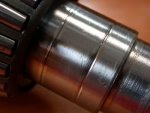
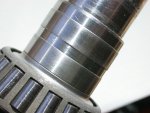
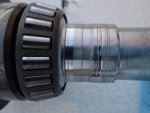
I have attached 3 pictures: the worn shaft before and after repair in 2012, and the last from 2016

Jan

DSCN5471.JPG
DSCN6264.JPG
P7072320 kopi.JPG
 
Hi,
this is perhaps a slight drift in topic; has anyone of you experience of the durability of speedi-sleeve used on a propeller shaft?
I fitted speedi-sleeves on my sail drive shaft in 2012. In 2016 the sleeves looked no better than the shaft before the repair. I assume when the sleeves are worn through the result will be razor sharp edges that will eat up my seals in no time.
The simplest and most sensible would be to redo the repair ASAP, but I'm also curious about their durability.

I have attached 3 pictures: the worn shaft before and after repair in 2012, and the last from 2016

Jan

View attachment 67519
View attachment 67520
View attachment 67521

I couldn't say , but it's a lot cheaper to replace the sleeve then a new shaft . How many hour has it done between sleeve?
 
I couldn't say , but it's a lot cheaper to replace the sleeve then a new shaft . How many hour has it done between sleeve?

Good point. I am unfortunately not in the good habit to note engine hours, but I would guess 200-250h.
It also struck me that the wear is perhaps not that predictable. I notice that it is the outer seal that makes the most wear. I assume this is because occasionally a grain of sand get stuck under the seal lip.
I also have to confess that I forgot to fill the space between the two seals with grease, at the last change of seals. That could also have contributed to the wear at the outer seal.

Still it would be interesting to read others experience on the durability.

Jan
 
Good point. I am unfortunately not in the good habit to note engine hours, but I would guess 200-250h.
It also struck me that the wear is perhaps not that predictable. I notice that it is the outer seal that makes the most wear. I assume this is because occasionally a grain of sand get stuck under the seal lip.
I also have to confess that I forgot to fill the space between the two seals with grease, at the last change of seals. That could also have contributed to the wear at the outer seal.

Still it would be interesting to read others experience on the durability.

Jan

Is the outer seal a twin-lipped seal and the inner one a standard seal?

Your wear rates seem too high to me unless you are motoring in extremely gritty water ..... but if those are two standard seals then something else is going on and we need more info.

Richard
 
Is the outer seal a twin-lipped seal and the inner one a standard seal?

Your wear rates seem too high to me unless you are motoring in extremely gritty water ..... but if those are two standard seals then something else is going on and we need more info.

Richard
The outer seal do wear more Richard but 200 250 hours Seen a hell of a lot , when we did our we put 900 hours when I had to replace the seals and the sleeve where still good .
 
Is the outer seal a twin-lipped seal and the inner one a standard seal?

Your wear rates seem too high to me unless you are motoring in extremely gritty water ..... but if those are two standard seals then something else is going on and we need more info.

Richard
Both seals are standard VP seals. The double wear traces are because of a seal change after the speed-sleeve repair.

I bought the boat in 2009 and have struggled with occasionally water in the gear oil since. I changed seals the year before I mounted Speedi-sleeves. I put the seal a bit offset to avoid the wear trace. That did not solve the problem. When I mounted the Speed-sleeves I did not touch the offset seals. After a while the water problem came back. Now I changed the seals again, and put them at their proper position. That is why there are double traces.

And, yes, I have checked and changed the drain plug gasket.:)

This problem is more a puzzle than a pain. This year it has been fine.
The excessive wear of the Speedi-sleeves was disappointing as they are said to be very hard and resistant to wear. The water around is not very gritty (the coast of Norway), but occasional maneuvering in a shallow harbor may have thrown up some sand. Does it all come down to the missing grease between the seals?

Jan
 
Both seals are standard VP seals. The double wear traces are because of a seal change after the speed-sleeve repair.

I bought the boat in 2009 and have struggled with occasionally water in the gear oil since. I changed seals the year before I mounted Speedi-sleeves. I put the seal a bit offset to avoid the wear trace. That did not solve the problem. When I mounted the Speed-sleeves I did not touch the offset seals. After a while the water problem came back. Now I changed the seals again, and put them at their proper position. That is why there are double traces.

And, yes, I have checked and changed the drain plug gasket.:)

This problem is more a puzzle than a pain. This year it has been fine.
The excessive wear of the Speedi-sleeves was disappointing as they are said to be very hard and resistant to wear. The water around is not very gritty (the coast of Norway), but occasional maneuvering in a shallow harbor may have thrown up some sand. Does it all come down to the missing grease between the seals?

Jan

OK Jan, I understand. The grease between the two seals is a good idea, especially if you have the proper waterproof variety, and this would certainly protect the inner seal but probably not provide a huge amount of benefit to the outer seal.

Because you clearly have an ongoing problem here, I'm going to suggest another cause which is that either the needle roller bearing (probably roller) at the far end of the shaft or the bearing (tapered roller) at the seal end of the shaft have too much play. This will cause excess chatter in the shaft and will definitely cause premature failure of the seals and/or shaft. You've not suggested that there is any rumbling from the saildrive in use so it could be just enough wear to cause the shaft failure.

This would result from the drive being run with too much water content in the oil by the previous owner.

You might be able to check the play and end-float limits but how much is acceptable is the issue. Check the Volvo manual to see if there is any guidance.

Richard
 
Last edited:
Thanks for the advice, Richard. I will check these things at next lift up.

Since the topic has now drifted from VP shaft seal to saildrive and now to my specific water in oil problem, I think I will not go further in this tread.
I do not suggest that Speedi-sleeve is no good based on my single experience. There seems to some odd condition that I have to identify.

Jan
 
Getting back to the OP question, in the past I had this scoring problem on my 25 mm shaft with a Volvo shaft seal, all I did was to make an extension to my stern tube moved the seal forward 25 mm and it was fine, all that is needed is stainless tube same size as the stern tube and and reinforced rubber tube to fit over the stern tube and the stainless tube a couple more clips and it was fine.
Mike
 
Getting back to the OP question, in the past I had this scoring problem on my 25 mm shaft with a Volvo shaft seal, all I did was to make an extension to my stern tube moved the seal forward 25 mm and it was fine, all that is needed is stainless tube same size as the stern tube and and reinforced rubber tube to fit over the stern tube and the stainless tube a couple more clips and it was fine.
Mike

Interesting idea to extend the stern tube, but I'm afraid I haven't been able to follow your description. (It's now theoretical to me as I replaced the shaft but still interesting to hear about.)
 
Top