using my propeller shaft to charge my batteries

casenetinc

New Member
Joined
16 Jul 2012
Messages
1
Visit site
I have heard that there is a system that is mounted on the propeller shaft that will generate electricity to my batteries. Does anyone know about this and where I might find one. My transmission must let my propeller turn all of the time. So I thought that i could make use of this wasted energy.
 
Anything you take from the prop shaft will have to be supplied by the wind / sails, so it will slow the boat down. You don't get anything for nothing.

That's true, but there are shaft generators out there.
No idea who makes/made them though.
I don't think the output is large by any standards though.
 
Welcome

In theory yes, in practice no. You cannot get the shaft to spin fast enough to get any significant charge out of an alternator. You can get purpose built water powered generators for towing behind the boat, but they have an effect on speed and output is poor, so only really good for continuous long distance sailing.

You will find many people have tried to harness that so called wasted energy, but none have been successful. It features in some of the hybrid power solutions, but is the bit that does not work. See Niki Perryman's write up of their experiences with it in Classic Boat mag.
 
I'm about to live on a boat that has one fitted - it was on the boat when I bought it and I have yet to see if it works or not.

It looks homemade. It uses a standard alternator, some belts and some wiring/switches, so would not cost very much at all to replicate.

The quirky thing is that the alternator takes current to energise the electromagnets in the alternator, so when turned on, it is taking current.

If I remember I'll post back in here after I've tested it out in the water. Reading the posts above I am not very confident! Ah well.

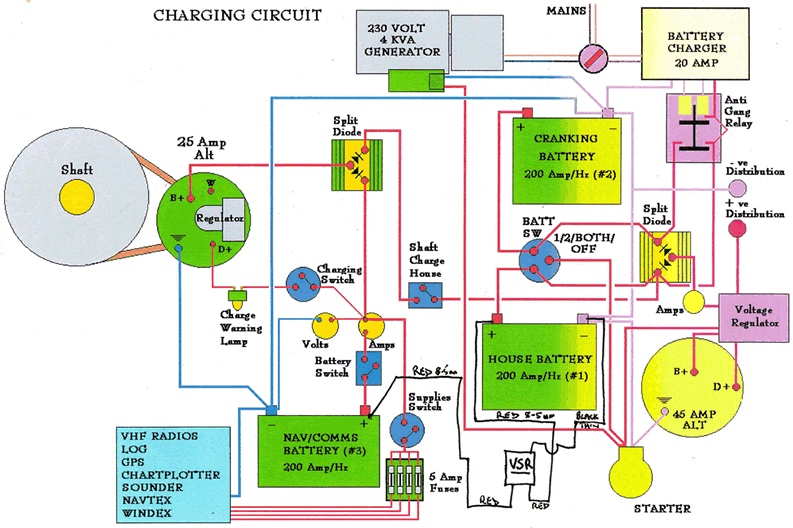
Here's a wiring diagram of my boat's charging circuit, which includes the shaft generator:

charging.gif
 
I expect your shaft driven alternator is there to produce power when you are motoring as an alternative to an additional alternator driven by a belt from the engine, rather than to harness power when sailing.

The maximum propshaft speed because of the reduction box is less than 1500 rpm at full power, so if the gearing is right through the pulley sizes you should get some output. One problem with using a prop shaft is that they tend to move about, whereas the alternator needs to be firmly attached to something so you have difficulty in tensioning the belt. Better if the shaft is fixed by, say using an Aquadrive.

Different when you are under sail as you are reliant on the prop being able to spin the shaft fast enough to get the alternator going, and this seems to be the problem with those who have tried in the past. And of course, if you are interested in efficient sailing you will probably fit a feathering or folding prop which won't spin the shaft at all.

Jeremy Rogers built an "eco" 32 recently and one of its features was a hybrid propulsion unit that had a special feathering prop which was supposed to turn into a generator when sailing. Not sure it worked.
 
Even if you manage to get the prop rotating fast enough I don't think there will be much power available. If you've ever tried manually stopping a rotating shaft while sailing it's not very difficult, and I'd be willing to bet it would be easier to stop than, say, a 1/4 hp mains electric motor, so that would be less than 170 watts. Subtract the losses from the belt drive, factor in the cost and time of setting up an alternator and you'd be better off with a wind generator or solar panel.
 
A shaft connected dynamo would work better than an alternator as this would produce some power at lower spinning speeds, not sure if you would knacker it whe you were motoring. You might need to have a system to disconnect it from the shaft when under power, something very simple similar to how a dynamo bike light works. It would look a bit home made but it would be cheap and give you something to fiddle with and tweak when passage making.

Ross
 
I expect your shaft driven alternator is there to produce power when you are motoring as an alternative to an additional alternator driven by a belt from the engine, rather than to harness power when sailing.

I don't think so as there's a key arrangement set up so that you can't energise and connect the shaft driven alternator unless the ignition is off.

We're going to be mostly anchored in a tidal river so _maybe_ we'll get something useful out of it. I will report back in a couple of weeks after some testing...
 
Yes, thats interesting. Hope you get something out of it.

There have been proposals to get power from spinning shafts as long as there has been a need for charging batteries on boats. Remember seeing them in pre war US magazines. However, they have never caught on and not sure anybody has made a commercial success out of selling them, which suggests they are not that effective. Of course now you have powerful engine alternators, smart charging, solar panels, wind generators etc the need for such a device has rather gone.
 
Here's a wiring diagram of my boat's charging circuit, which includes the shaft generator:

charging.gif

Thats an excellent wiring diagram - I could do with investigating my boat and doing a similar diagram. Did you do it yourself? I suspect not from the hand drawn addition but if you did, what software?
 
The revs that the prop shaft would do when sailing, will be so much less than when under power, that if the gearing is correct for sailing, it will be far too much when under power. Some means of disconnecting the drive would be required.
 
I have met a few crusing boats that have a propshaft generator and they seem successfull when well implimented.
Owners talk about 5-6A at resonable crusing speeds, but these are systems that are difficult to fit to boats unless it has been designed from the beginning.

I believe Amel offer them as an option.

There are also towed generators and some that use a retractable saildrive type leg.
 
Jeremy Rogers built an "eco" 32 recently and one of its features was a hybrid propulsion unit that had a special feathering prop which was supposed to turn into a generator when sailing. Not sure it worked.

The hybrid setup has been replaced by a conventional inboard diesel. As a knowall I was pleased as I never saw the point of the hybrid gambit in boats ... but then I never saw how the European single currency was going to work nor how rampant house prices nor rampant outsourcing of services nor PFI. were going to benefit the country in the long run etc., etc.
 
Thats an excellent wiring diagram - I could do with investigating my boat and doing a similar diagram. Did you do it yourself? I suspect not from the hand drawn addition but if you did, what software?

MS Visio is the one I would use but there is an open source one called "dia". The pic above looks like it was made in an old version of Paint Shop Pro to me.
 
In theory yes, in practice no. You cannot get the shaft to spin fast enough to get any significant charge out of an alternator. You can get purpose built water powered generators for towing behind the boat, but they have an effect on speed and output is poor, so only really good for continuous long distance sailing.
My Aquair 100 towed generator delivers 6 amps at 6 kts, with a speed loss of ¼ - ½ kt. Not far off what you'd get from a small battery charger. Why can't a free-wheeling propshaft deliver a similar amount?
 
Last edited:
My Aquair 100 towed generator delivers 6 amps at 6 kts, with a speed loss of ¼ - ½ kt. Not far off what you'd get from a small battery charger. Why can't a free-wheeling propshaft deliver a similar amount?

Your towed generator is designed for the job. I said theoretically yes, practically unlikely and the reasons have come out here. An engine driven alternator needs revs to get it going and shafts are unlikely to turn at more than 1000 rpm even sailing flat out. You have to find a means of mounting the alternator, gearing it to run fast enough, disengage when the engine is running and driving the shaft and keeping tension on the drive belt when the alternator is fixed and the shaft is (usually) not. All in what is, in many boats, a confined space.

If it was simple and effective, then somebody would have developed a commercial design, but there does not appear to be any. There are many other alternatives (such as your towed generator) that are easier and cheaper to use to generate extra power.
 
The hybrid setup has been replaced by a conventional inboard diesel. As a knowall I was pleased as I never saw the point of the hybrid gambit in boats ... but then I never saw how the European single currency was going to work nor how rampant house prices nor rampant outsourcing of services nor PFI. were going to benefit the country in the long run etc., etc.
Not surprised. However, hybrids do have potential - just not as auxilliaries in sailing boats. Electric motors are more efficient at powering propellers and the developments will probably be (as in cars) in diesel electric systems where a diesel generates the electricity for electric motors to power the prop, probably with some form of energy storage medium. Big, complex and expensive, so not suitable for a poky 32 footer. 45'+ and possibilities open up.
 
.the developments will probably be (as in cars) in diesel electric systems where a diesel generates the electricity for electric motors to power the prop, probably with some form of energy storage medium. Big, complex and expensive, so not suitable for a poky 32 footer. 45'+ and possibilities open up.

Type 45 Destroyers are driven by electric motors. Don't have storage batteries thougfh.
 
Top