Using a nail as an outboard shear pin?

Bought a couple of new shear pins for my Mercury 3.3 last week as the original brass one had sheared, and the new ones came in stainless steel: marked Mercury on the packet. I asked the dealer why and he said ".... they've changed - the old brass ones broke too easily".

On the little Tohatsu/Mercury/Mariner engines the visible split pin is not a shear pin - the actual shear pin is hidden inside the prop hub. Confused me at first....

Indeed, same thing here, I can confirm they are now stainless! So much for knitting needles, pieces of brass etc!
So to the OP, a common nail would get you out of trouble. Vyv could perhaps tell us the shear strength of ss versus ms?
By the way I still have a full threaded piece of an ss set screw as mine!
 
I would have thought that except for a very temporary emergency repair, a nail was not a good substitute for a genuine shear pin. The object of a shear pin is exactly as it says on the tin to ‘shear’ when subjected to an excess load, thus protecting other components of the engine, nails are of a different structure and bend under excess stress, they also rust.
It would seem that in the circumstances where a prop hits something with sufficient velocity to fracture a shear pin, a nail would simply bend and probably continue to allow drive to the prop thus not actually performing the designed function of a shear pin. Once a nail has bent it may also be much more difficult to disassemble the prop assembly partially if it has been in use for a while and has started to rust. Split pins would be much the same as nails as the bend rather than shear.
My feeling is if nothing else available and continued use of the engine is essential then almost anything of the correct shape and size could be used but should be replaced with the ‘correct’ item as soon as possible.
 
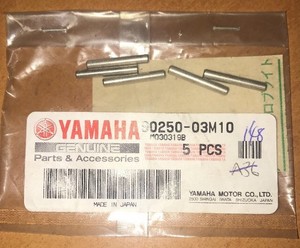
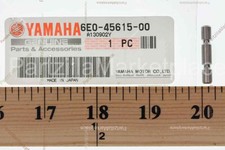
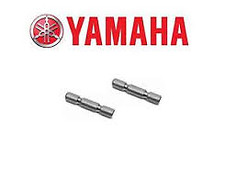
A proper shear pin should has a reduced section designed to shear at the correct load and the correct point

YAMAHA-3-shear-pin-2-Split-pin.jpg


http://pacermarine.co.uk/product/yamaha-4a-5c-2-stroke-shear-pin-packs/
 
Last edited by a moderator:
A proper shear pin should has a reduced section designed to shear at the correct load and the correct point

2205063.jpg

Oh dear me. Myself and the other poster have first hand knowledge of what Mercury provide as shear pins. A piece of straight ss. So why muddy the waters?
 
Effing shear pins, they have cost me $4 million in down time, round tripping pipe out the the hole. We now test on surface if the downhole tool will shear at the correct surface pressure. If it does we cut a new length from the same batch and redress the tool. Although not common, we do occasionally find that certified shear pins don't shear at the loads they are supposed to.
 
Oh dear me. Myself and the other poster have first hand knowledge of what Mercury provide as shear pins. A piece of straight ss. So why muddy the waters?

Because it c**p design and cheaper to produce but can damage either the shaft of the prop hub.

Yamaha have the correct design as in my modified post.

But if you are happy go for it.
 
All glider pilots are trained to handle cable breaks at any point in the launch. The vital thing is to lower the nose to get flying speed, and then you can decide if there is space to land ahead or if you need to circle to land. Nothing particularly difficult about it: huge fun.

Aircraft engine / tug / winch failure ' circle to land downwind from low altitude ' is usually a recipe for a Bad Day.

Boat outboard shear pins as in the type I've got on both main and tender engines - 5 & 2 hp - are brass as they're supposed to shear rather than knobble the prop or geartrain if one runs into something nasty.
 
Torqueedo had a steel 'shear' pin from new and the blades bust. Difficult to get the remains off as it had rusted badly.
One of our Twin Commanches was in a turn, when the autopilot roll actuator seized. With the plane trying to roll inverted, the pilot (big bloke) heaved with all he could and managed to get in centered and level. As he said after, if he had broken it, he was no worse off. Got it back with the rudder and engines, luckily the wind was straight down the runway.
I dismantled it and found that the specified shear pin had been replaced with a steel one.... The CAA werec quite interested and sent out an AD about it.
The previous flight had been with a petite female pilot and three pax.
 
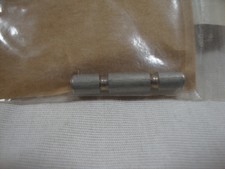
This is mine also from E-Bay

s-l225.jpg


s-l225.jpg


s-l225.jpg

I suspect that the plain shanked steel ones are not a standard bit of 316. Looking at the broken ends the metal appears highly crystalline, so I expect that there has been some alloying & heat treating going on to make them brittle. Broken ones appear to have no plastic deformation at all, although there must be a tiny bit.
 
Aircraft engine / tug / winch failure ' circle to land downwind from low altitude ' is usually a recipe for a Bad Day.

Boat outboard shear pins as in the type I've got on both main and tender engines - 5 & 2 hp - are brass as they're supposed to shear rather than knobble the prop or geartrain if one runs into something nasty.

Cable breaks are always practiced during training and are not a rare event for real. IIRC weak links are 1000lbs. One of my ex syndicate members wrote the glider off (fortunately after I sold out) when he had incipient spin after cable break, thankfully only broken bones.

I would only use a nail as a shear pin in emergency, if it's too strong and the prop bonding doesn't fail, gearboxes are expensive.
 
Cable breaks are always practiced during training and are not a rare event for real. IIRC weak links are 1000lbs. One of my ex syndicate members wrote the glider off (fortunately after I sold out) when he had incipient spin after cable break, thankfully only broken bones.

I would only use a nail as a shear pin in emergency, if it's too strong and the prop bonding doesn't fail, gearboxes are expensive.

Yes I know about training, and also the golden rule unless in exceptional circumstances is ' never turn back if there's a cockup on takeoff, land straight ahead '.

Angus,

who would use 316 as a ; ' Shear ' pin ?! Surely more of a drive pin.
 
Aircraft engine / tug / winch failure ' circle to land downwind from low altitude ' is usually a recipe for a Bad Day.

Boat outboard shear pins as in the type I've got on both main and tender engines - 5 & 2 hp - are brass as they're supposed to shear rather than knobble the prop or geartrain if one runs into something nasty.

A long time ago I analysed one and found it was copper-nickel. Very handy as I had plenty of brazing spelter rods, same material, same diameter.
I would think that shear pins break in accordance with UTS, which for mild steel and 300 series SS are pretty similar.
 
A long time ago I analysed one and found it was copper-nickel. Very handy as I had plenty of brazing spelter rods, same material, same diameter.
I would think that shear pins break in accordance with UTS, which for mild steel and 300 series SS are pretty similar.

Shear pins design is based in ultimate shear strength not ultimate tensile strength (UTS)

Mr Google tells me this

For example, for a mild steel with an ultimate (or tensile) strength of 60000 psi, the ultimate strength in shear would be 0.82(60000)=49200 psi. This material will fail (or fracture) in shear if the shear stress exceeds 49200 psi.

So for mild steel shear strength is lower than tensile strength.
 
Yes I know about training, and also the golden rule unless in exceptional circumstances is ' never turn back if there's a cockup on takeoff, land straight ahead '.

Angus,

who would use 316 as a ; ' Shear ' pin ?! Surely more of a drive pin.

No-one. That's why I said it isn't. I think you are confused again.

You're are talking like you are some kind of aircraft pilot again, by the way, which you are not. Don't want anyone else to get confused thinking that you are.
 
Shear pins design is based in ultimate shear strength not ultimate tensile strength (UTS)

Mr Google tells me this

For example, for a mild steel with an ultimate (or tensile) strength of 60000 psi, the ultimate strength in shear would be 0.82(60000)=49200 psi. This material will fail (or fracture) in shear if the shear stress exceeds 49200 psi.

So for mild steel shear strength is lower than tensile strength.

Yes, I know that but the two are proportional. I have no means of researching the topic from my current location but whatever is true of the relationship for mild steel is also true for stainless steel.
 
Top