Upsizing the inboard outboard

chris-s

Well-Known Member
Joined
24 Apr 2019
Messages
816
Visit site
We only have a little 24 foot sail boat, a Pegasus 700 bilge keeler which we bought at the beginning of 2019. Engine wise it came with a Yamaha 5hp 2-stroke outboard which is in great condition for its age and has never let us down.

But we have never had to use it in anything but light conditions, mainly because we avoid getting into those situations and don’t really go far.

However next season we would really like to go further. Based just up the river from Falmouth, the Isles of Scilly, and maybe even Brittany are on our list. And it’s these trips where I wonder if a larger engine might pay dividends if we got caught out with the weather. Say an 8hp fourstroke. I imagine we would only use it for the longer trips and offload it when not required. Yes, It would be 20-something kilos heavier but that’s still a net saving when there are just two of us onboard and not three anymore. Man handling it would be harder and we might have to make some adjustments to fit it in the well.

Before you suggest it, a larger boat is two or three years away.

Thoughts?

Thanks

Chris
 
It is worth mentioning that an 8hp fourstroke gives significantly less power than the equivalent 2 stroke and as you say weighs a lot more. I had a similar debate when I was considering ditching a 8hp 2 stroke Yamaha for an 8hp four stroke, on my 22ft Etap. I consulted an engineer at Robin Curnow Outboards in Penryn. He told me I was far better off keeping the existing engine, which I did. It does have a sail drive prop.
As you are based so close to them I would seek their advice. They also fitted a four stroke engine in a friends Etap well after doing a few alterations and in my experience are always very helpful.
I would imagine your 5hp is on the limit for your size of boat - have you considered a second hand 2 stroke - good ones do very occasionally come up for sale
 
It is worth mentioning that an 8hp fourstroke gives significantly less power than the equivalent 2 stroke and as you say weighs a lot more. I had a similar debate when I was considering ditching a 8hp 2 stroke Yamaha for an 8hp four stroke, on my 22ft Etap. I consulted an engineer at Robin Curnow Outboards in Penryn. He told me I was far better off keeping the existing engine, which I did. It does have a sail drive prop.
As you are based so close to them I would seek their advice. They also fitted a four stroke engine in a friends Etap well after doing a few alterations and in my experience are always very helpful.
I would imagine your 5hp is on the limit for your size of boat - have you considered a second hand 2 stroke - good ones do very occasionally come up for sale

8 hp is 8 hp. Outboard engine power is measured at the prop shaft by a standard method. It makes no difference whether the engine is a 2 stroke or a 4 stroke. It is important that the propeller is suitable for the type of boat, but that applies equally to both. A low pitch high thrust prop is what is required for a sailing yacht

The disadvantages of a four stroke are its weight and physical size. For someone planning extensive cruising the much lower fuel consumption of a 4 stroke might well be a great advantage.
 
I've also got a pegasus 700 and the boat came fitted with a four stroke 8hp saildrive yamaha. This definitely gives the boat some grunt when punching tide and/or wind. However it gets left in the well as the previous owner upsized the prop, meaning it won't lift out without taking the prop off, upside being I know the outboard won't get nicked!

I believe that they were originally offered with a 6 or 8hp.

Might be worth an ask via the association

Pegasus Yacht Owners Club

Or join in at the Facebook site
 
Sometimes we all have to motor a full tide particularly with extended cruising. Personally,
I find the noise and fumes particularly wearing with 2 strokes at higher revs. Who knows, different propellers rather than different outboards might be the answer as suggested.

I used to own a boat that had an outboard well , and an outboard clamp on the transom. I think the previous owner only used the boat for racing on Wednesday nights and the outboard lived on the transom. On one occasion, I had a 6hp 2 stroke outboard in the well and a 2hp Honda on the transom in tandem. I seem to remember the stern well down for a 18' light trailer sailor with lowish revs on both engines, but probably easily hull speed in the flat water. Possibly the only twin screwed , multistoke 18' sailing boat on my bit of the East Coast that day.

It's always nice to have an extra outboard for backup and for use in the dinghy .

Worth considering ?
 
8 hp is 8 hp. Outboard engine power is measured at the prop shaft by a standard method. It makes no difference whether the engine is a 2 stroke or a 4 stroke. It is important that the propeller is suitable for the type of boat, but that applies equally to both. A low pitch high thrust prop is what is required for a sailing yacht

The disadvantages of a four stroke are its weight and physical size. For someone planning extensive cruising the much lower fuel consumption of a 4 stroke might well be a great advantage.
Ok. maybe I used the wrong technical terminology when I said "power" as I am not an engineer, but speaking to others it seems common that a 2 stroke of the same horsepower will outperform a 4 stroke, when it comes to acceleration. Commonly one hears of 4 strokes being sluggish on acceleration etc - although a 4 stroke will perform better at low revs.I took the advice of the company I mentioned ( who could have sold me a new engine ) . I would agree that if one is extensively cruising then a four stroke will be far more economical and cleaner.
The other problem is that in "older" boats the wells were designed to take the physically smaller 2 strokes and it can be difficult to fit a larger engine without major redesign of the well.
This dealership in Canada has produced a useful comparison - they even state that for the same horsepower the 2 stroke is actually more powerful, backed up by my dealer.
Two-Stroke Vs. Four-Stroke Outboards: Advantages & Disadvantages
 
Last edited:
My brief dalliance with a Pegasus 700 found me removing the 9.9hp 4-stroke outboard and replacing it with a 2-stroke 4hp sailpower outboard.

Never had any problems or lack of power from the 4hp sailpower (larger propeller, different gearing ratio and electric charging) and was always able to get the bilge-keeled 700 up to hull speed.

The 9.9hp, however, was a ton weight in the back of the boat. (OK, so was I...) I also had to remove the lower part of the outboard leg from under the boat to uninstall the engine. A pain of a job, but that's another story.

In short, the engine swap was good, I'd do it again. I might consider a 5hp or 6hp but never found the need for it. The key is the big propeller and lower gearing on the sailpower/sailmate outboards. Oh, and after lugging around a hole of slopping water (the outboard well) I made sure our next boat had a diesel inboard.
 
I replaced a variety of two stroke inboard-outboards and two rubbish inboards with a displacement boat propp'ed (i.e. a dedicated sailing boat motor) ~9.9hp Tohatsu 4T on my Listang T24.

It was the best improvement I ever made to that boat: Half the fuel consumption of the original two stroke 8hp o/b; better boat acceleration; higher cruising speed and far better able to hold speed against wind and waves ; quieter; reliable; would idle and would run at low throttle settings; electric start and hence decent generating capacity, not just a lighting coil. Finally, being transom mounted, it was far easier to clear of weed and debris. This was a real pain with the inboard outboard that would need doing at least twice a week.

Typically, 4T outboard motors don't rev up as quickly as 2T outboards, but they still rev up much quicker than you can accelerate a couple of tons of boat with less than 10hp. The lack of peakiness is actually one of the benefits of four strokes.

The disadvantages were that it was considerably heavier and physically much larger. Being a lazy git disinclined to do loads of frp work, I hung it on the back, rather than in the well. Having a longer shaft it was almost as well immersed as the i/b o/b, but would aerate more in a chop. It did punch through the overly light transom one day (another story) so I subsequently fitted a very oversized backing pad.
 
Coveman. An interesting link but it does seem to assume that you require speed where the op is after 'power' at displacement speeds. This is a different ball game and as I'm finding out no real definite answer.
My boat has a honda 30 with a modified yamaha dual thrust prop and I'm possibly going to modify the engine 'well' to fit a yamaha 25 high thrust. The general consensus amongst dealers is that for me, the yamaha will provide more power as it is swinging a much larger prop at lower revs. There will be more drag when sailing but I can always lift the engine up due to the well design. If I could fit the yamaha gear box on to the honda ......
 
Boathook, That may be the case, and I would agree that the most important aspect is to use a sail drive prop which has a different pitch to the propellor from the standard and therefore gives you far better performance when manoevering at close quarters . I would argue that the better acceleration of the 2 stroke + low pitch/high thrust prop gives the best combination, but no doubt everyone has there own preference and budget.
 
We only have a little 24 foot sail boat, a Pegasus 700 bilge keeler which we bought at the beginning of 2019. Engine wise it came with a Yamaha 5hp 2-stroke outboard which is in great condition for its age and has never let us down.

But we have never had to use it in anything but light conditions, mainly because we avoid getting into those situations and don’t really go far.

However next season we would really like to go further. Based just up the river from Falmouth, the Isles of Scilly, and maybe even Brittany are on our list. And it’s these trips where I wonder if a larger engine might pay dividends if we got caught out with the weather. Say an 8hp fourstroke. I imagine we would only use it for the longer trips and offload it when not required. Yes, It would be 20-something kilos heavier but that’s still a net saving when there are just two of us onboard and not three anymore. Man handling it would be harder and we might have to make some adjustments to fit it in the well.

Before you suggest it, a larger boat is two or three years away.

Thoughts?

Thanks

Chris


You would probably have to spend £1000 net on the new engine which is quite a lump on a small boat, in a falling market. In effect you might be buying a nice present for the next owner, as you will be selling in a few years. If you sail with the engine down the drag would be greater and with the engine up it will be more difficult to handle.

If you can live with the fumes and are happy with the flat water speed, I think I would stick with your present set up. In my experience the smoke thing is only really bad when motoring with a light following wind, the fumes from a 4 stoke would not be doing you a great deal of good either. It's also very difficult to know if an engine will fit or be convenient before buying the thing.

With longer trips on a smaller boat I think the forecast is the key and they are pretty good, the only times I have been "caught out" are when I was pretty much aware of the risk. You have to wait for the better forecast and avoid rough water and anything turning on the nose. I think this has to be the case whatever the engine in a 24 ft boat. If you move on to a She 36 your choices becomes quite different and you could afford to take things on the chin much more. : -)

Good luck whatever, you could have great fun in Scilly with a bilge keeler and there are some outstanding spots in Brittany that are denied to deep keelers.
 
Thanks for all the replies. I strongly suspect that the existing prop on the Yamaha is not a high-thrust/saildrive prop and it sounds like a comparative sized engine with better prop might help.

@coveman, yes, I will chat with the guys at Robins, they still have our dinghy outboard from a pre-lockdown service.

@doug748 , value wise, I agree with you on all of that, but I would keep the original engine and any replacement is something that could be sold separately. I've already added some nice presents for the next owner, but accept that on the basis that we get a better experience in the meantime.

Once again, thanks to all for the replies, it helps a lot.
 
Ok. maybe I used the wrong technical terminology when I said "power" as I am not an engineer, but speaking to others it seems common that a 2 stroke of the same horsepower will outperform a 4 stroke, when it comes to acceleration. Commonly one hears of 4 strokes being sluggish on acceleration etc - although a 4 stroke will perform better at low revs.I took the advice of the company I mentioned ( who could have sold me a new engine ) . I would agree that if one is extensively cruising then a four stroke will be far more economical and cleaner.
The other problem is that in "older" boats the wells were designed to take the physically smaller 2 strokes and it can be difficult to fit a larger engine without major redesign of the well.
This dealership in Canada has produced a useful comparison - they even state that for the same horsepower the 2 stroke is actually more powerful, backed up by my dealer.
Two-Stroke Vs. Four-Stroke Outboards: Advantages & Disadvantages

I believe it is true that 2 strokes will accelerate more quickly . That is one reason why they are still popular for sports boats. They will get the boat planing y or a water-skier up more quickly

It remains total nonsense to claim that " for the same horsepower the 2 stroke is actually more powerful. " The power is determined by the ICOMIA 28/83 test procedure and is measured at the prop shaft
 
Thanks for all the replies. I strongly suspect that the existing prop on the Yamaha is not a high-thrust/saildrive prop and it sounds like a comparative sized engine with better prop might help.

@coveman, yes, I will chat with the guys at Robins, they still have our dinghy outboard from a pre-lockdown service.

@doug748 , value wise, I agree with you on all of that, but I would keep the original engine and any replacement is something that could be sold separately. I've already added some nice presents for the next owner, but accept that on the basis that we get a better experience in the meantime.

Once again, thanks to all for the replies, it helps a lot.
Chris,
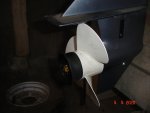
If your prop looks like this one it is probably a sail drive - this is my Yamaha 8hp 2 stroke prop which is a sail drive type. I think the black collar on the prop denotes it is sail drive.DSC01985.JPG
The standard prop and sail drive type are interchangeable so you could swap one for the other if you want to keep the same outboard.
Good luck!
 
just checked the Yamaha and it has a 7 1/2x8 B prop on a 5CMH engine. It doesn't have the black (dual thrust) collar thats for sure. I'm now doing some googling to see what that prop size equates to.
 
Last edited:
I imagine your's is the standard prop then. A quick phone call to Robin's should give you your answer ( and no doubt the price!!) of a high thrust prop. Mine was an 8CMH engine so would imagine yours is very similar.
 
I imagine your's is the standard prop then. A quick phone call to Robin's should give you your answer ( and no doubt the price!!) of a high thrust prop. Mine was an 8CMH engine so would imagine yours is very similar.

On one occasion I was in a Portsmouth chandlers and saw both versions of the then-Yamaha 5 outboard side by side. The increased size of the propeller on the high thrust/sailmate/sailpower engine was obvious and striking.

I had a Mercury 4hp 4 stroke sailpower on my 22' E-Boat years ago. Again, the propeller was obviously bigger than a standard Mercury 4 and also it had the wiring harness for the charging circuit coming out from under the cowling. The charging worked better than I thought it would too (ran the VHF and chart plotter).
 
Would be interesting to check on the boss and number of splines on your current propeller
to make sure it will fit. You probably knew that anyway.

Someone mentioned the gurgling and sloshing in an outboard well, I conducted a few tests last season. I slid a wheelbarrow inner tube (or two) over the leg and inflated using a mountain bike pump . This stopped the sloshing, and the cushioning effect resulted in less vibration and I think slightly less noise.

You could also use a ride on mower, or mobility scooter tube.
 
You would probably have to spend £1000 net on the new engine which is quite a lump on a small boat, in a falling market. In effect you might be buying a nice present for the next owner, as you will be selling in a few years. If you sail with the engine down the drag would be greater and with the engine up it will be more difficult to handle.

If you can live with the fumes and are happy with the flat water speed, I think I would stick with your present set up. In my experience the smoke thing is only really bad when motoring with a light following wind, the fumes from a 4 stoke would not be doing you a great deal of good either. It's also very difficult to know if an engine will fit or be convenient before buying the thing.

With longer trips on a smaller boat I think the forecast is the key and they are pretty good, the only times I have been "caught out" are when I was pretty much aware of the risk. You have to wait for the better forecast and avoid rough water and anything turning on the nose. I think this has to be the case whatever the engine in a 24 ft boat. If you move on to a She 36 your choices becomes quite different and you could afford to take things on the chin much more. : -)

Good luck whatever, you could have great fun in Scilly with a bilge keeler and there are some outstanding spots in Brittany that are denied to deep keelers.
The fume problem can be overcome to a certain degree by leading an exhaust tube ( Yamaha do a heatproof rubber pipe ) which is tapped into the rear of the engine leg and exits through the transom - a standard fitting on my boat. If the well plug is a good seal around the engine then fumes are kept to a minimum. As you correctly say it is very difficult to know whether a different engine would fit prior to buying and likely that either the well or plug would need some modification.
 
Top