
upgrading boat engine

Peter Wilks

New Member
Joined
9 May 2021
Messages
6
Visit site
Hello, I currently have an inboard Peugeot Indenor 2.5 diesel engine from a Talbot van...yes it is 1970's era! The boat is a six berth 30ft steel cruiser, weighing in at 6 tons. At 2000 revs I can do about 5-6 knots. I want to replace the engine with another keel cooled heat exchange engine so I can do 8 to 10 knots on the tidal Thames. Advice please I have no idea where to start!
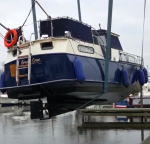
Screenshot 2021-05-09 at 17.03.56.png
 
The Indenor is good for 50-60hp; unless you're very overpropped you should be able to do 8-10kts with the engine you have and if you're doing 5-6kts at 2000rpm it doesn't sound like you are overpropped.
 
The stern looks like it may generate a bit of lift so should be able to go a bit quicker. 2000rpm seems low, what is the engine maximum?
 
The 2.3-2.5l Indenors were marinised by a variety of OE marinisers, output varying between ~50hp at 3000rpm up to ~75hp at 4500 rpm. That hull shape will go beyond hull speed with enough power, which that engine will provide.
 
Gentlemen, Thanks for your replies. Very helpful. The other reason for changing the engine is that it produces fumes. Not because there is oil in the engine - engine is good but does produce fumes and when the wind is astern blowing over the boat it sinks! So what would you suggest I replace it with to be sure if 8 - 10 knots at a reasonable Revs of about 2000?
 
2000rpm is rather low, I suspect you are looking for a large capacity old design for that. Even the ancient 6 cylinder fords ran to 2500rpm and ran continuously at 2300rpm. Why do you want such as low speed engine?
Diesel fumes smell, perhaps a very modern common rail might run cleaner.
 
Diesel exhaust pongs, a new engine might be slightly sweeter but it's still diesel smut; are you getting smoke? To get 8-10kts at 2000 rpm seems rather arbitrary; is there a reason? A modern engine of 50-60hp will be quite happy doing the job but will rev to 3000 or so.
 
Gentlemen, thanks again, yes the 2000rpm is rather arbitrary ... The engine is not smoking apart from usual emissions on starting. When running it produces no smoke. I was thinking the smell maybe more noticeable because the engine is old... I do not know how many hours it has clocked up. Your advice is very helpful. I shall conduct some more ‘speed’ tests over the next couple of months to a certain a more sensible knots/rpm evaluation. Then report back!
 
I would be surprised if your present engine will not give you more or less the speed you require. Let's say you get the speed at max power and that is 60hp. You would then need to look for an engine that produces that power at your desired rpm of 2000. Likely to be considerably larger and heavier than the present one. You then need to work out the prop size and pitch to give you that speed, likely a lot more pitch. This is likely to increase the speed at tickover considerably, maybe making manoeuvring more difficult. To get the same power at much lower speed you will have increased the torque considerably so need to check if the existing propshaft will cope.
Seems to me much easier to use more revs with the engine you have!
 
Unless you want to spend many thousands going new and common rail you will get diesel fumes - that is just how they were.
maybe worth getting injectors looked at and treat fuel with marine 16 or something similar before spending mega money re engining
 
Well, thank you guys for taking the time to answer my question. You have covered the topic pretty thoroughly it seems I will stick with what I have for now and do more speed tests.... thanks so much.
 
Hello, I have at last accomplished some speed tests and have discovered that the maximum revs the engine does on full throttle is 18000. This gives me about 6 knots. Therefore as you have commented...the engine should be able to produce more revs. The issue is the link to the excelerrator leaver in the engine itself....hoe to make it longer to get more revs but not increase idling speed!
 
With a diesel you set desired RPM with the lever and the governor adjusts the fuel to keep it there. If, as above, you find the Morse lever at its limit but not at the stop on the pump you will probably be able to move the cable at the Morse lever end.
If it does reach the pump stop see what RPM you get in neutral. If that is the same as in gear try adjusting the stop. If it is higher there isn't enough fuel under load.
 
"I have at last accomplished some speed tests and have discovered that the maximum revs the engine does on full throttle is 18000"

Jeez, how many more revolutions do you need ????
 
Ok, so the engine, is from the 70s, does your engine, have liners ? When were they last checked ?
What about worn pistons & rings ? Any of those, will waste fuel !
Also, is your exhaust, out of the stern, or side ?
Normally side mounted exhausts, do not give fumes, as they are blown away, whereas stern exhausts, can fill the boat with fumes when going downwind.
 
Top