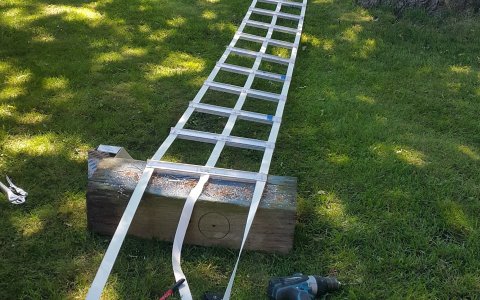
Up the mast

I didnt like the idea of just webbing steps as they fold around your feet making it harder than it needs to be.
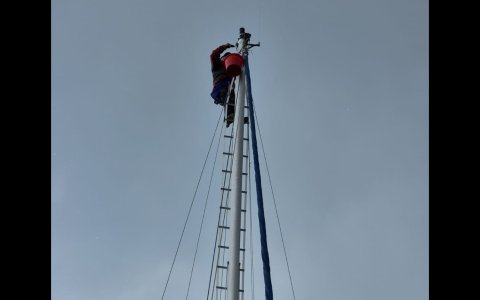
I bought a reel of webbing and a few 6m long aluminium right angle to make the steps. Every step has a sail slider so it goes in the mast track and you can get tension on it so its not floppy. My topping lift is then ran from mast top to mast base and tensioned and i run a troll rocker which slides itself up or down the topping lift as a safety line. I use a bosuns chair with belt/buckle so it stays around my waist and doesn't slip down when climbing plus it has storage compartments and is comfortable to sit in when at height.
It works so well that others keep wanting to borrowing it..
The whole lot fits in a lidls bag.
 

Attachments

  • Screenshot_20251014_104820_Photos.jpg
    Screenshot_20251014_104820_Photos.jpg
    74.6 KB · Views: 9
  • Screenshot_20251014_104936_Photos.jpg
    Screenshot_20251014_104936_Photos.jpg
    137.1 KB · Views: 9
  • Screenshot_20251014_105028_Photos.jpg
    Screenshot_20251014_105028_Photos.jpg
    622.2 KB · Views: 9
I didnt like the idea of just webbing steps as they fold around your feet making it harder than it needs to be.
I bought a reel of webbing and a few 6m long aluminium right angle to make the steps. Every step has a sail slider so it goes in the mast track and you can get tension on it so its not floppy. My topping lift is then ran from mast top to mast base and tensioned and i run a troll rocker which slides itself up or down the topping lift as a safety line. I use a bosuns chair with belt/buckle so it stays around my waist and doesn't slip down when climbing plus it has storage compartments and is comfortable to sit in when at height.
It works so well that others keep wanting to borrowing it..
The whole lot fits in a lidls bag.
The Mast MAte takes a few tries to properly learn. I had one of the type you built and gave it away. The webbing loop design is better. I used them both side-by-side.

  • The rungs sway with hand on them. With a Mast Mate you put your hands around the mast or you can grab rigging. Nice and rigid.
  • By grabbing rigging or puting your hands around the mast you don't have to lean as far back or put weight on your arms. Less tiring.
  • The rungs sway with your feet on them. With a Mast Mate your toes hug the mast and don't sway.
  • Yes, the webbing rungs grab your feet when weighted. They can't slip out, even when working vigorously. The feet do NOT get stuck if you wear deck shoes (no lug treads, not even running shoes).
  • The rungs open ready for your feet if you roll the Mast Mate properly in storage.
  • Yes, you do need to look at your feet and place them in the loops.
It's different to use than a ladder with rungs, but much better once you learn it. The surveyor for my last boat used a Mast Mate.

I'm sure you like the ladder you built and that it works for you. Looks solid. My comments were for others. Different stokes.

9.%20The%20Goblin%20trails%20at%20knee%20level.jpg
 
Two episodes from my youth.

  • Shinnied up 38-foot mast to recover a halyard. The boat didn't have winches, but I did tie (bowline on a coil) to a spare halyard and was given a hip belay. (20s)
  • Climbed a mast underway with no one to winch. I eased the main halyard just a little (creates gaps) and I climbed using the sliders. Belayed with a prusik. (40s)
I'm not recommending either. Both are physical and a little tricky, but neither is as dangerous as they sound. Mostly inconvenient and uncomfortable.
 
Pah. All this talk of harnesses and halyards. The other day we were chugging along the Chesapeak-Delaware canal and my son wanted to see over a wall that we were passing. Next thing I know he's climbed the aft lower shroud using nothing but hands and bare feet. He comfortably made it to the first spreader and ha da good gander at the view.
Oh to be nine years old again...
 
The Mast MAte takes a few tries to properly learn
:unsure: whereas rungs on a fairly rigid ladder takes no learning ;). While your looking for the next loop to put your feet in im already at the top working ?
The first time i used it i held the mast and rigging on the way up but it worked far easier for me just holding the rungs and going up like a normal ladder.
The rungs are two pieces of 25mm ally back to back giving a 50mm wide tread and it doesnt really move once the ladder is put under high tension.
I have to be facing into the wind to raise mine else each rung snags on the spreaders. Would be no good for swept back spreaders.
I did make to fit my boat and me.. sewed everything in dark blue on white 450kg webbing so i would be able to easily see any failing.
It took quite a while to make and not that cheap but a gamechanger for going up and down solo .
It was one like yours that gave me the idea for mine 😄
 
:unsure: whereas rungs on a fairly rigid ladder takes no learning ;). While your looking for the next loop to put your feet in im already at the top working ?
The first time i used it i held the mast and rigging on the way up but it worked far easier for me just holding the rungs and going up like a normal ladder.
The rungs are two pieces of 25mm ally back to back giving a 50mm wide tread and it doesnt really move once the ladder is put under high tension.
I have to be facing into the wind to raise mine else each rung snags on the spreaders. Would be no good for swept back spreaders.
I did make to fit my boat and me.. sewed everything in dark blue on white 450kg webbing so i would be able to easily see any failing.
It took quite a while to make and not that cheap but a gamechanger for going up and down solo .
It was one like yours that gave me the idea for mine 😄
a. I've been a rock climber for 40 years and still am. With the right shoes and technique it is very fast, just a few seconds per step, like a ladder. If the ladder is stored and deployed properly the loops should just fall open (if you look at the image above they are all wide open and waiting). If, on the other hand, it was stored or rolled improperly, yes, that can be fight. A mistake you only make once. The instructions, in fact, are clear on this.
b. Every boat I have owned had swept back spreaders. It's a multihull thing. Even the webbing ladder will snag once or twice on the way up. Rigid rungs are a non-starter. Swept spreaders are becoming more common, with more masts having prebend.

I guess it's about the right tool for the job.
 
From what I've read above, it would seem that folding mast steps save a lot of bother, and save stowing a lot of extra "stuff".
  • Turbulence.
  • Folding and unfolding is as much work as climbing a webbing ladder.
  • Weight aloft.
  • You don't keep the other types of gear on the boat unless world cruising. In 40 years only twice have I climbed a mast while out cruising, and steps would not have worked for one of those (main up). Others have different experiences.
  • You will need a harness or bosun's chair either way/anyway. For the scarce need, that is probably all you need.
  • Mast steps are not always a substitute for other methods for climbing underway. They can be less secure and are not usable if the main is up (which is preferable underway, because it stabilizes the roll and keeps you from swinging around the mast).
Just the contrarian view. Do what You like. This is sort of like boxers vs. briefs; people have strong opinions on mast steps.
 
Interesting. Not at all sure that world cruising is any different from coastal cruising, in terms of needing to go up the mast. I had a Genoa halyard wrap, which caused the halyard attachment lug on the top swivel to break off, so I had to go up to get the halyard down. That was when cruising locally in the Outer Hebrides in Scotland. That, and the fact that there was both radar and a wind generator on the mizzen, which required occasional attention, persuaded me to make going up the masts, more simple.
I made fixed steps for the mizzen, and fitted bought folding steps for the mainmast. With the main, I normally go up the front of the mast, so it wouldn't matter if the sail was set or not. (In-mast furling).
With the mizzen, I normally go up the after side of the mast, but can go up the fore side if required. Was up the fore side just last week, to do something with the radar.
I'm not sure where you're getting the "less secure". Less secure in what respect?
Anyway, I'm not trying to convince anyone about the pros and cons. We all have our own preferences, but with respect, some of your comments are simply wrong.
 
Top