Unexpected currents off the Kent coast - am I missing something obvious?

ZoeImogen

Active Member
Joined
27 Aug 2013
Messages
43
Visit site
I have a suspicion someone is going to tell me I've missed something obvious here, and I'll have a d'oh moment, but here goes...

Last Friday, we sailed Scarlet round from the Crouch to Dover. All carefully planned out to make sure we picked up a decent tide on the way. Speed log was calibrated at the start, and all the logs indicate that it was perhaps overreading by ~10%. Boat was behaving normally in the morning, and was behaving normally once in Dover Harbour itself and the following day, including giving expected SOGs and STWs.

However, between North Foreland and most of the way round to Dover we were struggling to make much more than 3.5kts over ground. Engine revs should have been good for about 5kts given the sea state (top end of a sight, wind on the bow so some slamming as a result) and that's consistent with the reported speed through water. The only possible explanation I can come up with for this is the obvious - there was a 1.5 knot current against us. But multiple sources all report that 1300BST onwards on Friday 29th September we should have had a 1 knot+ tide in our favour.

Wind was F4 from the SSW, route was ~1NM from the coast - S Brake PCM -> Downs PCM -> Deal Bank PCM. A diversion of about 0.5NM W did not result in any reduction of the apparent adverse current.

Are unexpected currents normal around that area, or have I just admitted to an embarassing failure of skippering by forgetting something obvious?
 
Back eddies can always cause problems. I know there is a definite strong back eddy between South Foreland and the eastern entrance to Dover. I'm not sure I have ever come across a back eddy between North and South foreland, but for some reason I always seem to have a counter tide there due to poor planning or just slogging on regardless, when a back eddy would be welcome.
 
Ditto Glayva: the Gull Stream would be expected to be 'as expected' as would from the North Foreland down to Ramsgit.

Have you got detals of your log: Time off North Foreland, time to the Downs etc. Were you getting the SOG from a stand alone GPS or a plotter and boat speed from a separate log? There are the odd anamalies with some plotters and tidal diamonds but none of that would have suggested anything that would have impacted for that part of the passage from the North Foreland to Dover (indeed any I have noticed would have impacted on that time of the day or the position). Interesting to investigate.
 
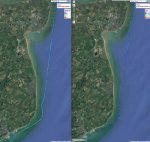
I've put a plot of our route up at http://www.gpsvisualizer.com/display/20171004002143-42034-map.html - should be available for the next 24h at least. Speeds on that one are SOG, pulled from the raw NMEA data so times are UTC - both an iPhone app (Imray Navigator) and Mk 1 Eyeball combined with written log tally exactly with what it was reporting. (Left hand half of the image)

Same visualisation with STW from the NMEA logs is at http://www.gpsvisualizer.com/display/20171004003709-42034-map.html (Right hand half of the image)

Screen Shot 2017-10-04 at 08.40.12.jpg
 
Umm. Using a very crude 'overview', North Foreland to due East of the Dover Patrol = 14nm @ 3 hrs = 4.6kts (Tilman Rules!). The colour of the track indicates SOG speed? If I am understanding that at some points you had 7kts. Using analogue data North Foreland to Ramsgit was picking up 0.6kts of tide building to 0.8kts (crude quick look), then into the Gull Stream at least 1+kts Neaps.

'tis odd. From the Dover Patrol the colour of the track suggests slower perhaps 4kts. That at a very quick look certainly looks odd - what had you picked up perhaps? Once you are entering the Eastern Entrance you were clearly getting over 5.8kts until clear.

I will try to correlate the VHW data (Boat Speed) track with the RMC data (Speed over the ground). There is certain a lot of variation in speed between the two tracks from Ramsgit to the Dover Patrol - pitching into the weather?

Must look more closely.

PS - quick question, were you motor sailing or main up only or just engine?

Sorry second supplement question: did you have a separate log/boat speed instrument? If so were you able to see generally what boat speed you were doing? e.g. when you entered the Eastern Entrance you clearly (and sensibly) gunned the engine to clear the entrance and I would have expected that you were registering on the speedo 6kts or so.
 
Last edited:
I'm going to confess to being a bit thrown by last weekends tides as well. We were racing on the Medway and I noticed that the ebb tide on Saturday seemed to go on forever, well at least for over an hour after the predicted low water..... Someone did explain to me that the flow does take time to stop and turn around so on rivers things are not always that easy to predict but I also noticed that was an extra hour between the high tides that day. Normally we see 12 hours and somewhere around 30 or 40 minutes between high tides, that day there was 13 hours 30 minutes between the Chatham high tides (08:04 and 21:34)...... Have I also being dim over the years not noticing this before or is there something I need to learn here?
 
The colour of the track indicates SOG speed? If I am understanding that at some points you had 7kts.

Yes, left side of the image is SOG. We'd managed 7.7kts earlier in the journey which is why the scale goes that high, but as you note North Foreland to Ramsgate also (As expected) had tide in our favour.

I will try to correlate the VHW data (Boat Speed) track with the RMC data (Speed over the ground). There is certain a lot of variation in speed between the two tracks from Ramsgit to the Dover Patrol - pitching into the weather?

Yes, wind and weather was head on, so there was a fair bit of pitching and some slamming going on. Shouldn't have caused the SOG to overread though, and we've experienced worse.

PS - quick question, were you motor sailing or main up only or just engine?

Just engine, the wind was too close to the bow to do anything other than rattle the rigging.

Sorry second supplement question: did you have a separate log/boat speed instrument? If so were you able to see generally what boat speed you were doing? e.g. when you entered the Eastern Entrance you clearly (and sensibly) gunned the engine to clear the entrance and I would have expected that you were registering on the speedo 6kts or so.

Separate display, yes. (Scarlet's helm wouldn't be out of place on the bridge of the Enterprise) Once we entered the Eastern Entrance, the speed log and GPS speed were roughly agreeing again. We didn't gun the engine to get in - apart from a brief pause to let the ferries past, rpm was the same as outside, the lack of current just meant our SOG picked up!
 
Umm. 'tis very odd. :confused:

Triassic's point is good. I recall once crossing Harwich/Felixstowe, Harwich VTS were reporting to shipping that the ebb was significantly stronger than expected and as we passed the Inner Ridge and the tide flow was very very strong and not the direction we expected. But this is sustained 'oddness' over time.

The expected logic is quite simple: the southerly flow from the North Foreland starts 5 hrs after HW Dover to 2 hrs before HW Dover. So that on the 29th September was southerly for the relevant time (12:25 to 15:25 North Foreland to the Dover Patrol) For the 3 hours of passage the 'analogue' data would have suggested you would have had 3.5 nm tide help during that time. 14nm for that section of the passage with 3.5nm of help gives 3.5kts average - as you found. Spot on. :encouragement:

Using the VHW data shows that you reached 7.7knots 'through the water' in places, in the upper 5+kts in most and occasionly less (4kts ish?). Headwinds probably affecting the variation in 'through the water' speed. Using the RMC data would now expect the speed over the ground (assisted by the tide) to show high speeds - it doesn't! The correlation with the two tracks side by side doesn't really get high. For example between 13:25 and 13:40 just south of Ramsgit only gets into 5kts boat speed occcasionly but never over the ground! :confused::confused:

Actual tide performance shows the evening High Water was less than predicted (about 0.3/4m approx - couldn't get the exact data only interpolate a poor graph) but that period in the Gull Stream would expect 1.6kts of tide help. :nonchalance:

Mechanics? Intermittent slipping clutch? Hardly likely, you achieved 7.7kts but SOG still didn't get close. :(
Back Eddies? Hardly likely on that track. :(
Dragging something? Hardly likely given that you achieved 7.7kts. :(
Data error? Hardly likely. The simple 14nm over 3 hours is unarguable. :(

So "How often have I said to you that when you have eliminated the impossible, whatever remains, however improbable, must be the truth? - Mr Sherlock Holmes Valley of Fear"

Significant surface drift after sustained SW winds? Deeply improbable? :nonchalance:
Data error? Umm VHW data very, very significantly over reads the boat through the water speed (Actually to the exact letter, the instrument over reads, the VHW data just collects what it reads). Assuming tide advantage, reverse engineering the expected boat speed is about 3kts. I suspect you would have noticed! :confused:

I can't think of anything else so now for suggestions from others.

I am tempted to ...... I have had some useful help from Hydrography professionals in the past. Dare I run the puzzle past a couple? Or prefer Tilman Rules:

"At last about tea-time, when land began to loom vaguely to port, to starboard and also ahead, we realised that we were near the head of Cardigan Bay, two points off course and some forty miles from Holyhead. Currents, the compass, the helmsman, even the navigator may have been responsible for these anomalies. It is not, however, for the navigator to accept responsibility for them or to show surprise or he may sap what confidence the crew have in him. Attack is the best form of defence. A few remarks about the impossibility of navigating the ship if it is not steered straight will restore his own confidence and subdue and mystify the crew. HW Tilman" :encouragement::encouragement:

Er, the Wind is blowing v nasty right now on Mersea. Best I wait for a little while. Will there be a surge today as predicted?
 
Have I also being dim over the years not noticing this before or is there something I need to learn here?

I've noticed the tidal streams outside Gillingham being up to an hour out before as well, though I have no idea if the height times match the stream changes. Don't know if it is an inaccuracy in the tidal predictions, or weather related, or simply an oddity caused by geography.
 
I've had a look through the evidence and reckon it was just one of those days that Pye End refers to, when a combination of circumstances makes a significant difference to tide times and flows.
 
I’m Scarlet’s co owner and was crewing that day. I can’t work it out either. If the tide was what it should have been, then yes, we were doing perhaps less than 3 knots through water while the log, which reported more or less the correct speed once we were in Dover Harbour, read around double that.

The engine worked fine before and since, giving the expected performance. The log was calibrated using Raymarine’s multi point calibration in slack water with 3 widely spaced speed points and, as Zoë says, was overreading by maybe 10% at the high end. No more than that.

And I was watching our wake. I know what a 3 knot wake looks like and we were doing more than that.

I can only conclude the tide was flowing strongly in the “wrong” direction and doing it for a number of hours.
 
Top