Underwater thread sealer for shackle

Don't worry, they, Loctite, 'go off' achieve more than sufficient hold underwater as Vyv and I have both said. They will of course go off in the dry as well. We have used 263 with success and I think Vyv suggests 242 (but check Vyv's post for the number). I suspect there are whole range of Loctites that will work - I tried what the local hardware store stocked.

Jonathan
 
Thanks for all the input.
Welding shackles for moorings I certainly approve of but I neither have the expertise or tooling to do this underwater.
I will drill the nut and pin, apply Loctite topsides and assemble underwater, finally mousing through the drilled hole.
If I remember, I will feedback on the next inspection.

By way of feedback, all appeared ok on inspection 2017 & 2018.
When I dived today, the nut was hanging loose on the shackle pin, retained only by a strand of Monel.
The loctite appeared to have given up.
I have had this bottle for quite a few years now. Could it have gone off?
Glad I did the inspection as we're expecting a bit of a breeze over the next day or two.
 
By way of feedback, all appeared ok on inspection 2017 & 2018.
When I dived today, the nut was hanging loose on the shackle pin, retained only by a strand of Monel.
The loctite appeared to have given up.
I have had this bottle for quite a few years now. Could it have gone off?
Glad I did the inspection as we're expecting a bit of a breeze over the next day or two.

Confession

I haver tested 3 different variants of Loctite, and been impressed, and have used one specific formulation over long term (6 months) add had need to resort to a blow torch to release. I have never considered (and would not consider it) good for a few years. Some of the formulations might be good for a few, or many, years - but I don't have the patience to find out.

In your specific instance (based on your comments) we don't know if the Loctite failed much earlier, and if the Monel was holding it together.

I'm happy with Loctite - but I don't leave it, the bond of the Loctite, particularly long and test its integrity every few months (or less). I'm also swapping anchors fairly frequently so the bond is not expected to last for a few years.

A valuable cautionary comment - thank you.

Jonathan
 
At my club we have used galvanised steel shackles for moorings for decades - I cant remember one ever coming undone. We dont seal the threads because rust and corrosion makes then ever harder to undo. I used to mouse mine with AISI 310 mig welding wire again without a problem.

To my mind sealing the threads would make them more likely to come undone
 
At my club we have used galvanised steel shackles for moorings for decades - I cant remember one ever coming undone. We dont seal the threads because rust and corrosion makes then ever harder to undo. I used to mouse mine with AISI 310 mig welding wire again without a problem.

To my mind sealing the threads would make them more likely to come undone

I think a significant difference is that shackles used to secure mooring will be, or should be, checked every twelve months and remedial work conducted. Nothing, that I can think of, will stop corrosion occurring and will break the bond of any adhesive. I'm impressed that the Loctite lasted as long as it did - and it may not be the Loctite that 'failed' but the corrosion that caused it to fail. Loctite may, or may not, reduce the rate of corrosion - I have not thought to test it - but I would be checking regularly for the integrity of the adhesive - its easy (even under water) to test a shackle pin with a spanner.

Jonathan
 
[ATyTACH=CONFIG]80849[/ATTACH]IMG_20191007_181325.jpg

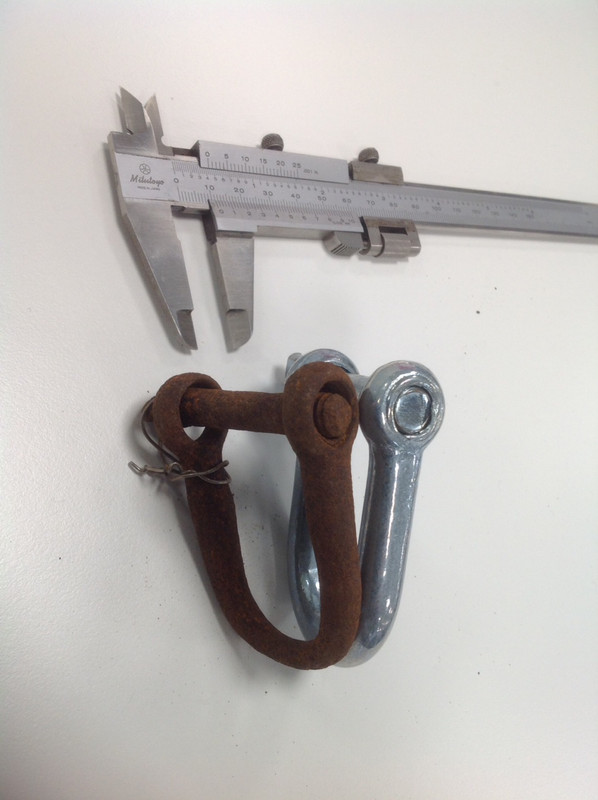
These are of the shackle in question.
Before installation, the nut was nipped on the pin and drilled.
Loctite applied and after installation, nut was seized with Monel through drilled hole.
Almost no wear in the bow or centre of the pin after three years, but the thread on the pin and nut has been eaten away entirely. There is also pitting of the full circumference of the pin where it meets the bow.
Clearly there has been some form of electrolysis going on.
Should I be suspicious of the Monel? Despite what the reel of wire says, might it just be stainless and how could I tell?
 

Attachments

  • IMG_20191007_181014.jpg
    IMG_20191007_181014.jpg
    273.5 KB · Views: 5
Why drill through the nut rather than putting something through the already drilled hole? I rather suspect that drilling through the nut contributed to the excessive corrosion of the threads.

My mooring uses 3-part green pin shackles from Van Beest which look exactly as the picture, but I never drill them, just put in a stainless split pin. They last much longer than the chain does, and none have loosened by themselves.
 
I always understood that stainless and carbon steels should not be together underwater?
The reasons the nut and pin were drilled were that the nut could be wired when tight and that the siezing did not have to intrude inside the shackle as I've had issues previously with wear here.
 
I always understood that stainless and carbon steels should not be together underwater?
The reasons the nut and pin were drilled were that the nut could be wired when tight and that the siezing did not have to intrude inside the shackle as I've had issues previously with wear here.

The (in)advisability of mixing galvanised high carbon and stainless steel I should leave to such experts as Vyv Cox, although tbh I've not had issues, but why do you say that a split-pin seizing would 'intrude into the shackle' if it's through the hole Van Beest already made? Isn't it further away from the inside of the D?

PS: I note your location is "NW Scotland". My mooring is in Plockton, ie Loch Carron, so possibly not so distant. The local mooring contractor tells me he uses Van Beest Green pin shackles without extra drilling, and they were supplied and recommended by Gael Force (so admittedly Inverness, ie east coast).
 
I'm not defending the use of Loctite but your original inference was that the Loctite has failed. From your recent post it seems that the Loctite might have failed but it seems more likely that the failure is due to corrosion - from (currently) unknown reasons.

Van Beest's Green Pin shackles are 'almost' a standard to which other might strive to equal but they are as prone to corrosion as any other shackle. Green Pin shackles are famed for their excellence in consistent strength (and I think are individually Proof Tested). I am not aware that any shackles are tested for corrosion resistance (probably because the makers have no control over how they are used - for example drilling the nut and pin and introducing another metal). The pins of the shackle are commonly made from a steel of different composition to the body. Many shackle makers supply shackles with nuts, pre-drilled, with pins - though these might only be available in larger sizes. Most of Van Beest's shackles are a Grade A shackle, in larger sizes they do supply Grade B shackles which are roughly similar in quality to Crosby's G209A shackles (a Grade A 3/8th" shackle will have a WLL of 1t whereas a Grade B would have a WLL of 2t) and are twice the strength of Grade A shackles. Noting - strength does not equate to corrosion resistance. More easily available are CMPs Titan shackles but it should be noted their Black Pin shackle WLL is an Imperial ton, short ton, not a metric ton, even though they are sold in a metric market. Equally I lack confidence in CMP's quality control - buyer beware. Their, CMP/Titan Yellow pin shackles have been very consistent and well within specification.

Which shackle, Crosby, Titan, Van Beest or a nefarious shackle from your hardware store might have a better corrosion resistance - don't know.

Jonathan
 
It's a Crosby shackle. Not particularly clear from the pic.
I had a problem previously of the chain inside the shackle wearing on the siezing so keeping that outside seemed like sense.
The previous shackle, also a Crosby, did not show the corrosion pattern that this one did. It was replaced only because it showed more wear than I was comfortable with and would have been six or seven years in use.
 
I believe the shackle pins are a different alloy to the bow, you would expect different corrosion - or at least not be surprised. To have lost all the thread would, in my opinion, be unusual,

I understand your reasoning to not want the seizing wire to be 'lost' through abrasion. Whereas the finger might be pointed at the wire through the nut and pin (as the root cause of the problem) I'm hesitant - primarily as the assembly appears to have been underwater and unchecked for longer than I would have practised (12 month inspection being my idea) - but maybe I have misinterpreted your posts.

I am amazed at the lack of wear on the shackle itself - failure appears to be corrosion in the absence of abrasion - which implies it is a corrosion issue. Here - there are 2 mechanisms, corrosion accellerated by abrasion (any 'rust' is simply and quickly worn away). You don't appear to have any abrasion at all! Again here failure would be at the 'crown' where 2 components rub together - which is absent in your application. (Academically interesting not much help to you :( ).

As previously you did not have this issue with the same shackle - the finger is more firmly pointing at your seizing wire.

I'm hoping Vyv will read the post and give a more educated response.

Jonathan
 
This shackle was found in the condition shown after only a few months on a mooring for a small yacht on Menai Strait. The owner, who took the photograph, thought that the problem was due to galvanic corrosion between the steel and the monel mousing wire. I believe that the monel cathode is far too small to have caused this but, as suggested by Jonathan, it appears to me that there has been a galvanic reaction between the pin and the bow of the shackle.

The pin itself appears only moderately corroded, whereas the eye and thread of the bow are considerably enlarged. One might imagine that the pin had a small alloy content whereas the bow did not. I know of similar problems in pipework on offshore platforms, where the weld, made to high compositional quality from dead mild steel, corroded in preference to the pipe, which contained some stray alloying elements. Welding rods for this duty now contain 0.25% chromium, making them cathodic to the pipe. In the case of the photo in post#30 it would seem that the nut was milder than the pin, which is commonly the case.

Once some slackness was present it seems likely, also as suggested, that corrosive wear took over. Corrosive wear can be a very rapid and damaging process, giving me the opportunity to show this super photo once again.
 
Last edited:
...I had a problem previously of the chain inside the shackle wearing on the siezing so keeping that outside seemed like sense...

I'm maybe being thick here, but I still don't get it.

green_pin.jpg

How does the chain inside the shackle wear on the seizing (which is a split pin)?
 
I'm maybe being thick here, but I still don't get it.

View attachment 80873

How does the chain inside the shackle wear on the seizing (which is a split pin)?

I think you misunderstand.

Normal mousing through the hole in the shackle pin demands wrapping the seizing wire round part of the bow of the shackle (just above the eye at the 'end' of the bow). The chain contained in the moused shackle can then rub on the mousing wire and caused premature failure. One way to over come this is to use Loctite - but if the thread corrodes the Loctite will soon fail.

The alternative solution is to use a shackle that is secured by a nut on the end of an extended shackle pin. These are standard assemblies and as in your photo come with a split pin to secure the nut (but you could always use Loctite). The split pin is then not subject to abrasion from the chain (but I find the pins rust quickly).

The OP appears to have found a shackle with the extended shackle pin but the pin and nut were not drilled (or not drilled to his demands) - so he drilled the nut and pin himself and used Monel wire to secure the nut. It might be the nut was a drilled but he wanted to have the nut as tight as possible so drilled a new hole.

The nut should really be made from the same steel as the shackle pin but it is possible the pin was an alloy steel, common in shackles and the nut was, any old, mild steel - and the bow of the shackle a different alloy steel again and this, as Vyv's post described, caused corrosion from different metals (as illustrated visually with his photo - quite stunning).

It is quite possible to buy alloy nuts and as high tensile bolts are marked and coded, so are nuts. Google nut and bolt coding - you will find chapter and verse. But you will not know if the nut matches the extended shackle pin (for alloy content) so better to use a supplied nut.

There are quite a few different designs of shackle, of increasing complexity, with external nuts to improve security. Most shackle makers define, vaguely, that their shackle pins are alloy steel, they may also define the steel from which the nut is made (I've never checked).

I would always suggest an annual visual look and a check of integrity with a spanner at any mooring assembly - and possibly even more frequent if the mooring is in mud.

I would not be keen on the swivel in your picture - I've tested them and they invariably fail long before a matching shackle. You are also dependent on the integrity of the nut welded that forms the 'swivel'. The chain looks very undernourished. The galvanising on the chain, swivel and shackle will last about a month (or that's the life I have found here in Sydney - where mooring contracts simply use 'black' steel. I hope that is a genuine Green Pin shackle - I saw a man in HK, outside a lifting component 'shop' with a big pile of green pin shackles. He was carefully stamping the word 'Holland' into the body of the shackles. His workmanship was a very good, quite professional - except the 'writing' on shackles is usually embossed - and his of course was recessed.

Jonathan
 
I think you misunderstand.

Normal mousing through the hole in the shackle pin demands wrapping the seizing wire round part of the bow of the shackle (just above the eye at the 'end' of the bow). The chain contained in the moused shackle can then rub on the mousing wire and caused premature failure. One way to over come this is to use Loctite - but if the thread corrodes the Loctite will soon fail.

The alternative solution is to use a shackle that is secured by a nut on the end of an extended shackle pin. These are standard assemblies and as in your photo come with a split pin to secure the nut (but you could always use Loctite). The split pin is then not subject to abrasion from the chain (but I find the pins rust quickly).

Jonathan

No, this is exactly what I understood. But the OP appears not to have used a split pin but a wire mousing through the shackle body itself, the reason for which I didn't understand - why was a split pin rejected? The picture on post #30 shows clearly that there is a pre-drileld hole for a split pin.

I would not be keen on the swivel in your picture - I've tested them and they invariably fail long before a matching shackle. You are also dependent on the integrity of the nut welded that forms the 'swivel'. The chain looks very undernourished. The galvanising on the chain, swivel and shackle will last about a month (or that's the life I have found here in Sydney - where mooring contracts simply use 'black' steel. I hope that is a genuine Green Pin shackle
Jonathan
Many thanks for the advice, but it's been 5 years now since that picture was taken.
1. I am absolutely sure the shackle manufacturer was Van Beest
2. I am equally sure that the chain was from a reputable source (Henderson), and came with C of C, specifying the testing and galvanising standard. In any event the section in the photo is above the swivel and is in fact only the top 1 metre of 13mm chain passing through the Norfloat booy. I replace it every 2 years but its rust is minimal in any case.
3. Ditto the swivel. I don't see what's wrong with it: it's not a cheap welded nut but a rather pricey forged one. Maybe the photo is unclear.
As I said, it's been 5 years now and so I replaced it all this summer, despite the shackles and swivel being all fine with no discernable wear at all (still using Van Beest shackles and forged swivel, but actually with black chain for the riser this time).

But this is all irrelevant and hijacking the thread. I simply wanted to understand why 'mousing' a 3-part shackle with a stainless steel split pin was considered a bad idea. You state that they 'rust quickly' but nonetheless my experience differs and I think it's almost certainly better than Monel wire through the shackle's body, and drilling a new hole in an already manufactured and galvanised item. My stainless steel split pins haven't rusted away, and nor do they seem to have accelerated corrosion on the shackles. Oh, and I do use loctite as well, but naturally can't say whether that has helped; the nut hasn't fallen off or unscrewed anyway.
 
Last edited:
Top