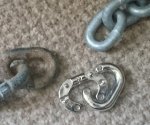
Tying my anchor rope to the boat...

Thanks for the tips guys.

It looks like it could be a bracket of some sort to hold an anchor in place... though there's no clips... but then maybe the anchor was one which slotted in sideways, then had a peg stuck in it to stay put.

I'm a bit nervous about drilling holes through to support a U-bolt. I mean... the boat is 35 years old... my thoughts are that there's something I don't understand over thinking I should drill and improve on it.

I think I'm leaning towards some sort of sacrificial tie to stop a mindless run-out... but sacrificial in the sense that in a deep water drop, I'd want it to snap rather than rip the front of the boat off. Are there fittings/rope/cable-ties that can be used for such sacrifice? Maybe 3 cable ties through a loop on the bitter end joining to one of the 'plastic rectangle things'? A massive momentum could just cause the cable-ties to snap rather than major damage, but an accidental non-momentum run-out could be potentially saved?

Additional side question... a chain joining link is the right thing to put my existing anchor and 3m chain onto my 3m chain+spliced warp? Am not looking forward to carrying 5kg anchor, 5kg chain, 5kg+ of rope back to the boat once all joined. One of these:
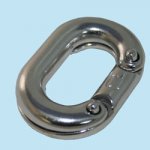
8525.jpg

Or should I be using something like a climers carabina, to be able to detach the anchor/warp?

Other info: I don't have a windlass... only a roller over the bow tip, and a cleat between there and the locker... this is the view from outside:

bow.jpg

I'm not much looking forwards to heaving up so much weight!
 
Thanks for the tips guys.

It looks like it could be a bracket of some sort to hold an anchor in place... though there's no clips... but then maybe the anchor was one which slotted in sideways, then had a peg stuck in it to stay put.

I'm a bit nervous about drilling holes through to support a U-bolt. I mean... the boat is 35 years old... my thoughts are that there's something I don't understand over thinking I should drill and improve on it.

I think I'm leaning towards some sort of sacrificial tie to stop a mindless run-out... but sacrificial in the sense that in a deep water drop, I'd want it to snap rather than rip the front of the boat off. Are there fittings/rope/cable-ties that can be used for such sacrifice? Maybe 3 cable ties through a loop on the bitter end joining to one of the 'plastic rectangle things'? A massive momentum could just cause the cable-ties to snap rather than major damage, but an accidental non-momentum run-out could be potentially saved?

Additional side question... a chain joining link is the right thing to put my existing anchor and 3m chain onto my 3m chain+spliced warp? Am not looking forward to carrying 5kg anchor, 5kg chain, 5kg+ of rope back to the boat once all joined. One of these:

View attachment 65101

Or should I be using something like a climers carabina, to be able to detach the anchor/warp?

Other info: I don't have a windlass... only a roller over the bow tip, and a cleat between there and the locker... this is the view from outside:

View attachment 65100

I'm not much looking forwards to heaving up so much weight!

From your picture it looks like a planing hull boat. Weight distribution and especially weight in the bow will be critical to performance at speed and bashing into rough water. Experience will tell you how much weight your boat can take in the bow but I am guessing not much. If you decide you can't take the 15kg in the bow I suggest you make up or buy a hold all sort of bag to take anchor chain and rope. So that you can carry the anchor from stowage under the floor in the middle of the hull. You might also consider a lighter anchor and lighter chain for those picnic anchoring situations which may be OK in the anchor locker or easier to carry forward.
No carabiners or similar snap shackles are not recommended for anchors unless you can afford to risk losing the anchor.
Don't rush to learn all this stuff get out boating and try the anchor in the bow and try anchoring. Experience has a way of showing you how to do things. olewill
 
You do not really need any chain at all if the seabed is mud or sand. You will only be day anchoring, not overnight - I assume. Most modern anchors, Rocna, Spade, Knox, Excel, Supreme, Kobra, Fortress will set at short scope and/or an all rope rode. All will benefit from some chain - but not a great length. You can buy a Spade, Excel or Fortress in alloy and all are demountable (so pack flat (of flattish :) ) - but availability might be an issue - you do not declare where you are located. Fortress is excellent in mud and sand, Spade and Excel excellent in sand, weed, stoney seabeds. Most modern anchors work well in sand.

Use a simple shackle (mouse it), one 5m length of chain and a decent anchor - all will be well.
 
From your picture it looks like a planing hull boat. Weight distribution and especially weight in the bow will be critical to performance at speed and bashing into rough water. Experience will tell you how much weight your boat can take in the bow but I am guessing not much. If you decide you can't take the 15kg in the bow I suggest you make up or buy a hold all sort of bag to take anchor chain and rope. So that you can carry the anchor from stowage under the floor in the middle of the hull. You might also consider a lighter anchor and lighter chain for those picnic anchoring situations which may be OK in the anchor locker or easier to carry forward.
No carabiners or similar snap shackles are not recommended for anchors unless you can afford to risk losing the anchor.
Don't rush to learn all this stuff get out boating and try the anchor in the bow and try anchoring. Experience has a way of showing you how to do things. olewill

Mmm... That's all a bit bothersome. You're right about it being a planing boat. Experience is what we're low on... and limited opportunities to gain it currently.

My thoughts are that we need the anchor to be ready in an emergency, but heaving 15 kg through the cabin hatch might be a nightmare.

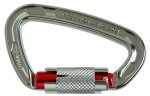
I was hoping carabiner like this could be the halfway ground...

Mad-Rock-Ultra-Tech-Twist-Carabiner.jpg

So that I could switch the rope to fit the cruise.

As it stands... If I complete this chain link... It looks like there'll be no easy going back.

_20170716_135029.JPG
 
The end of my chain has about a metre of lightish rope and then a rich great galvanised shackle, chosen to be (a) cheap and (b) to big to get up the chain pipe.
 
I think your 'over engineering' - you need a modern 5kg - 10kg anchor, and 10kg is really a generous upper limit. You can use 6mm chain - maybe 5m. Joint the whole lot together, anchor, shackle (moused or Loctite) chain spliced to 10mm anchor braid. The steel work will weigh, max, 15kg and possibly only 10kg. A small, Rocna, Spade or Supreme will be perfect. If you really want to save weight look at an alloy Spade (2.7kg). I think Jimmy Green will offer small chain spliced to nylon as a package.

I fail to understand why you worry about quickly deploying a 15kg anchor assembly. In an emergency weight will not be an issue - a 10 year old could chuck it over the side.

Buy the kit, store it neatly and go out and enjoy yourself.

Jonathan
 
^^ Generally quick links (mallion rapide) are considerably weaker than an equivalent shackle and more prone to jamming. there is no way to mouse it. There are reasons these are not used for rigging.

I've no idea what "mousing" is.

My boat is a mobo... I've no windlass, only a small bow roller to get any joint over, so jamming isn't likely to be an issue (the gap between roller and locking pin above it is a good couple of inches)...

View attachment 65100

I think your 'over engineering' - you need a modern 5kg - 10kg anchor, and 10kg is really a generous upper limit. You can use 6mm chain - maybe 5m. Joint the whole lot together, anchor, shackle (moused or Loctite) chain spliced to 10mm anchor braid. The steel work will weigh, max, 15kg and possibly only 10kg. A small, Rocna, Spade or Supreme will be perfect. If you really want to save weight look at an alloy Spade (2.7kg). I think Jimmy Green will offer small chain spliced to nylon as a package.

I fail to understand why you worry about quickly deploying a 15kg anchor assembly. In an emergency weight will not be an issue - a 10 year old could chuck it over the side.

Buy the kit, store it neatly and go out and enjoy yourself.

Jonathan
I've got the chain-to-rope splice done by the chandlers (about 4m of chain). The anchor also has about 2m of chain on it, so what I'm talking about is the chain-to-chain link, this is what I've presently got, and querying... do i go ahead and bash this link on?

View attachment 65194

The quick deployment would only become an issue if I kept either the anchor/chain, the 50m of rope or both below in the cuddy (as per William_H - reply #23). I don't want an engine failure along the coast, to be compounded by having to faff for an additional 3 mins. But then, having such weight in the bow anchor locker of a 35yr old 6.5m plaining mobo could affect the weight distribution.

It doesn't help either that the gap between the bow roller and the grab rail above it mean a little contorting to get the anchor through... thankfully I have a safety line prepped for myself to do this in the event of the worst.

I think I'll quiz on the Bristol Channel forum for anchoring spot suggestions to ride out the low tide and suggest it to the other half for our next outing.
 
Last edited:
One of the concerns that is not often considered is the scenario where the anchor is accidentally dropped in deep water. The anchor and chain will develop considerable momentum as the whole length of chain runs out if, for example, the clutch is loose or the chain has jumped off the gypsy. It would not be safe to arrest the drop in such a case.


It is hard to imagine any boat hardware surviving the sudden stop at the end. I am not sure what is best solution to this (fortunately rare) problem, but as well as having a rope tail that is enough long to lead on deck so it can be cut, it may be worth making sure the rope is weaker than the under deck fitting that is securing the bitter end.

Case in point :)
https://www.youtube.com/watch?v=IBBoQzPq69k
 
One of the concerns that is not often considered is the scenario where the anchor is accidentally dropped in deep water. The anchor and chain will develop considerable momentum as the whole length of chain runs out if, for example, the clutch is loose or the chain has jumped off the gypsy. It would not be safe to arrest the drop in such a case.


It is hard to imagine any boat hardware surviving the sudden stop at the end. I am not sure what is best solution to this (fortunately rare) problem, but as well as having a rope tail that is enough long to lead on deck so it can be cut, it may be worth making sure the rope is weaker than the under deck fitting that is securing the bitter end.

Why would that happen? I'm pretty sure my car can't survive a 100km/hr collision with a concrete bridge, so I don't hit bridges.

Another alternative--less fatalistic--is to splice ~ 3-5 meters of rope at the end. That would absorb the impact of a speeding chain and anchor AND it would allow the rode to be released from on-deck. Simple.
 
Thinwater, Its like the preparation for anchoring in 70knots - people do like to post the most alarmist scenario's imaginable - they have never experienced them and only a very, very few ever will.
 
^^ I get that.

The rope suggestion was given to me by a man with a very deep chain locker. Apparently he had found himself crawling in there, in the pitch black with a pitching bow, trying to release a chain. He was not thinking of this scenario, but it seems to me that splicing on a modest amount of rope (3-5 meters) might solve a multitude of potential problems; release and also shock absorption. The latter could be because the anchor was in free fall, or simply because the snubbers blew and the chain was not secured. That seems more likely, since I know I don't always bother to secure the chain. But my chain is backed by rope, so no problem... though I would drop back 150 feet!
 
Why would that happen?

The greatest risk is when sailing in rough conditions and the lashing securing the anchor and chain chafe through.

The other possibility occurs in those locations the water is deep close to shore. There is a risk of accidentally dropping the anchor in this deep water when you are approaching the anchor spot. You need to retain a safety rope until the water is shallow enough where an accidental drop would not be a problem, but mistakes can happen.

I'm pretty sure my car can't survive a 100km/hr collision with a concrete bridge, so I don't hit bridges.

No one plans car accidents, but they do occur to even the careful drivers. Engineers work to make modern cars as safe as possible so if mistakes occur the results cause the least damage to occupants. Even bridges are built with safety barriers to minimise injury. The same philosophy of designing safety with good engineering and choice of materials can be usefully adopted to mitigate possible sailing problems. Securing the bitter end of the chain is a simple problem, but one that needs some thought.

Another alternative--less fatalistic--is to splice ~ 3-5 meters of rope at the end. That would absorb the impact of a speeding chain and anchor AND it would allow the rode to be released from on-deck. Simple.

I think expecting 3-5 metres of rope to absorb the energy of 100m of chain and anchor in free fall is very optimistic. Of course I have never tested this and don't intend to do so in future :). However, I do often drop my anchor by releasing the clutch and allowing it to free fall rather than using the winch to power the anchor down. In water deeper than 10m the speed and power of the anchor chain running out is impressive. In deep anchorages it becomes scary. You don't want to be anywhere near that chain while it is running out and I would not suggest anyone uses this technique for deeper water. However, in these cases the seabed will arrest the fall of the anchor and chain well before the whole 100m is deployed. An accidental drop in deep water allowing the whole 100m of chain to fall would have a lot of energy.


I think the idea of the rope tail is the best solution. Make it long enough so that it reaches on deck and can be cut if want to release the anchor, but my suggestion would be to make this rope weaker than fitting it attached to, so in the worst case the rope snaps rather than ripping out fittings and damaging the structures.

This is no different to driving a car with airbags, it is safety feature that I hope to never use.

The other suggestion is consider using a longer length of floating rope (say 20m) before using a slightly weaker rope as the final attachment point. As an alternative a longer length of conventional rope with a suitable float ready for rapid attachment is a good option. The advantage is if you do need to cut away your anchor (for example if another boat becomes tangled in your rode) the floating rope will act as a marker so the anchor can be retrieved later.
 
I think your 'over engineering' ...

Golly. That's possibly the most out-of- character statement I have ever seen here. Coming next (guess the poster - I've done one for you):
  • "Of course, members of Poole Yacht Club aren't typical of leisure sailors"
  • "I'm sorry, but I haven't been able to find a manual for your outboard online'
  • "I miss Wales, but there is so much we can learn from foreigners'
  • "I just don't know enough about that to have an opinion" - JumbleDuck
 
Top