Twin mainsheet - deckeyes loading

…and I have seen them fail. A U bolt is a continuous rod without weld.

And I’ve seen U bolts fail.
A high load pad eye bolts through the deck at 4 points. If you buy a good quality load rated pad eye, from Wichard or similar, the weld won’t fail. U bolts are cheaper certainly, but for dealing with the force of a crash gybe I’d want the stronger option. Agreed on the folding pad eye though- I’d prefer a non-folder.
 
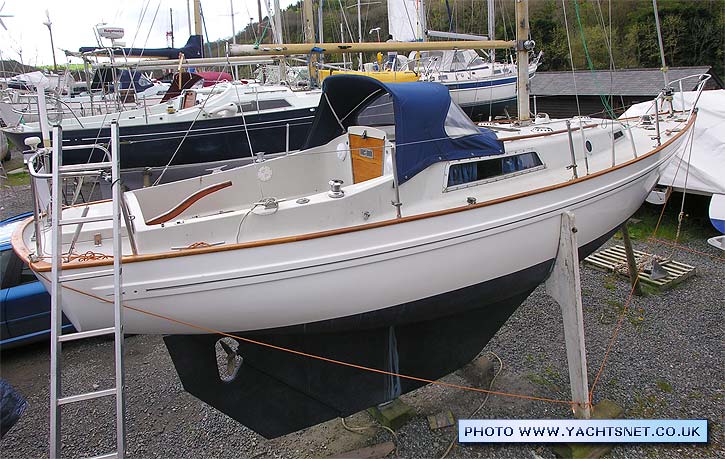
h50411-ashore-top.jpg


Looking at the coaming, I would construct inverted U bars between the inboard and outboard of the coaming and put a bolt horizontally through.
 
Sorry but two items now I would not use in this situation :

Folding Padeyes
Sprung clip

I realise that OP wants a solution that is quick to fasten / unfasten ... lays near flat ... but those two reqt's lead to need to increase items size to have safe margin against load failure.

A hard fixed EYE + shackle is my choice.

As to the main sheet traveller mounted across companionay access 'bridge-deck' - I have always hated that idea ... seen plenty trapped hands from them. My race boat in Tallinn had traveller mid point of cockpit ......... thought that was bad enough !!
 
Sorry but two items now I would not use in this situation :

Folding Padeyes
Sprung clip

I realise that OP wants a solution that is quick to fasten / unfasten ... lays near flat ... but those two reqt's lead to need to increase items size to have safe margin against load failure.

A hard fixed EYE + shackle is my choice.

As to the main sheet traveller mounted across companionay access 'bridge-deck' - I have always hated that idea ... seen plenty trapped hands from them. My race boat in Tallinn had traveller mid point of cockpit ......... thought that was bad enough !!
I agree and have had both but despite the limited traveller movement possible I have loved having the traveller forward of the hatch - so crossing it just past the point of maximum hatch opening. Nothing to get a body caught in like the lethal case much posted on this forum, or the man overboards on the RTW races caused by mainsheet slamming across.
 
For occasional use you may be OK with folding padeyes, but I wouldn’t want them as my primary system because the constant movement, even when you’re not on the boat, would lead to wear at the hinge.

TBH I’m not a huge fan of those springclips on a boat either, because if you twist them the right way on a ring or padeyes you can get them to release. I wouldn’t want my main sheet to come undone unless it was intentional.
 
Would number of purchase make a difference to load on deck fitting? I would have thought that just determines how easy it is to move the boom when it’s loaded.
In terms of crash loading of boom and main sheet in a gybe no difference. In fact in my case not a huge worry as boom is carbon fibre light weight. However on my little boat with centre main sheet on a traveller the tension on the 4 purchase main sheet was made by a pull upwards. The tension max seemed to be limited by the strength of the sheet hand. Hence the comment more purchase more load on attachment. ol'will
 
Sorry, I've only just spotted this thread.

If it's of any use, Avocet used to have a mainsheet horse going across the cockpit, immediately ahead of the lockers. (Where the guy's welly is). That was a pain for lying down in the cockpit, so I stuck a couple of ring bolts through the side of the cockpit, just ahead of the drain channels for the cockpit locker lids. That's an inherently very stiff bit of boat, but I dapped a couple of layers of fibreglass and polyester resin on the backs of them before doing so. Frankly, I don't think I'd have needed it. They've been like that for more than a decade and don't flex at all. Either one is plenty strong enough for mainsheet loads. Not only does that arrangement give me redundancy, but I can unshackle one of them if I want to use the setup a bit like a mainsheet traveller (albeit with only three positions - (left, right and centre). Also, when not sailing (and when the kids were small) I could undo one of them to allow the kids to walk the length of the cockpit.

Using the coamings would, I'm sure, also be strong enough (they can take Jib sheet winch loads) and the loads from a mainsheet are better directed. I'd only really put a thick plate under there, the same width as the internal gap. Cutlasses are laid up like tanks.Mainsheet attachment.jpg
 
As an engineer I could calculate the hell out of this. But there is a much simpler way.

  1. Look at the strength ratings on your existing boom fittings, mainsheet, and traveler. They have been speced based on experience, and the load will be the same on the new system. Each leg must be able to hold the full load, because sometimes that will happen.
  2. The peak load is probably a crash jibe, which you will not be able to calculate. But "1" above accounts for that.
  3. A pad eye will better manage loads at an angle.
  4. Don't forget the deck and backing plates. More than for a cabin top winch, because the pull is up instead of sheer and because of impact. Close to the cabin walls is better, and I'd probably lay 4 layers of 1708 biax to spread the load. But I don't know your cabin.
That's not a big sail, but I've seen sails that size bend stuff on beach cats.
 
I respect grizzled engineers who can look at a problem, delve into their decades of experience, and come up with a simple answer - knowing full well they could 'calculate the hell out of this'. That kind of engineer came up with the chainplates for my fit-out of a shell of a Telstar tri 'way back'....AND the bolts, each one of which had an individual Rolls-Royce test certificate attached. They were intended to hold the R-R Spey engines into an RAF Phantom strike/recce aircraft!

I'm conscious of the problem of a wild gybe, having experienced a handful of them along the way - the first on a JSATC 'Nicki 55' on a spinnaker run through the Portland Race.

My solution to the damage-potential of a crash gybe is the use of a 'Boom Brake' - but not one that costs 300 quid/euros. I've used this much cheaper braking device ( courtesy of RAF Kinloss MRT ) for a wheen of years. It has earned its keep....

52519424838_b21c56fd0c_z.jpg
 
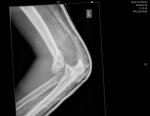
My boat has the mainsheet traveller across the bridgedeck, it's the only thing about the boat I really dislike -I have a still unfitted complete wheel / pedestal conversion (tiller steered for past 17 years). Fitting a wheel would enable me to move the mainsheet track to the aft end of the cockpit but the price would be losing the large in-port cockpit a tiller gives. I've had one accident when racing two handed - inevitably a crash gybe, which resulted in a completely dislocated elbow, probably the most painful thing I've known, at the moment, as a cruiser now, cockpit space is winning the argument

Camaret.jpg elbow.jpg
 
I respect grizzled engineers who can look at a problem, delve into their decades of experience, and come up with a simple answer - knowing full well they could 'calculate the hell out of this'. That kind of engineer came up with the chainplates for my fit-out of a shell of a Telstar tri 'way back'....AND the bolts, each one of which had an individual Rolls-Royce test certificate attached. They were intended to hold the R-R Spey engines into an RAF Phantom strike/recce aircraft!

I'm conscious of the problem of a wild gybe, having experienced a handful of them along the way - the first on a JSATC 'Nicki 55' on a spinnaker run through the Portland Race.

My solution to the damage-potential of a crash gybe is the use of a 'Boom Brake' - but not one that costs 300 quid/euros. I've used this much cheaper braking device ( courtesy of RAF Kinloss MRT ) for a wheen of years. It has earned its keep....

52519424838_b21c56fd0c_z.jpg
Your boom brake and variants of it are readily available at all good rock climbing shops. Petzl, and DMM variants were £12.95 in Cotswolds, N Wales at the weekend. I was looking at ascenders.
 
As an engineer I could calculate the hell out of this. But there is a much simpler way.

  1. Look at the strength ratings on your existing boom fittings, mainsheet, and traveler. They have been speced based on experience, and the load will be the same on the new system. Each leg must be able to hold the full load, because sometimes that will happen.
  2. The peak load is probably a crash jibe, which you will not be able to calculate. But "1" above accounts for that.
  3. A pad eye will better manage loads at an angle.
  4. Don't forget the deck and backing plates. More than for a cabin top winch, because the pull is up instead of sheer and because of impact. Close to the cabin walls is better, and I'd probably lay 4 layers of 1708 biax to spread the load. But I don't know your cabin.
That's not a big sail, but I've seen sails that size bend stuff on beach cats.
I'd agree with all of that, but winches aren't loaded as much in shear as one might first think. Avocet's coachroof (to which I added a couple of halyard winches) does actually flex a bit because of the offset between the winch base and where the rope comes off the drum!
 
I'd agree with all of that, but winches aren't loaded as much in shear as one might first think. Avocet's coachroof (to which I added a couple of halyard winches) does actually flex a bit because of the offset between the winch base and where the rope comes off the drum!
True, I was making a point. In fact, the critical bolt failure will be up-lift on the aft bolts. I pulled a winch out of a deck because the PO didn't even use fender washers. Fortunately, I caught it before it pulled out all the way and went overboard!

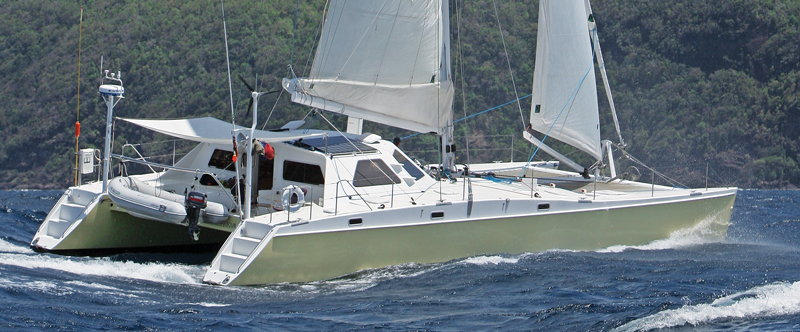
I have tested twin sheets on my trimaran, attaching the turning blocks to the aft beams close to the hull. It worked well. But this leads me to the question about where to attach the pad eyes. Just as a longer traveler is better, farther outboard is better. If in the cockpit area, probably right near the rail. If forward of the cabin, you might stay inboard of the side decks just for freedom of movement. But maybe not, something to consider. For an engnieering perspective, farther out is probably better, depending on the boom height (you also do not want the angle greater than ~ 90 degrees when centered, so the spacing should not exceed 140% of boom height... but probably should not be less either. Because it was a trimaran, I tested a variety of spacings, and if you look at performance cats with twin sheets, they follow something close to this rule, even though they have more beam. Wider, beyond 140%, does not help with downwind trim and increases mainsheet loads.

Note that these designs do not use vangs, and because of aft swept shrouds, can't ease the boom square. It would be unusual to ease the boom more than 45 degrees.

Neel-45-from-stern.jpg


atlantic-57.jpg
 
Last edited:
The first owner of my current boat had her fitted out for offshore/ocean sailing including twin mainsheets. I took her over from him in Plymouth. By the time we got home to Orkney I had decided that they were a pain in most parts of the anatomy. As we have a fairly narrow beam most of the time only the lee sheet was in use. The lazy sheet was always draped across the cockpit waiting to entangle anyone or anything within its reach. Close hauled the working sheet was down from the boom to the toe rail, but as the sheet was eased it draped over the guardrails and had to be taken off and re-attached outside the guard rails to give a fair lead. Mounting the ends on the coaming might reduce the guardrail problem but probably not eliminate it.

Once home I ordered track and traveler to fit to the forward end of the cockpit as per the original design. Perhaps not ideal but thirteen years later I still think it is a vast improvement over the twin mainsheets. Looking back I can think of a few times, mainly having to respond to squalls and sudden big wind shifts at night, when the second main sheet across the cockpit could have been potentially lethal. Unfortunately, my boom does not extend far enough aft to put the mainsheet where it should be: well out of the way aft of the helm.
 
See Below in RED.

The first owner of my current boat had her fitted out for offshore/ocean sailing including twin mainsheets. I took her over from him in Plymouth. By the time we got home to Orkney I had decided that they were a pain in most parts of the anatomy. As we have a fairly narrow beam most of the time only the lee sheet was in use. The lazy sheet was always draped across the cockpit waiting to entangle anyone or anything within its reach. Yup, it cut the cockpit in two. Close hauled the working sheet was down from the boom to the toe rail, but as the sheet was eased it draped over the guardrails and had to be taken off and re-attached outside the guard rails to give a fair lead. Mounting the ends on the coaming might reduce the guardrail problem but probably not eliminate it. I did not have the lifeline problem. Sounds like it eliminates many good locations on monos. The cabin top sounds like the best candidate in most cases. I imagine the lifeline also limits the practical traveler width on many monos.

Once home I ordered track and traveler to fit to the forward end of the cockpit as per the original design. Perhaps not ideal but thirteen years later I still think it is a vast improvement over the twin mainsheets. Looking back I can think of a few times, mainly having to respond to squalls and sudden big wind shifts at night, when the second main sheet across the cockpit could have been potentially lethal. Unfortunately, my boom does not extend far enough aft to put the mainsheet where it should be: well out of the way aft of the helm.

I still think it is a good jury rig that every sailor should know, in case the traveler blows up. Ease to rig using spare blocks and secondary winches.
 
I still think it is a good jury rig that every sailor should know, in case the traveler blows up. Ease to rig using spare blocks and secondary winches.
Totally agree, and I have the gear ready to rig should it ever be needed as a jury rig.
I was simply giving my experience of twin mainsheets as a primary system. Other boats/owners may well find they suit their needs.
 
Totally agree, and I have the gear ready to rig should it ever be needed as a jury rig.
I was simply giving my experience of twin mainsheets as a primary system. Other boats/owners may well find they suit their needs.

Like you, I tried it and switched back to a traveler system. It worked, of course, but not as well, overall.
 
Your boom brake and variants of it are readily available at all good rock climbing shops. Petzl, and DMM variants were £12.95 in Cotswolds, N Wales at the weekend. I was looking at ascenders.

Aye, laddie. Ah ken fine..... ;)

HerMaj didn't want her Clog Original back. Said I could keep it..... along with my collection of drilled-out aircraft wheelnuts on slings.
 
Aye, laddie. Ah ken fine..... ;)

HerMaj didn't want her Clog Original back. Said I could keep it..... along with my collection of drilled-out aircraft wheelnuts on slings.
Back in the early 90s I went climbing in Poland, met some Russians. We swapped my walkman tapes for titanium ice screws that the lads had made themselves. They said they came from a place called Baikonur. Can’t think where they got the titanium.
 
Top