Trying to learn Charts - Need help understanding compass roses

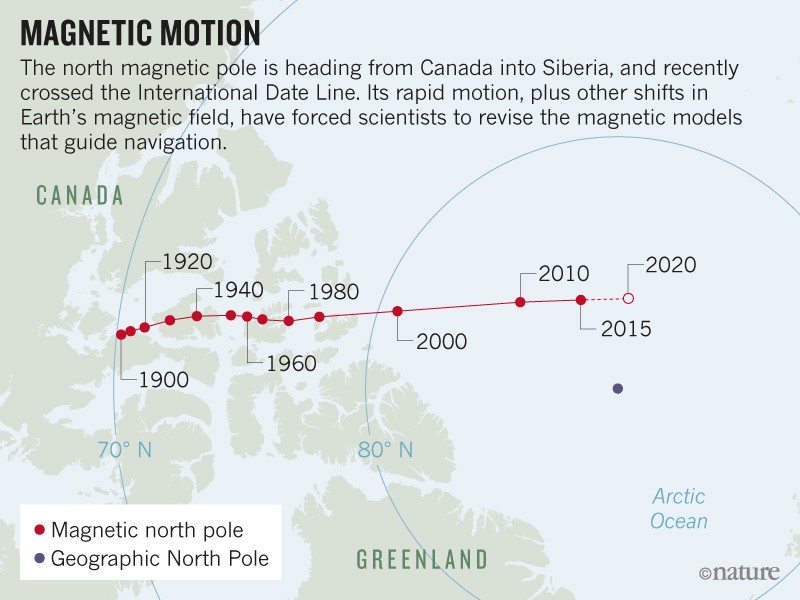
d41586-019-00007-1_16383826.jpg


shows how the location of the magnetic north pole has been moving. So viewed from around 0 degree longitude (eg in the UK) it's now just a tiny bit east of due north.
 
At the end of the day, there are only two directions that you need to consider. The true direct to an object and the compass direction. The intermediate stage is magnetic direction. The mnemonic Tired Virgins Make Dull Company leads you from True to Compass. Starting from the true direction required, apply the Variation and you get the magnetic direction. As Variation is negligible at present (not always the case as when I started learning this Variation was stated as 9 degrees West) magnetic and true are the same.

If you are out walking there is no deviation either, or if there is, you will not know it and cannot apply it. Deviation is the difference, on a vessel, between where the compass SHOULD point (Magnetic) and where it does, Compass. This is due to the distortion effect of the hull, machinery and anything else such as the mobile phone case in you pocket. Unlike Variation, which is virtually constant and negligible anyway, Deviation depends on the direction in which the vessel is pointing and must be read off from a deviation card prepared for the vessel by a compass adjuster.
 
Personally I find it harder to remember whether or not the cadets are true virgins than simply to visualise (no imagination necessary with new charts where the compass rose does all the work for you but still not hard even where variation has changed direction since the chart was published) where magnetic north is relative to true north and add or subtract accordingly.

However my YM theory instructor insisted on trying to teach us these and obviously they work well for a lot of people. Is it a generational thing that people who were at school in the 50s got used to learning by smutty mnemonics?

If you learn compass to true that way (ie CADET) does the reverse work equally, do you use another acronym for true to compass or does it take a moment extra to process (like me trying to tie a bowline "back to front")?

Is the current negligible variation in the middle of the south coast which even those of us who are fairly fastidious about our nav ignore a problem for yachting instructors?
Sorry to read that your think TVMDC a smutty mnemonic. Several years ago, I posted on here to ask if anyone knew a better/alternative way to remember it but nothing was forthcoming. It doesn’t matter what one uses to learn about variation and deviation and how to deal with them when navigating.

Regarding the south coast having negligible variation, this is not a problem for either Shorebased or practical instructors.

The RYA Training Charts show approx 7 deg W within their roses. Most exam questions give a variation to use and in the classroom a good instructor will have a range of charts available as teaching aids when coverimg the subject. A North Atlantic routing chart is a good aid for many reasons including to demonstrate how variation changes with position.

There’s not an issue with practical courses, either. If demonstrating and/or asking a candidate to work out a course to steer, the instructor can give a fictitious variation if there’s any doubt over its use.
 
The North magnetic pole is heading from Canada into Siberia
I blame the Russians!?
When I learned to read a map as a young soldier the mantra was Grid to Mag Add, Mag to Grid get rid. That's all out the window now that Mag N has moved E of True North, but as my Chart Plotter deals with it, all I have to worry about is how devious I am ?
 
Personally I find it harder to remember whether or not the cadets are true virgins than simply to visualise (no imagination necessary with new charts where the compass rose does all the work for you but still not hard even where variation has changed direction since the chart was published) where magnetic north is relative to true north and add or subtract accordingly.

However my YM theory instructor insisted on trying to teach us these and obviously they work well for a lot of people. Is it a generational thing that people who were at school in the 50s got used to learning by smutty mnemonics?

If you learn compass to true that way (ie CADET) does the reverse work equally, do you use another acronym for true to compass or does it take a moment extra to process (like me trying to tie a bowline "back to front")?

Is the current negligible variation in the middle of the south coast which even those of us who are fairly fastidious about our nav ignore a problem for yachting instructors?
I don't know the cadets are true virgins one. How does that one work?

Compass ADd Easterly going to True.
C > ADE > T, therefore subtract if it's Westerly. Obviously you just reverse the rule when going from True to Compass.

It was the first mnemonic I ran across for this and never bothered with any others. To be honest, I just did the calculation almost immediately and don't even know if I'm internally referring to CADET without conscious thought. :D

I don't actually use many mnemonics and just remember things like buoyage, colours of rainbow etc. Cadet always struck me as an easy one to teach others if they couldn't work out how to convert.
 
I don't know the cadets are true virgins one. How does that one work?

I think my post may be being taken a little too literally. Given that it wasn't that funny so I don't lose much by explaining the joke, it was a deliberate confusion of different mnemonics to illustrate my assertion that I find such mnemonics harder to remember than the actual concepts they're supposed to make you remember. This is not a criticism of its use or anyone whose brains work differently to mine. Whatever works for people is good.
 
+1!

Can people not visualise the globe and where the poles are relative to them? Just knowing that the magnetic N pole is a little to the East of the true North Pole when viewed from where we are is all that's required surely - what the point of mnemonics, amusing or otherwise? Understanding is surely better than half-remembered 'rules'.
 
+1!

Can people not visualise the globe and where the poles are relative to them? Just knowing that the magnetic N pole is a little to the East of the true North Pole when viewed from where we are is all that's required surely - what the point of mnemonics, amusing or otherwise? Understanding is surely better than half-remembered 'rules'.

Yes, I think it's easy enough to work out by looking at the compass rose, or even a wrist watch and call 12:00 North. No stupid mnemonics required.
 
.....
Alright, I think I understand it better now. Charts are fun, but a lot more complicated than a chartplotter.

Edit: Yes, I know it is not significant but I just wanted to learn the principle of this calculation. What confused me, and maybe confuses others at first; The difference between degrees and minutes, and you mustn forget conversion.
...


Years ago there was a bloke called Peter Mellor who wrote a book called "Sailing Made Simple". He reckoned that you should ignore true bearings entirely, make sure your compass has no significant deviation, and plot everything against the magnetic rose of an up to date chart. Job done.
Mind you, I agree it does not help you to understand what is going on.

Remembering how to apply variation I have always used the Mnemonic:

Compass to True the signs will do
True to Worse the signs reverse

The "sign" is an imaginary minus and plus on the face of the rose (actually I pencil one in on each), just like a clock, minus to the left, plus to the right.

.
 
Error west, compass best. Error east, compass least. Another one that's helped generations of sailors. Can't see why that's stupid.

Next some killjoy will re name the bunny rabbit knot as a bowline. ?
 
Fred Drift. May West and Easter Egg helped me remember cardinal marks's day shape a long, long time ago. CADET was the one used when I learned Competent Crew as a 13 year old.
 
Top