Trumpet type air vents, any use in hot climes

pcatterall

Well-Known Member
Joined
2 Aug 2004
Messages
5,508
Location
Home East Lancashire boat Spain
Visit site
Trying to ensure good airflow through our boat in the med. Do those trumpet type vents catch much breeze? I'm thinking of the ones you can remove when sailing, possibly there is a model where you can change over to a conventional one.
We use a wind scoop to good effect when the wind is right, it can bring a good breeze from the V berth through the saloon and into our centre cockpit.
 
Trying to ensure good airflow through our boat in the med. Do those trumpet type vents catch much breeze? I'm thinking of the ones you can remove when sailing, possibly there is a model where you can change over to a conventional one.
We use a wind scoop to good effect when the wind is right, it can bring a good breeze from the V berth through the saloon and into our centre cockpit.
When combined with Dorade boxes to keep out water, the advantage of these vents is that they can remain active while under way. To prevent lines from fouling, the vents are often covered with a hoop. It is most beneficial that each compartment or cabin have two vents; one to bring in fresh air and one to evacuate.
 
I had two on my previous boat, used in UK and near continent waters. One was the dorado type, the other not (i.e. it was just open underneath).

The latter certainly gave a good flow of air. Of course, if you weren't careful rain, too! It wouldn't have been suitable in most places unless it was replaced when under way by a closed cover (most come with these), because of the risk of getting spray and/or green water in. In my case it was at the rear of the coachroof, usually under the spray hood, and vented well the heads compartment, where a little rain wasn't a problem. Being able to turn the trumpet according to the wind direction was a boon.

The dorado type gave a much reduced, but still useful, flow into the forecabin. The First Mate is a bit of a fresh air freak, and I would certainly notice it being open when we were trying to sleep in typical British temperatures. It was no substitute for a big hatch open in really hot weather, but that is a rare problem in these parts. This vent could be open and closed from the inside. It also had some sort of flap that was supposed to close to keep out (most) green water. This was either effective or never put to the test, as we never got any water in underway.)

The other type we had was a large brass or bronze mushroom vent over the cooker. This certainly allowed a good flow when fully open, but had to be closed underway, and even when not underway could only be partially opened if it was raining.

Notice that no vent is going to let much air in or out unless there's another vent/opening somewhere to allow the reverse flow of air.
 
We have a pair in the saloon of our 10m cruiser that are pushing in a very perceptible draught right now. The missus keeps sticking socks in them to stop it and I keep pulling them out to keep the boat ventilated.
They really only keep the boat aired and smelling a bit fresher though. They don't contribute much, if anything, to keeping the boat cool in the Med summer heat. I've confirmed that on days when we've left the boat closed up all day compared to when we can open the hatches. We leave our three Caframo fans running 24/7 when it gets to 30 degrees, so they help air to come in and vent out in those conditions.
They have fairly large dorade boxes and I seal the vents only in the worst weather. But even at F7 Offbeat is a very dry boat on deck.
 
One problem with Dorades is the ease with which one can knock them off and then they land in the sea. I put a short length of string around a chopstick and the other end into a convenient hole in the edge of the dorade. I then drop the chopstick into the dorade box, before screwing the plastic dorade onto its base. In that way, when the dorade is knocked, the string+chopstick stops it falling into the sea.
TS
 
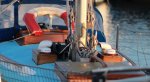
My experience with these vents is based on time spent in the tropics and two non-stop Pacific crossings. Our present boat also has a pair. Their main purpose is to keep the boat ventilated, so as not to grow (to many)strange things below decks. For cooling purposes, most of the cowls offered today are simply too small; decent ones are crazily expensive. The ones on the boat( not mine) I did the Pacific on where a foot high, chromed bronze (ah, the envy). Nothing quite screams ship as a nice set of cowls.DSC_0213 (2).jpg
My present boat came with a fairly decent set, but no boxes. That was fine until you forget to turn them in the rain or start shipping the kind of water we did in the Baltic two years ago. I made some boxes by joining two PVC sewage pipe caps and painting them to match. That worked out nicely. For the trough-deck I used 3" waste pipe as well, with a screw-on inspection cap for when things turn really nasty. The biggest problem with many Dorade boxes is that the drains are frequently too large and this wastes a lot of the precious air coming in through the cowl.
 
Last edited:
In terms of air circulation in the Med in summer, they’re next to useless.
I turned the hatches round so the hinge is to the aft side of the hatches. With the hatches propped at 45 degrees or so, it channels the breeze into the boat nicely, provided you’re at anchor and therefore facing the breeze. I also made a wind scoop out of ripstop nylon to fit on the forehatch: it does a good job in light winds but is noisy in anything above a zephyr of wind, so no good at night.
When we head north for UK I’ll turn the hatches round again so the hinges face forward, as I’d prefer that when dealing with the weather in the Atlantic.
 
One problem with Dorades is the ease with which one can knock them off and then they land in the sea. I put a short length of string around a chopstick and the other end into a convenient hole in the edge of the dorade. I then drop the chopstick into the dorade box, before screwing the plastic dorade onto its base. In that way, when the dorade is knocked, the string+chopstick stops it falling into the sea.
TS
Great tip. Another thing to add to my to-do list.
My three dorade vents are protected by athree-legged 4mm stainless rod 'cage' or the granny bars at the mast. But once in a while a sheet contrives to get in there anyway and wrap around the cowl. Five years ago in the middle of the North Sea, my Plastimo dorade vent was torn off during a tack and flipped overboard, cowl AND box, leaving a 60mm hole in the deck. The lesson is to make sure that the cowl is the weak link in the fitting, not the box or deck fixings!
My two other dorades are moulded into the deck so no risk there. I quite fancy replacing the Plastimo one with a wooden box as in Buck Turgidson's post above, for both strength and somewhere secure to put shackles, tools, tape, etc when working on the foredeck.
 
Boats vary. I have never lost a plastic Dorade vent in twenty years and have never felt the need to replace with the blanking cover. Even in winter they are blocked off with socks when dehumidifying.
 
My experience of dorade boxes in the Caribbean is that they are a complete waste of time. They simply do not move anything like enough air. The Caribbean is pretty breezy but they still contribute nothing to keeping a boat cool. We removed three good sized dorades from our boat and replaced with forward facing hatches. Huge improvement
 
My experience of dorade boxes in the Caribbean is that they are a complete waste of time. They simply do not move anything like enough air. The Caribbean is pretty breezy but they still contribute nothing to keeping a boat cool. We removed three good sized dorades from our boat and replaced with forward facing hatches. Huge improvement
Hmm. I would whole heatedly disagree with a categorical statement like that; it is not that simple. In Panama and Central America we had daily rain storms that were so intense we could literally shower outside and fill all our water tanks; leaving a hatch open was simply not an option. Offshore at night, the risk of sudden squalls, bringing rain and winds up to 40-50kts quickly taught us that leaving ports and hatches open was not advisable. A return trip, South to North across the North Pacific entails a 1500 mile slog to windward; leaving the forward hatches open ... moisture in the boat was so high, that (fresh) laundry in the cabinets was starting to grow fur.
Fair enough, I have also spent a few months anchoring around the Caribbean with open hatches and ports and with wind sails set funnel down the breeze, but you cannot leave the forward hatches open at sea, bringing in all that salt. Our boat was a 50' CC cutter, we had five opening hatches, a well-protected companion way, nine large, rectangular opening ports in the freeboard, and eight dorades. It's not one or the other, but a combination of all. There are also places, where leaving hatches open on an unattended boat is not advisable and current day producers like to cheap out on opening ports.
 
I don’t think anyone is suggesting sailing with open hatches..... and I agree that open hatches in rain storm don’t work. However, when you’re moving you’re generally not spending much time down below so the need to keep up a throughflow of air is minimised. Hence my remarks that dorade vents are a waste of time in a hot climate. There are a number of differing solutions to the problem including some ingenious canvas wind scoops which channel air into them boat whilst keeping the rain out. But to reproduce the funnelling effects using fixed dorade vents would entail such large “trumpets” as to be impractical on most moderately sized boats.
 
Hmm. I would whole heatedly disagree with a categorical statement like that; it is not that simple. In Panama and Central America we had daily rain storms that were so intense we could literally shower outside and fill all our water tanks; leaving a hatch open was simply not an option. Offshore at night, the risk of sudden squalls, bringing rain and winds up to 40-50kts quickly taught us that leaving ports and hatches open was not advisable. A return trip, South to North across the North Pacific entails a 1500 mile slog to windward; leaving the forward hatches open ... moisture in the boat was so high, that (fresh) laundry in the cabinets was starting to grow fur.
Fair enough, I have also spent a few months anchoring around the Caribbean with open hatches and ports and with wind sails set funnel down the breeze, but you cannot leave the forward hatches open at sea, bringing in all that salt. Our boat was a 50' CC cutter, we had five opening hatches, a well-protected companion way, nine large, rectangular opening ports in the freeboard, and eight dorades. It's not one or the other, but a combination of all. There are also places, where leaving hatches open on an unattended boat is not advisable and current day producers like to cheap out on opening ports.
Well having been in the Caribbean for the last five years with our boat my experience would suggest that Dorades move so little air they are a waste of time. We have burglar bars on our deck hatches so no problem leaving them open but normally we close the forward facing ones or put them on vent when we go ashore as we get frequent short rain squalls. We have 12 portlights of which 7 are left open permanently at anchor, we still have two dorades by the mast base but a complete waste of time. Even in 25kts of wind at anchor the flow rate is negligible. We have 6 deck hatches. The side facing deck hatches have hats so they can be left open in the rain. Far more effective than dorades. We did a 9,000 nm trip around the Caribbean a couple of years ago and yes you are correct, Panama is damp but with light winds in summer ZERO air was circulated by our two remaining dorades.
Of the three Dorades we removed and replaced with hatches you could never force me to refit dorades for ventilation. Totally different story in the UK when leaving a hatch open would mean freezing to death!
 
I don’t think anyone is suggesting sailing with open hatches..... and I agree that open hatches in rain storm don’t work. However, when you’re moving you’re generally not spending much time down below so the need to keep up a throughflow of air is minimised. Hence my remarks that dorade vents are a waste of time in a hot climate. There are a number of differing solutions to the problem including some ingenious canvas wind scoops which channel air into them boat whilst keeping the rain out. But to reproduce the funnelling effects using fixed dorade vents would entail such large “trumpets” as to be impractical on most moderately sized boats.
Anchoring every night while crossing the Pacific, so as to open the hatches and go to sleep down below, is a tricky proposition. The cowls on the 1960 classic I sailed across the pacific on, where about 12" high with an opening of about 8" and a deck flange of 6". Baby cowls, a la Plastimo, will of course be useless when you're baking in some Mediterranean port.
 
Anchoring every night while crossing the Pacific, so as to open the hatches and go to sleep down below, is a tricky proposition. The cowls on the 1960 classic I sailed across the pacific on, where about 12" high with an opening of about 8" and a deck flange of 6". Baby cowls, a la Plastimo, will of course be useless when you're baking in some Mediterranean port.
And it is Plastimo size that most people have or would be considering when asking if they are any use for ventilating a boat. My remaining two dorades have 6” mouths with 4” throats. Useless but bigger than many on sale in the chandlers
 
And it is Plastimo size that most people have or would be considering when asking if they are any use for ventilating a boat. My remaining two dorades have 6” mouths with 4” throats. Useless but bigger than many on sale in the chandlers
Yes, they don't seem to fit into modern styling concerns and big ones are crazily expensive. Typically, older S&S designs, especially ones destined for cruising the Bermudas or Caribbean, had whole batteries of these things on their decks, plus loads of opening ports. Ventilation on wooden vessels is (was) absolutely critical to combat rot, especially in the Tropics.
 
Just wondering........ I see that one can buy Vetus electric fan for ventilation. Has anyone retrofitted an electric fan into the Plastimo type dorade to force a flow of air? Wouldn't that be better than the little cabin fans that simply move air around the cabin?

TudorSailor
 
Last edited:
Top