True Wind - your definition.

When you use the term 'True Wind' do you typically mean:


  • Total voters
    126
Slide 30 is where you want to look.

Slide 15 answers my specific questions:

1) Good practice is to specifically consider sailing wind when setting start lines.
2) In at least one document the RYA refer to True Wind with Tide factored in as "Sailing Wind".
 
Last edited:
True wind is the wind that you feel if you are not moving...the wind that blows across the land (or water) and the one the weather forecasts refer to!
Perhaps "at a fixed point" would be a better way of putting as the point can be fixed over land or water.
 
Slide 30 is where you want to look.
And it's interesting.
If you set the start to the sailing wind, competitors may be happy as they get the illusion of a fair start. It feels like a normal fair line in no tide.
It works when the tide is say 1 knot and the boats can do 5 knots on a beat.
The object of the race officer's life is to get the race away without damage, delay, protests etc. Not to give the muppets a fair start. That's a means to an end.

But re-draw it with 2 knots of tide and 4 knots of boat speed. Plot where a boat from each end would be after say three minutes, if one tacks, who will cross whom?

Both the start line and the direction to the windward mark should be set with reference to the wind as felt by the free floating competitors if you want a fair beat. I don't see what boat speed has got to do with it unless the tide is so strong that they can't make reasonable progress against it.
 
Slide 15 answers my specific questions:

1) Good practice is to specifically consider sailing wind when setting start lines.
2) In at least one document the RYA refer to True Wind with Tide factored in as "Sailing Wind".

The document is I think plain wrong in slide 30, if you re-label the tide arrow as 'tide wind', i.e. the tide is the other way, it makes more sense.
The document does not support any definition of 'true wind' as the phrase does seem to be in the document.
It uses 'sailing wind' and 'ground wind' which is a reasonable way to avoid ambiguity.

I think in relation to my thread of a couple of days ago, if the start line seems fairly square to the sailing wind, then unless the tide is taking you in the general direction of where you want to go, the up tide end is favoured?
 
Both the start line and the direction to the windward mark should be set with reference to the wind as felt by the free floating competitors if you want a fair beat. I don't see what boat speed has got to do with it unless the tide is so strong that they can't make reasonable progress against it.

I can recall a couple of occasions where we were all lined up in Lagos Harbour ready to race but the tide started increasing just as the wind started dropping. Some boats kept tacking back and forth across the line trying to hold station but others, including me, just chucked out the folding anchor on a bit of string and opened our tea flask and sat behind the line enjoying the sunshine. After an hour soaking up the rays the race is declared void and we all get a tow back to LYC behind the safety boat. ;)

Richard
 
Both the start line and the direction to the windward mark should be set with reference to the wind as felt by the free floating competitors if you want a fair beat. I don't see what boat speed has got to do with it unless the tide is so strong that they can't make reasonable progress against it.

Quite often in Chichester harbour the tide is quite strong and the wind quite light.
I think in extreme cases, boat speed has a lot to do with it.
If you take a fast boat like a foiling Moth, it will spend half the time on the beat that a Mirror does. So the tide takes it half the distance.

Yes in an OD fleet, the RO should be wanting the boats to spend roughly the same amount of time on Port as Starboard up the beat.
But if you're setting windward-leeward courses, that turns the run into a reach.

Any fool can set a course in 15 knots of breeze. Keeping competitors happy when it's at the light end of sailable is the mark of a good RO. IMHO.
 
The document is I think plain wrong in slide 30, if you re-label the tide arrow as 'tide wind', i.e. the tide is the other way, it makes more sense.
The document does not support any definition of 'true wind' as the phrase does seem to be in the document.
It uses 'sailing wind' and 'ground wind' which is a reasonable way to avoid ambiguity.

I think in relation to my thread of a couple of days ago, if the start line seems fairly square to the sailing wind, then unless the tide is taking you in the general direction of where you want to go, the up tide end is favoured?

No. You have missed the point of my reply to the other thread . If the line has been set square to the sailing wind (and the windward mark is set to the sailing wind) there is no advantage to either end of the line. There may be other reasons such as wanting to go left or right up the course for wind or tide advantage, but a line set to the sailing wind should be equally fair along its length
 
No. You have missed the point of my reply to the other thread . If the line has been set square to the sailing wind (and the windward mark is set to the sailing wind) there is no advantage to either end of the line. There may be other reasons such as wanting to go left or right up the course for wind or tide advantage, but a line set to the sailing wind should be equally fair along its length

You are right.
I find the best way to visualise it is to shift the diagram so that sailing wind is straight down the page.
Then how far up the page each boat is tells us who is ahead or behind.
The fact that the mark is moving in this frame makes no difference.

Maybe I have sailed too many races in falling breeze, where to be down tide is rarely a good thing.
 
Maybe I have sailed too many races in falling breeze

You say that like it's a bad thing. Summer Evening Series where the wind always seems to die off towards the end are fantastic for those in faster boats. :D Not so great if it's a pusuit. :(
 
You are right.
I find the best way to visualise it is to shift the diagram so that sailing wind is straight down the page.
Then how far up the page each boat is tells us who is ahead or behind.
The fact that the mark is moving in this frame makes no difference.

Maybe I have sailed too many races in falling breeze, where to be down tide is rarely a good thing.

Now I'm being slow. Could you help me out here? I get the relative frame of reference relative to the water, with the sailing wind coming straight down the page from the top of the paper. The mark is then drifting to the right of the page.

So is it true that merely how far up the page each boat is tells us who is ahead or behind? With the tide coming from the right, so the mark drifting towards the right of this relative frame of reference, then with two competitors who are equally far up the paper, isn't the right-hand one of them ahead in the race? In which case, the fact that the mark is moving (to the right) in the frame does make a difference? Or am I misconceiving here?
 
Now I'm being slow. Could you help me out here? I get the relative frame of reference relative to the water, with the sailing wind coming straight down the page from the top of the paper. The mark is then drifting to the right of the page.

So is it true that merely how far up the page each boat is tells us who is ahead or behind? With the tide coming from the right, so the mark drifting towards the right of this relative frame of reference, then with two competitors who are equally far up the paper, isn't the right-hand one of them ahead in the race? In which case, the fact that the mark is moving (to the right) in the frame does make a difference? Or am I misconceiving here?

With the sailing wind straight down the page, if the two boats are level on the page, and the left hand one tacks onto port, they will collide.
How far to the left or right the mark is does not affect how long it takes to get there, just whether you sail a little more on starboard and a little less on port.

The acid test of who is ahead on a beat is always
If the two boats were on closing tacks, who would cross ahead?

The boat that is behind can be closer to the mark, for example if he is directly down wind of the mark and the other boat is close to the lay line.

This all assumes both boats need to tack to lay the mark.
 
You are right.
I find the best way to visualise it is to shift the diagram so that sailing wind is straight down the page.
Then how far up the page each boat is tells us who is ahead or behind.
The fact that the mark is moving in this frame makes no difference.

Maybe I have sailed too many races in falling breeze, where to be down tide is rarely a good thing.

If you know that the strength of either the wind or tide is going to change then you can predict a shift in the sailing breeze. This should tell you which side of the course you want to be on.
 
Quite often in Chichester harbour the tide is quite strong and the wind quite light.
I think in extreme cases, boat speed has a lot to do with it.
If you take a fast boat like a foiling Moth, it will spend half the time on the beat that a Mirror does. So the tide takes it half the distance.

Yes in an OD fleet, the RO should be wanting the boats to spend roughly the same amount of time on Port as Starboard up the beat.
But if you're setting windward-leeward courses, that turns the run into a reach.

Any fool can set a course in 15 knots of breeze. Keeping competitors happy when it's at the light end of sailable is the mark of a good RO. IMHO.

Both the Moth and the Mirror experience the same sailing wind, which is a function of wind speed and direction and tide speed and direction, and not boat speed, so the offset needed to set a fair beat is the same for both fleets. This is generally 15 degrees for each knot tide above 10kts wind speed and 20 degrees if under 5kts wind speed.

You are correct that it is not possible to set a true windward-leeward when there is tide running across the course as the offset reverses up and down wind (but for a reason I don't fully understand the downwind offset is only half that required upwind) The RYA advice is to either "split the difference" or to use a tidal offset spreader mark, which then introduces a short third leg into the windward leeward course.
 
In a one design fleet doing triangles and sausages, we can sometimes move the leeward mark to make the run reasonably two-sided.
 
In a one design fleet doing triangles and sausages, we can sometimes move the leeward mark to make the run reasonably two-sided.

Yes that's true, but in a cross tide if you have adjusted the downwind leg to make it true, inevitably you will have affected the next windward leg as it will become a biased beat. In practice, the shifts or variation in the wind during a race mean that most beats or runs are only true some of the time, and as RO when setting a course I look for the best average in wind direction and best compromise between upwind and downwind bias in a cross tidal flow.
 
With the sailing wind straight down the page, if the two boats are level on the page, and the left hand one tacks onto port, they will collide.
How far to the left or right the mark is does not affect how long it takes to get there, just whether you sail a little more on starboard and a little less on port.

The acid test of who is ahead on a beat is always
If the two boats were on closing tacks, who would cross ahead?

The boat that is behind can be closer to the mark, for example if he is directly down wind of the mark and the other boat is close to the lay line.

This all assumes both boats need to tack to lay the mark.

Indeed. But it seemed to me that if the mark is moving to the right of the page in the situation we’re talking about, that ceases to be the case for the RH boat. In which case, being ahead is not just about being at the same height on the page, but being on the side of the mark - no?
 
Indeed. But it seemed to me that if the mark is moving to the right of the page in the situation we’re talking about, that ceases to be the case for the RH boat. In which case, being ahead is not just about being at the same height on the page, but being on the side of the mark - no?

No.
You can tack and go left or right up the page equally, provided the sailing wind is straight down the page.

Who would cross who if we tacked to converge is the acid test.

Unless you go too far and go beyond the layline......
The layline of course has to take into account the apparent motion of the mark.
 
'When I use a word,’ Humpty Dumpty said in rather a scornful tone, ‘it means just what I choose it to mean — neither more nor less.’

Now I support everyone's right to use language exactly how they want to and I suspect that many in the ybw demographic are uncomfortable with the notion that "truth" may be subjective rather than absolute and universal. However, the question was about what you mean when you use the term, not what you think in your head it would best be applied to.

The only time I think I use the term "true wind" on a boat in a non-pedagogical context is when asking about or relating the numbers on the wind speed indicator. It would be a perverse skipper indeed who, when asking a crewmember for the "true wind speed" expected an estimated current correction to be applied to the numbers on the instrument before being relayed.
 
However, the question was about what you mean when you use the term

Yeah, my question was purely about usage, I wasn't asking about what was "correct". Now I've googled a bit it seems clear nobody has ever agreed what 'correct' is. I don't think we've even had a serious suggestion for who the arbiter of correct is.
 
I find the best way to visualise it is to shift the diagram so that sailing wind is straight down the page.
Then how far up the page each boat is tells us who is ahead or behind.
The fact that the mark is moving in this frame makes no difference.

With the sailing wind straight down the page, if the two boats are level on the page, and the left hand one tacks onto port, they will collide.
How far to the left or right the mark is does not affect how long it takes to get there, just whether you sail a little more on starboard and a little less on port.

You can tack and go left or right up the page equally, provided the sailing wind is straight down the page.

Who would cross who if we tacked to converge is the acid test.


Unless you go too far and go beyond the layline......
The layline of course has to take into account the apparent motion of the mark.


At the risk of laying out my stupidity for all to see, I still ask for some help here. You describe a helpful frame of reference relative to the water, with the 'true' (sailing) wind coming straight down the page. This is what we all sail in; if we luff up and just float on the water, we're not moving in this frame of reference even though the tide we're sitting in is shifting to the left over the ground and the chart. But as you describe, with a tide running from left to right of the paper, the windward mark is drifting to the right of this water-relative frame of reference - to the right of the page.

It still seems to me that with the tide running from the RHS, the RH of two sailors equally far to windward is closer to the mark, and becomes proportionally more so as time goes on.

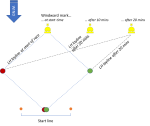
Here's a diagram. It's in the water-relative frame of reference we are discussing. The true (sailing, not ground!) wind is coming from the top of the paper, and the race (or cruise, makes no difference) starts directly to leeward of the windward mark.

Water-relative frame of reference.png

One competitor (Red) heads off on starboard tack and the the other (Green) on port tack at the same boatspeed (STW). So after a while, let's say ten minutes, they are equally far to windward but Green is to the RHS of the course compared with Red. However, by then the windward mark has drifted at the tide's speed to the right of the course. By the time either competitor reaches the mark it's drifted further to the right.

Red simply has further to sail towards the mark from the mid-course positions shown. So I'm not understanding how the statements in bold above can be true, where there's a tide running across the course.

Where am I going wrong?
 

Attachments

Last edited:
Top