True Wind - your definition.

When you use the term 'True Wind' do you typically mean:


  • Total voters
    126
??!

we’re discussing instruments not human sensory inputs!

You say true wind is best for detecting changes in atmospheric wind.
I respectively disagree and say ground wind is best for this.

Have you done any sailing?
 
Whether its a weather going tide or not has played a substantial part in when or if to make a passage or more than one occasion.

Sneaky little Grebe. :cool: You're deliberately mistaking Sea state induced by wind over tide for the two knots or so windspeed difference the current makes! If you're not I'd love to hear more detail.

It's the OP and his friends who want to redefine it as a kind of "wind on the seabed" that you without instruments cannot feel or see while sailing.

None taken! :nonchalance:


we’re discussing instruments not human sensory inputs!

Not sure we really are. This poll was just to find out which one people were referring to when they used one term: Specifically the one when you either factor tide into Ground wind or factor tide out of apparent wind. Personally, I don't care if people call it "Eric", I just wanted to know.

All of this was seemingly not worth mentioning when we were all trying to work out why Bramblemet was showing a different value to 3 yacht's MFDs, but critically important once there was the chance of a good old squabble! :D
 
Last edited:
No tide where I sail is the simple answer. :)

But yes, it's not 100% accurate in tidal areas but hopefully for most of us cruisers, most of the time, the wind speed and boat speed are such that the tidal induced error is not worth worrying about.

(I know that the Swellies surfers or the Corryvrecken whirlers will probably pile in now ..... but please relax and chill ;) )

Richard

I agree it's fine in the real world provided you understand what it's telling you.
But if somebody wanted your system to tell then 'ground wind' and they're excitable about the difference between that and true wind, they might be disappointed.
 
Never had a term for it. I'd probably have called apparent without the boat movement vectors. Or true wind with tide factored in.


In the recent Bramblemet under reading thread it would have been very important - but nobody mentioned it there. (Care to guess why?)

Other value. Well, I once sailed through the Sound of Sleet in a gale and took some comfort that for part of the day apparent windspeed would drop by 9kts. (Although it didn't because the funnel effect of the Mountains was far more than the tide.) I've occasionally been crossing the channel in light stuff and thought "When the tide changes we'll have 4kts extra wind and a lift assuming nothing else changes.".

Have I never made a sail change decision or a go-no go decision base on anticipated wind increased or reduced by tide? Nope.

Have I ever used Ground wind with tide factored in for tuning? Nope, and now I've thought about it and I'm surprised anyone else does. Apparent works better for comparative tuning because it ignores all the values you don't care about. Wind direction and speed and STW are the only factors that matter in boat speed. You'd go just as fast in a flat calm with a 10kt wind generated by 10kts of tide as you would at slack tide with 10kts of Ground wind. You just don't care.

My own planing is done with Ground Wind Forecasts which I never correct for tide and I've never known anyone correct forecasts for tide.

On the water I only care about apparent wind because that's all I can detect at the time. Yes it possible that if I'm the tide changes I'm going to get 4 knots change - but I won't because I'm very likely to be staying out of the tide if any component of it is against me - that's two knots difference. So something that I'm aware of but not something that would change my actions.

So far nobody has stated the "killer app" of factoring tide into ground wind (or factoring tide out of Apparent wind) I'd be interested to know. Everything stated so far has been unconvincing.

Thanks for the answer! You do realise that you gave that reply without once mentioning the word true?! Then go on to call the wind felt by a drifting observer apparent without boat vector or ground without tide vector . Bit of a mouthful, but I'd know exactly what you meant although I'd suggest something like awbv/gwtv rolls off the tongue more easily, but I'll defend your right to call it whatever you like - on your boat...

I'm glad that you mentioned tuning. Polar diagrams - almost always drawn with awbv/gwtv (evidently mis-labelled true). Very rarely with apparent. If you used ground wind in a polar diagram (and there was any current running) I'd love to be on board as you try to replicate it an hour or two later in tidal waters.
 
??!

we’re discussing instruments not human sensory inputs!

You say true wind is best for detecting changes in atmospheric wind.
I respectively disagree and say ground wind is best for this.

The post you replied to was about asking the question 'is there now enough wind for me to sail and turn the engine off?'
In as much as there's any real difference, true wind relative to the water is superior for answering that question, as that is what the sails will respond to.

It seems to me that answering this question is a big slice of what the cruising yachtsman wants from a wind speed instrument.
Another similar question is 'have we slowed down because my guests are sailing poorly, or is the wind dying?
 
I understand your need for true wind speed in this situation.

But I think I’d still prefer to know ground wind speed to know how atmospheric conditions are changing.

The post you replied to was about asking the question 'is there now enough wind for me to sail and turn the engine off?'
In as much as there's any real difference, true wind relative to the water is superior for answering that question, as that is what the sails will respond to.

It seems to me that answering this question is a big slice of what the cruising yachtsman wants from a wind speed instrument.
Another similar question is 'have we slowed down because my guests are sailing poorly, or is the wind dying?
 
Thanks for the answer!

So far nobody has stated the "killer app" of factoring tide into ground wind (or factoring tide out of Apparent wind) I'd be interested to know. Everything stated so far has been unconvincing. Sail changes? GO/No go decision?

Polar diagrams - almost always drawn with awbv/gwtv (evidently mis-labelled true). Very rarely with apparent.

They use apparent for the angle. Boats sail to the apparent wind. If the numbers are tested rather than calculated they must have converted the other way to start with. You have all the numbers required to convert the speed in Polars to apparent. Polars and tuning are a complete red herring in this.

I'm pretty convinced there's a huge chunk of Emperor's new clothes going on here. People are saying factoring tide out of apparent wind is essential. Nobody will say why. And the one time there was a thread on here where the distinction was critical nobody thought to mention it.
 
Imagine a large catamaran at a bend in a small river with a strong flow, if we had a log on each hull and one anemometer at the mast head, each hull would have a different "true" wind (in the instrumental sense of truth).

Is it valid to have two incongruous truths on the same boat?
 
I've lost the will to live opening up images to check, but I still think apparent for angle is pretty common. All academic since you can work out apparent from true. So no, you don't need awbv/gwtv on you boat for tuning purposes using polars.

Humour me with some other killer apps.


Nope, almost always awbv/gwtv. (True, to the faithful minority).

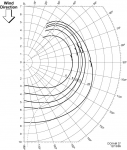
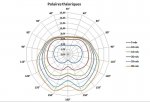
This is what they usually look like.

View attachment 67516

And here's one using apparent. Very odd.

View attachment 67517
 
I've lost the will to live opening up images to check, but I still think apparent for angle is pretty common. All academic since you can work out apparent from true. So no, you don't need awbv/gwtv on you boat for tuning purposes using polars.

Humour me with some other killer apps.
All vpp I've ever been involved in use true wind. Check out the wiki page https://en.m.wikipedia.org/wiki/Velocity_prediction_program
 
As apparent wind is dependent on boat speed how can your determine target boat speed using it? Excel would call this a circular reference.

I thought the whole point of the Polars is to tell you the speed. So you know boat speed & angle, wind speed & angle. Just add the boat vector to the wind vector and you've got apparent wind .

Btw I am not sure how you have decided my planning was based on sea state only...

I didn't, I hoped it wasn't and said "If you're not I'd love to hear more detail." to cover exactly that contingency.
 
Last edited:
I've lost the will to live opening up images to check, but I still think apparent for angle is pretty common. All academic since you can work out apparent from true. So no, you don't need awbv/gwtv on you boat for tuning purposes using polars.

Humour me with some other killer apps.

No. Polars are always TWS and TWA. They would not work as apparent as you’d be chasing your tail. And they’d be innacurate with ground wind. If you do not see that there could easily be a 5 knot difference in TWS with the same ground speed over a day’s Sailin somewhere like the Solent,, and that 5 knots is a big difference on a polar diagram... Using ground wind simply would not work for that. With a 10 knot ground wind and 2 knots of tide against it I’m sailing in 12. But if I’m using GWS to reference my polars I think I’m a genius because I’m looking at the speed I should be doing in 10 kts and beating it. Then the tide changed and I still have 10 kts GWS but now only 8 knots TWS. Why can’t I do the same speed as before? I’ve got the same wind...

So we use TWS as it’s the measure of the power available to your sails.

GWS is interesting, but as a tool to predict what might happen next, not now.
 
Oh, and my passage planner uses true wind polars and grib files to work out cts once it calculates the tides, so does iregatta, my BandG plotter and many more.
 
All of this was seemingly not worth mentioning when we were all trying to work out why Bramblemet was showing a different value to 3 yacht's MFDs, but critically important once there was the chance of a good old squabble! :D

Didn’t see that thread. But had I done so, then yes absolutely my answer would have been that you have to take the tide into account. I do a lot of racing in that but of water, and adjusting bramblemet readings with tide is standard practice when having the discussion a about what sails to have ready when we’re motoring out of the river.
 
I'd suggest something like awbv/gwtv.

Turns out back in 2013 Ben Ellison of Pambo fame wrote about this problem and suggested doing away with "True Wind" and replacing with:

Apparent Wind
Water Wind
Ground Wind

He claimed he was planning to use those terms from then on, not sure I remember if he's stuck to it or not.

I approve, a subjective term in a description like that is unhelpful.

Well worth a read, and the comments:

https://www.panbo.com/archives/2013/03/the_equinox_celestial_mechanics_pesky_true_wind.html

But that brings me around to a gripe I have about certain sailors and finally gets us to a point about marine electronics. Should a relatively small group of performance-oriented sailors get to define True Wind as relative to the surface of the water and not to True North. I don't think so!
Here's the story. If you have a wind display on your boat, it's quite likely that True Wind is calculated simply by subtracting your boat's Speed Through the Water (STW) from the Apparent Wind Angle and Speed sensed by the cups and vane on your mast. In other words, the motion of the water the boat is traveling through is not accounted for, which is why it's somewhat better termed True Wind relative to water. However, this value was not only much easier to calculate before GPS came along but it's also very useful for establishing performance benchmarks. Once you've learned that your boat can do, say, 7.5 knots with the full main and #1 headsail at a certain "True Wind" angle and speed, you can use your instrument to duplicate or maybe improve on the performance because the vagaries of current are not involved. But as useful and omnipresent as this form of "True Wind" is, it's not really True, is it?

Many earthlings naturally think of True Wind as relative to our planet -- just like True North, True Headings, and the lat/long system our charts are based on, not to mention the celestial mechanics I've been yammering about. And today true True Wind is relatively easy to calculate, being the difference between the COG/SOG vector and the Apparent Wind vector corrected to True Heading with electronic compass input. Dan, Johan, and I have been sparring over the details of this recently, which was part of my inspiration. A day isn't completely balanced without a wee rant.
At any rate, I don't expect to change any sailor minds on this subject, but it would be nice if some stopped insisting that their unnatural form of True Wind was the only True Wind.


EDIT: I've been reading the comments and WE GET A MENTION! Mr Pambo has heard of us:

And check out this forum thread over at YBW in the UK, where they fiercely thrash out the multiple definitions of True Wind:
http://www.ybw.com/forums/showthread.php?285023-Judging-true-wind-direction/page7
 
Last edited:
I do a lot of racing in that but of water, and adjusting bramblemet readings with tide is standard practice

The op in that thread also did a lot of racing in that bit of water. ...and he'd asked the crews of 3 other boats. ...and then he'd posted on YBW and got 22 replies and 1300 views. ...and nobody pointed out his cheese was a bit chalky.

adjusting bramblemet readings with tide is standard practice when having the discussion about what sails to have ready

It would be disastrous if you forgot to add that ~1kt on and started off with completely the wrong foresail! :D
 
It would be disastrous if you forgot to add that ~1kt on and started off with completely the wrong foresail! :D

indeed it would - we have a much liked but ageing number 2 which has our self imposed limit of 12 knots true. Looked after it will be useful for another 2 seasons, one race where we can avoid over stressing it but don't and it's goodbye. And I don't have the money to replace it.
 
Top