Trick to stop Topping Lift from Strumming

Leaving the halyard attached to the mainsail caused this catamaran to cartwheel. The force of the wind on the halyard broke the zip on the sailcover, then that force started to raise the mainsail - and it was game over for the cat.


You can see at 20-21 seconds how much of the mainsail is up. I never leave my halyard attached to the mainsail.
Was the mistake leaving it attached or relying on the sail bag zip? I do occasionally leave it attached - but it passes under the horns of a cleat and is tightened. If the winds were bad enough to rip sail bags I wouldn’t do that.
 
Says the man who presumably has never had a halyard break at sea. Or a failed sheave.
Do not presume sonny jim
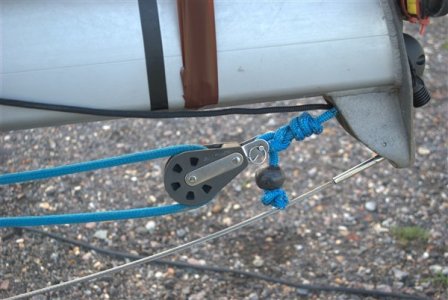
On holiday my halyard jammed under load so I solved it as shown
Halyard solution (600 x 402) (600 x 402).jpg
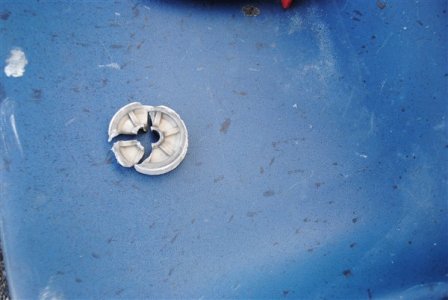
The reason it jammed was this - which you seem to think I have never experienced
Collapsed pulley2 - Copy (600 x 402).jpg
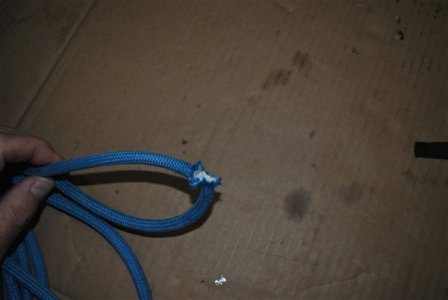
And this is what I was hanging on when I went up on a single line with no backup
I was up the mast for some time on a very hot day.
My son realising i might be about to faint lowered me down quickly & I took some time to recover
It nearly made me faint again when I had to pay £220 + VAT for a new halyard
I now back up with the spinnaker halyard
Halyard 2 (600 x 402).jpg
 
Last edited:
Leaving the halyard attached to the mainsail caused this catamaran to cartwheel. The force of the wind on the halyard broke the zip on the sailcover, then that force started to raise the mainsail - and it was game over for the cat.


You can see at 20-21 seconds how much of the mainsail is up. I never leave my halyard attached to the mainsail.
I do sometimes for a short stop, but I always loop it down under the ramshorn and tension it. If I forget it reminds me by slatting against the mast. I’m then up on deck either moving it to the after end of the boom or frapping it away from the mast.
 

You can see at 20-21 seconds how much of the mainsail is up. I never leave my halyard attached to the mainsail.

At about 28 seconds, a mast appears to be quickly shifting from 90° to c40° before coming into contact with an electrical wire. Given the Bayesian episode, I wonder what the story is there?
 
'thrum'

A new word for me. Learnt yesterday, thanks to Wordle.
‘Thrum’ normally applies to one of the two sexes of primroses, as in ‘thrum-eyed’, I think the female, however, it does seem to describe the sound of a topping-lift in the wind rather well.

The reason, of course, why one never hears it while sailing is that it is normally slack, and the reason why it doesn’t make a nuisance of itself against the sail is that it gets blown away from the sail in anything from a reach to windward. In my experience, it is not strong winds that make it vibrate but actually quite light airs, that can make it the more puzzling until you work out what is going on.
 
Do not presume sonny jim
On holiday my halyard jammed under load so I solved it as shown
View attachment 195163
The reason it jammed was this - which you seem to think I have never experienced
View attachment 195164
And this is what I was hanging on when I went up on a single line with no backup
I was up the mast for some time on a very hot day.
My son realising i might be about to faint lowered me down quickly & I took some time to recover
It nearly made me faint again when I had to pay £220 + VAT for a new halyard
I now back up with the spinnaker halyard
View attachment 195165
Forgive my assumption. But you did ask 'why would anybody want a spare halyard'. You seem to already know the answer.
 
Unless you have a Boom Crutch ( whats one of those?) you will often hear your topping lift humming as it is bearing the weight of your boom with tension also from mainsheet and kicker. The cause is turbulence in the wind passing over the halyard causing cavitation and thus vibration.

Slackening tension in the main sheet can reduce the resonance but at the cost of the boom slopping around in any rolling motion.

I have found a trick to damp the resonant frequency.

Support the boom and let off the topping lift to the maximum that your halyard allows at the mast. With a good hank of topping lift to hand simply wrap a spiral of 4mm cord around the topping lift maybe 20 turns or so extended down from the highest point accessible to the point of attachment to the boom securing both end with an appropriate knot or cable tie. Re-rig top the boom and enjoy a quiet glass of wine

The effect is dramatic.
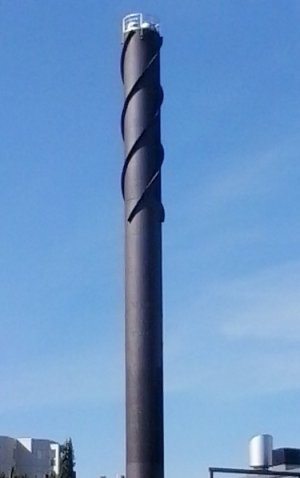
Not cavitation. It's "vortex shedding". Here's the solution for towers/stacks, which you've replicated on the topping lift.

vortex tower.jpg

I did similar to reduce noise from our cap shrouds, by wrapping some thin twine around them. A good suggestion for the topping lift - hadn't thought of that!
 
My boat being a cat I 'attach' the boom to a back stay and then the main sheet at an angle to pull it away. Stops the boom swinging all over the place, keeps it clear of the solar panel and means a lot less tension required on the mainsheet and therefore topping lift.
 
Top