Trailed Logs: What to look for

Simple. It's because the pleasure and relief of a satisfactory landfall achieved by dead reckoning and compass fixes is worth a 1000 times what you get when the GPS tells you that you're there. If you've only ever navigated with GPS, you don't know the joy that you are missing.
Hmm, well, I respect your view as I think you have far more experience than I, but when sailing out of Whitby on the NE coast I regularly crossed to Holland during the 1970s, some 250NM, give or take. Once, with light SE head winds, it took me 4 days. Four days of being swept up and down the North Sea by tides and arriving on a low featureless coast without a clue where I was despite all possible DR calculations. I always aimed high so knew to turn right on seeing land and sailing until seeing something to identify or it got dark enough to show the lights.

Astro was out because it was usually 100% cloud cover, RDF possible but a bit vague ... Knowing one's position accurately and therefore where any potential danger lies is a fundamental safety factor. Yes, a sense of achievement, but I can do without the stress - give me GPS any day.
 
Last edited:
I'm sure I'll be accused of being an ignorant heathen, but I can't understand this fascination with trailed logs. They're inconvenient and inaccurate, so why bother? The GPS will tell you very precisely how far you've travelled, which surely is the essence of what you want to know.

Not a heathen, but you might be accused of not having read even as far as the second sentence in the OP's post :)

Pete
 
On ocean passages the difference in behaviour of the through hull log is inconsequential for two reasons. First, for long distance a log speed is not required just use a GPs for position every few hours. Second, most ocean passages including the Atlantic are downwind, the only tacking you need to do is the short upwind bit to the anchorage/marina on the lee side of the island you choose to make landfall.

You mention not having a GPS, I would strongly suggest you fit a GPS and have a handheld as backup every other long distance boat does, so why make life difficult. One other thought it has been known for sharks to bite off towed logs, thinking they are fish, which would leave you with nothing.
 
Hmm, well, I respect your view as I think you have far more experience than I, but when sailing out of Whitby on the NE coast I regularly crossed to Holland during the 1970s, some 250NM, give or take. Once, with light SE head winds, it took me 4 days. Four days of being swept up and down the North Sea by tides and arriving on a low featureless coast without a clue where I was despite all possible DR calculations. I always aimed high so knew to turn right on seeing land and sailing until seeing something to identify or it got dark enough to show the lights.

Astro was out because it was usually 100% cloud cover, RDF possible but a bit vague ... Knowing one's position accurately and therefore where any potential danger lies is a fundamental safety factor. Yes, a sense of achievement, but I can do without the stress - give me GPS any day.

I've done those N Sea crossings in the dead reckoning days, and it was always a bit of a surprise when you worked out where you were.

There's no doubt that GPS takes the stress out of it; but it has also stolen a little of the satisfaction as well. That said, my GPS is on most of the time but, like you, I do know what I am missing. And I agree, it wasn't alway good. But when it worked it was wonderful.
 
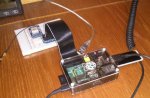
nmeaap.jpg

One of my 5 sources of GPS on board. This is an adafruit ultimate GPS connected to a raspberry pi which acts as a wireless access point and is distributing position data via IPv4 and IPv6 TCP servers and IPv6 multicast. This GPS also outputs a PPS signal and on my "to do" list is using it to create a pleasingly accurate NTP server.

Made up statistics suggest that 93% of people find the ability to name the next star of interest to become visible as the light fades as more romantic than the ability to name the current offset between GPS time and UT. Being short on natural charm I need all the help I can get and practice makes perfect.

I do normally record GPS position in the hourly log. I just plan on doing at least one ocean voyage where I don't (though I may encourage other crew to make a secret note of it at regular intervals)
 
Last edited:
You mention not having a GPS, I would strongly suggest you fit a GPS and have a handheld as backup every other long distance boat does, so why make life difficult. One other thought it has been known for sharks to bite off towed logs, thinking they are fish, which would leave you with nothing.

No, it would leave you with the log unit, to which you would attach one of your spare log lines. It may be hard to believe, but people actually managed to navigate before chartplotters.
 
Trail logs were supplied with a few spare spinners to allow for the odd shark taking a fancy ! My antique Walker log has a few spares presumably for this reason. :)

Trail logs ought to be standard kit even nowadays, SOG is very well and good but serious navigators need SMG through the water as well to judge the tide.:)
 
I use a wasp log. It seems reasonably accurate and good for maximising speed through the water which is good for a small slowish boat like mine. Nothing has eaten the spinner as yet. Below a certain speed it stops, twiddles the string up then spins like crazy but still seems to give good distance measurements.
 
I bought a Stowe off Ebay for about £20, and its proved reliable and reasonably accurate.
It can just be seen at the foot of this image, one of the few taken looking aft!.

IMG_5125_zps03c1ebed.jpg


I tie the trailing cable onto a short string to the pushpit. The unit is mounted on same timber that holds the outboard.

Like others every day I meet others and am trailing a log I get a shout "You're trailing a rope mate!".
Its a good idea to remember to take it in before motoring in reverse!!
 
Tip for launching & recovery. I have a plastic ball attached to the string close to the meter end. It makes it really easy to see the string spinning from a distance & they do get fouled with weed some times. I also have a short cord with a small clip on the end. This I use to clip the meter to the boat as for safety while it's in use.

So to launch flake out the cord. Clip on to the meter & then pay out the cord in a long loop. Launch the spinner only after all of the cord is out in a long loop. That way, if you get a knot, there isn't a spinner spinning away & making it worse while you sort out the knot. They do happen.

To recover, this is where the plastic ball & the short cord with the clip come in. Clip the clip over the spinner cord aft of the ball. Then what ever happens, you can't lose the cord & spinner. Then disconnect the spinner cord from the meter & stream it backwards pulling in the spinner. Once the cord is completely reversed, you have the spinner & any twists in the cord spin out. Then pull in the cord & coil it. If you just try to pull the spinner in, it will spin enough times before you get to it, so you have a completely twisted up knot of cord.
 
Tip for launching & recovery. I have a plastic ball attached to the string close to the meter end. It makes it really easy to see the string spinning from a distance & they do get fouled with weed some times. I also have a short cord with a small clip on the end. This I use to clip the meter to the boat as for safety while it's in use.

So to launch flake out the cord. Clip on to the meter & then pay out the cord in a long loop. Launch the spinner only after all of the cord is out in a long loop. That way, if you get a knot, there isn't a spinner spinning away & making it worse while you sort out the knot. They do happen.

To recover, this is where the plastic ball & the short cord with the clip come in. Clip the clip over the spinner cord aft of the ball. Then what ever happens, you can't lose the cord & spinner. Then disconnect the spinner cord from the meter & stream it backwards pulling in the spinner. Once the cord is completely reversed, you have the spinner & any twists in the cord spin out. Then pull in the cord & coil it. If you just try to pull the spinner in, it will spin enough times before you get to it, so you have a completely twisted up knot of cord.

How did you attach the plastic ball to the string then? Any chance of a piccy?
 
Used a stowe trailing log for many years far more reliable than my current st60 paddle wheels however I did run over the trailing wire after forgetting to pull it in whilst anchoring. I ended up with a join that I had to tie to take the load, I always used to say that this gave me an extra knot!
 
Thanks for all for advice and also for Tranona's posts making me think about accessibility from the cockpit, as I have a centre cockpit boat. I wouldn't ask crew alone on night watch to leave the cockpit to read the log. Hopefully this is not a show stopper. Over the course of a long passage I should get a better idea of how the through hull log behaves by comparing it to a trailed log. Course alterations while I'm off watch should hopefully not be the norm and if they are occasionally necessary then noting course changes and approximate/relative speed (from the through hull) in the log book should give some indication of estimated position until the log can be safely read again.
 
Top
