Touching pos & neg of battery

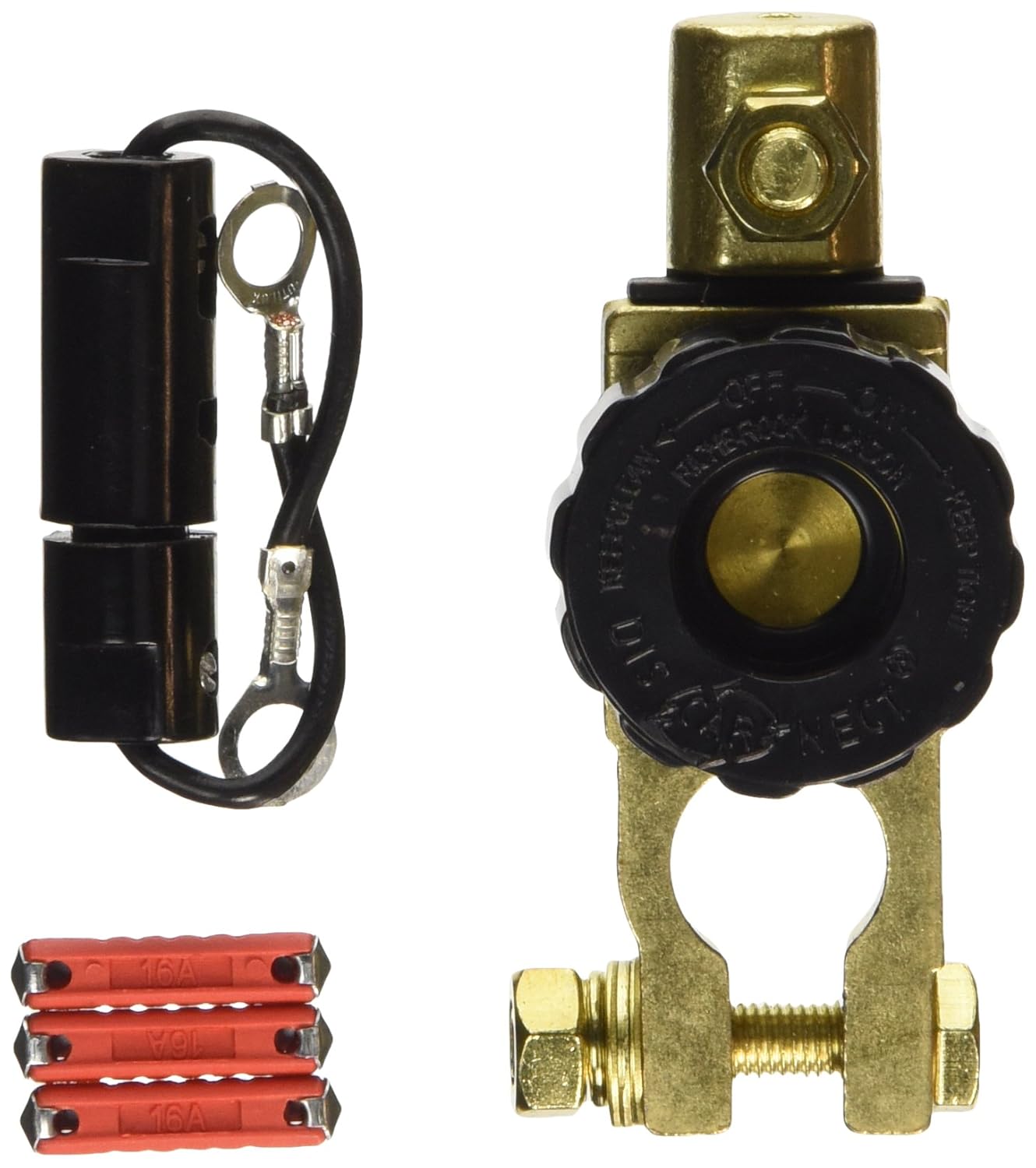
I use a "Dis-car-nect". A tenner from Amazon: https://www.amazon.co.uk/Richbrook-1000-01-Discarnect-Immobiliser-Battery/dp/B0019ULCPW

71AcDhqr3iL._SL1500_.jpg


The fused link is so that you can keep clocks, alarms and so on running while the battery is disconnected for high currents. An anti-theft device, basically. I've never bothered with that bit.

Those fuses are terrible. I had an East German motorbike when I was a student, I learned the hard way that you can't trust those fuses.
 
As children do, we used to lick the 9v batteries that cycle headlamps used, it gave a sharp tingling, i wonder what would happen if you connected two wires to a 12v battery and licked that, its only 3v more after all, could someone try it and post the results please.

One of our staff, a bit of a joker, just persuaded another one to lick the ends of an 18v lithium drill battery...

They are both in their fifties!
 
Sometimes hard to tell on PBO Richard :)

It's certainly fair to say you won't get fried by touching the terminals of a 12v car battery, but it definitely is possible to get a shock, in the way you get a shock by sticking your tongue on a small battery, rather than getting hurled across the room and dying a horrible death.

I was somewhat surprised to get a couple of 24v shocks on one boat in the Summer, i've been in situations where there have been 240v earth leaks (pre-RCD days) and people have complained about getting shocks from the wall, where i could not feel them.

I have on occasion had 12 V shocks. Probably when I had damp salty and cut hands. Though I have handled it less I have had 24 V shocks and they are noticeably more unpleasant.

But one day I was doing some arc welding in the rain (No H&S elves back then) and got an *80 V shock... That threw me across the yard!

I guess that is why 110 V was chosen for site electrics as it may be a sub-lethal voltage (& hence current)?

* At least the welder was meant to only be putting out 80 V...
 
I have been fiddling with 12 v circuits on cars and boats for most of my life and never felt a thing. But I was helping to rescue a boat that was flooding once, and had taken some pumps and batteries out. Working to connect the 12 v pump I was surprised to get a quite distinct tingle from the 12 v battery. A second 24 v pump gave me quite distinct jolt. I was quite er , shocked! We had been bucket bailing as well so my hands and the connectors were all well soaked with brine. We managed to refloat her and get her beached for temporary repairs.
 
I guess that is why 110 V was chosen for site electrics as it may be a sub-lethal voltage (& hence current)?

Site electrics are actually 55V two-phase, using a centre tap on the transformer secondary. You get 110V across equipment, but only 55V to ground, which enormously reduces the risks.

Likewise the US mains supply is 110V two-phase, so their heavy appliances, like cookers, can run on 220V across both phases.
 
The bad shock I experienced was when working on a car engine I lent on the engine and accidentally on the poss terminal of the battery at the same time.
I can't remember if my hands were wet or not but the shock threw me onto the floor and with a burn on the hand that had touched the battery.
On many other occasions I have touched both battery terminals with no ill effects at all.
 
The bad shock I experienced was when working on a car engine I lent on the engine and accidentally on the poss terminal of the battery at the same time.
I can't remember if my hands were wet or not but the shock threw me onto the floor and with a burn on the hand that had touched the battery.
On many other occasions I have touched both battery terminals with no ill effects at all.

12v DC wouldn't do that under any circumstances. You must have touched the distributor or an HT lead.
 
Those fuses are terrible. I had an East German motorbike when I was a student, I learned the hard way that you can't trust those fuses.


What's wrong with them? Aren't they the standard type of fuse on every motor vehicle currently manufactured? Or are you referring to the fuse holder?
 
What's wrong with them? Aren't they the standard type of fuse on every motor vehicle currently manufactured? Or are you referring to the fuse holder?

Those fuses were used on the likes of Montegos, Maestros and other such lovely cars back in the 70s and 80s. They are called continental fuses (or Bosch fuses) and they were rubbish. Twas a regular thing to take the lid off of the fuse box and run ones thumb across them, causing them to spin and make contact, for a few days.

Modern cars almost exclusively use blade fuses, i about 4 different styles/sizes. I often fit the "standard" blade fuse boxs to boats, they are cheap, but extremely reliable.
 
Last edited:
Those fuses were used on the likes of Montegos, Maestros and other such lovely cars back in the 70s and 80s. They are called continental fuses (or Bosch fuses) and they were rubbish. Twas a regular thing to take the lid off of the fuse box and run ones thumb across them, causing them to spin and make contact, for a few days.

Modern cars almost exclusively use blade fuses, i about 4 different styles/sizes. I often fit the "standard" blade fuse boxs to boats, they are cheap, but extremely reliable.

Thanks. My memory is suitably jogged :o
 
12v DC wouldn't do that under any circumstances. You must have touched the distributor or an HT lead.

Frankly I don't really care if you believe me or not. The engine was not running at the time so no HT contact.

As it was, I was there and you were not. You have no right to contradict me.

If you want you can come and examine the scar on the palm of my hand, still there after nearly forty years.
 
Frankly I don't really care if you believe me or not. The engine was not running at the time so no HT contact.

As it was, I was there and you were not. You have no right to contradict me.

If you want you can come and examine the scar on the palm of my hand, still there after nearly forty years.

I don't need to be there to know that twelve volts DC cannot cause an injury. The acid in a 12V accumulator can cause serious burns, and the current from a 12 battery can heat up a wire and inflict burns, and that's about all. The current alone cannot cause injury, even through wet flesh.
 
I don't need to be there to know that twelve volts DC cannot cause an injury. The acid in a 12V accumulator can cause serious burns, and the current from a 12 battery can heat up a wire and inflict burns, and that's about all. The current alone cannot cause injury, even through wet flesh.

I would agree with Elton that 12v could not do that directly, which leaves the question of what actually caused your accident Samyl. Something quite out of the ordinary happened to throw you to the floor and leave a permanent scar. It is though exactly what would happen if you were holding a tool or other piece of metal which touched earthed metal as well when you leaned on the + terminal, making it red hot causing the burn. with an instinctive body reaction to the pain throwing you to the floor. Heating happens very quickly specially with a light tool like a small spanner or screwdriver
 
I would agree with Elton that 12v could not do that directly, which leaves the question of what actually caused your accident Samyl. Something quite out of the ordinary happened to throw you to the floor and leave a permanent scar. It is though exactly what would happen if you were holding a tool or other piece of metal which touched earthed metal as well when you leaned on the + terminal, making it red hot causing the burn. with an instinctive body reaction to the pain throwing you to the floor. Heating happens very quickly specially with a light tool like a small spanner or screwdriver
Capacitor discharge?
 
Top