Touching pos & neg of battery

Frankly I don't really care if you believe me or not. The engine was not running at the time so no HT contact.

As it was, I was there and you were not. You have no right to contradict me.

If you want you can come and examine the scar on the palm of my hand, still there after nearly forty years.

The back emf from an inductive load being switched off can give you quite a jolt. The engine wouldn’t have to be running.
 
The bad shock I experienced was when working on a car engine I lent on the engine and accidentally on the poss terminal of the battery at the same time.

Was the engine running? The LT side of the coil can easily spike to 90V, particularly if the capacitor (in a traditional distributor) is on its way out. Same principle as a "joy buzzer".
 
I cannot understand why it should happen. I have applied all my physics learning to every possible scenario but I cannot come up with any logical explanation. I have worked on engines all my life with motorbikes, cars, vans, boats etc but only been injured this once by a shock other than HT.

No, the engine was not running and there were no tools or other bits of metal involved to heat up. It was a high capacity battery in an old Morris Oxford - if any of you remember what that was.
 
I seem to have done several of the "gotchas" mentioned in the various posts, though I don't wear rings or metal watchstraps, so I've been spared what, knowing my luck, would for sure have happened if I did.

12V on tongue. Ooh yes. I had a model railway set as a kid - the sort where the power supply connections had two prongs (1 short and 1 long) that slipped under the rails of the track. How could I resist putting both electrodes on my tongue and turning up the controller to see what I could take?

Wire-stripping with teeth. I pretty well instantly cured myself of this habit when one one occasion I saw the connection to the wall-socket still switch on when the cable was a few inches away from my mouth.

Ignition cables: riding a Triumph T90 though heavy rain wearing flared jeans (it was the 70s, don't blame me too much). The wind from the starboard side kept flapping the wet cloth against the poorly insulated suppressor cap. Current path: up leg and thankfully through wet seat via inner thigh, not gonads.

High voltage kit: An ion-beam thinner when I was a research student: 20kV but thankfully not much current capacity: via hand and the rest of me to the lab floor.

And before all that: Nasty noises from the kitchen when I was about 8, proving to be my dad unable to let go of an electric drill that must have developed a live-to-(metal)-case fault. I had the good fortune - I'd like to think it was presence of mind but more likely blind luck - to not touch him but to just switch the drill off at the mains. That's why we have RCD protection these days!
 
I can't believe the timing of this thread... Last week I was taking out the battery from my rib using my trusty Chrome Halfords lifetime warranty combination spanner. Yep...you guessed it. as I was undoing the negative bolt , the spanner also touched the positive. The spanner welded in place and within two seconds it was cherry red,within 5 seconds it was bright orange. I kicked it off the battery with a screwdriver and threw it on the ground. I shouted to my mate. It took him 20 secs to come over. It was still cherry red! The spanner is now s shaped and a blue colour. You have been warned.!!! Should I bring it back to Halfords? Nik
 
I can't believe the timing of this thread... Last week I was taking out the battery from my rib using my trusty Chrome Halfords lifetime warranty combination spanner. Yep...you guessed it. as I was undoing the negative bolt , the spanner also touched the positive. The spanner welded in place and within two seconds it was cherry red,within 5 seconds it was bright orange. I kicked it off the battery with a screwdriver and threw it on the ground. I shouted to my mate. It took him 20 secs to come over. It was still cherry red! The spanner is now s shaped and a blue colour. You have been warned.!!! Should I bring it back to Halfords? Nik

I don't think Halfords have these:

https://www.tester.co.uk/media/cata...9021ff0b5a/t/o/totally-insulated-spanners.jpg
 
Was the engine running? The LT side of the coil can easily spike to 90V, particularly if the capacitor (in a traditional distributor) is on its way out. Same principle as a "joy buzzer".
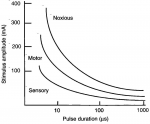
12V is plenty if correctly applied.

For TENS (Transcutaneous Electrical Nerve Stimulation);
- Body resistance is given as 150R to 500R using typical sticky pads. (Not via the hands though, pads are usually fitted over the muscle group to be stimulated.)
- Seen as a load, the body looks capacitive, which is why TENS machines use AC.
- Stimulation depends on current density, current and pulse duration. As a rough guide, for a 100us pulse;
* Feel it above 30mA.
* Muscle motor effect above 50mA.
* Painful above 70mA.

Given that;

12V / 500R = 24mA
12V / 150R = 80mA
There are muscle groups in the hands.

Then;

Contact via the hands must usually present a much higher resistance.

Also;

The apparent capacitive nature of the body when seen as an electrical load at these voltages is due to biological changes which are reversed when the current reverses.
Since a 12V battery isn't AC, the current on initial contact will quickly fall.
In order to stimulate a muscle, the skin contact region must result in a current path through the muscle nerve fibres at a high enough current density.

So;

Quite a lot of conditions need to be met in order to stimulate a muscle with a 12V battery.
It can happen, but not very often.
Seems to fit the observations here.

Capture.PNG
 
Last edited:
There's a well known "party trick" of dropping a big lump of wire wool across the top of a battery. Once you've seen that you'll always make sure batteries are properly covered or boxed.

Wire wool will glow like an electric fire with a 9v PP3 battery never mind a 12v lead acid battery!!!
 
It used to be great sport when we were finished testing ROV tether cables with 1000VDC meggers, then hand the bared end to 'the' trainee who'd get a 'jolt/buzz' off of it from capacitance. Utterly outlawed now of course, but was a very effective training tool to ensure he'd not grab a bare end without thinking again!
 
What is "R"? :confused:

Richard

It's electronic notation for Ohms. The letter is placed where the decimal point would be and the letter denotes the multiplier.

EG

500R = 500ohms

50R1 = 50.1ohms

2k7 = 2.7k ohms

27k = 27k ohms

5m1 = 0.0051 ohms

and so on......
 
12V is plenty if correctly applied.

For TENS (Transcutaneous Electrical Nerve Stimulation);
- Body resistance is given as 150R to 500R using typical sticky pads. (Not via the hands though, pads are usually fitted over the muscle group to be stimulated.)
- Seen as a load, the body looks capacitive, which is why TENS machines use AC.
- Stimulation depends on current density, current and pulse duration. As a rough guide, for a 100us pulse;
* Feel it above 30mA.
* Muscle motor effect above 50mA.
* Painful above 70mA.

Given that;

12V / 500R = 24mA
12V / 150R = 80mA
There are muscle groups in the hands.

Then;

Contact via the hands must usually present a much higher resistance.

Also;

The apparent capacitive nature of the body when seen as an electrical load at these voltages is due to biological changes which are reversed when the current reverses.
Since a 12V battery isn't AC, the current on initial contact will quickly fall.
In order to stimulate a muscle, the skin contact region must result in a current path through the muscle nerve fibres at a high enough current density.

So;

Quite a lot of conditions need to be met in order to stimulate a muscle with a 12V battery.
It can happen, but not very often.
Seems to fit the observations here.

View attachment 74799

What conductive goo is on the pads? How does it compare to sea water?
Why are you measuring capacitance on Ohms?
What would the capacitance be for the sticky pads placed each side of a bit of paper?
from your graph
10uS equates to 100kHz effectively RF, things are very VERY different at RF
while the other end 1000uS is a mere 1kHz, still significantly different from DC or even mains.,

Yes, these are pulses and an initial contact MAY be equivalent to the leading edge of a pulse, but that would require the victim to perform a significant electronic test of the input signal to determine the shape of the leading edge: was it a quick, firm contact or was it more a slow brush?
 
What conductive goo is on the pads? How does it compare to sea water?
Why are you measuring capacitance on Ohms?
What would the capacitance be for the sticky pads placed each side of a bit of paper?
from your graph
10uS equates to 100kHz effectively RF, things are very VERY different at RF
while the other end 1000uS is a mere 1kHz, still significantly different from DC or even mains.,

Yes, these are pulses and an initial contact MAY be equivalent to the leading edge of a pulse, but that would require the victim to perform a significant electronic test of the input signal to determine the shape of the leading edge: was it a quick, firm contact or was it more a slow brush?

In order then:-
I believe it's a saline based goo. I don't know for sure.
I'm not. The figures are for the initial body resistance.
I could calculate it but it's not relevant. The body behaves like a capacitive load. The pad/skin connection is resistive.
It's a medical research graph, it isn't mine.
No it isn't RF. 10us is the pulse width, not the pulse repetition rate which I didn't mention previously but is in the 5Hz to 300Hz range.

Current density through muscle tissue and pulse width are what cause muscles to be stimulated.
 
Last edited:
It's electronic notation for Ohms. The letter is placed where the decimal point would be and the letter denotes the multiplier.

EG

500R = 500ohms

50R1 = 50.1ohms

2k7 = 2.7k ohms

27k = 27k ohms

5m1 = 0.0051 ohms

and so on......

I'm familiar with the k and m convention replacing the decimal point and familiar with R representing resistance but I have never heard of "R" as a direct replacement for "ohms".

Can you provide a web reference to this R convention?

Richard
 
I'm familiar with the k and m convention replacing the decimal point and familiar with R representing resistance but I have never heard of "R" as a direct replacement for "ohms".

Can you provide a web reference to this R convention?

Richard

Some people will tell you R actually stands for 'Radix', meaning in this context 'decimal point'.
So 2k2 is 2200, 2R2 is 2.2
R01 is 0.01
10R is just 10, but the system doesn't do blanks.
You could use a '.' but their hard to see in the type size used on small parts.
It's part of the series G, M, k, R, m, u, n, p.
You can have an R10 inductor which would be 100mH not 100mohms.
But the literal meaning of radix seems to be different?
Maybe it's a word like radix? but not exactly that?
 
I'm familiar with the k and m convention replacing the decimal point and familiar with R representing resistance but I have never heard of "R" as a direct replacement for "ohms".

Can you provide a web reference to this R convention?

Richard

Can't think when I last saw a schematic circuit diagram with an omega symbol for ohms.

It's known as the RKM code and was defined in standards in 1952.
https://en.wikipedia.org/wiki/RKM_code
 
Top
