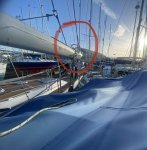
Topping Lift

Would they pass over the same sheave?
My 2 sheaves at the top of the mast are identical. I would imagine both are.
As for getting back a lost halyard I would then use the new one to go up the mast to collect the errant halyard. However, the chances of losing it in the first place is remote because I do not disconnect it from the sail, except at season end on the hard. I cannot understand the habit some of those who disconnect the halyard after every sailing trip.
 
My 2 sheaves at the top of the mast are identical. I would imagine both are.
As for getting back a lost halyard I would then use the new one to go up the mast to collect the errant halyard. However, the chances of losing it in the first place is remote because I do not disconnect it from the sail, except at season end on the hard. I cannot understand the habit some of those who disconnect the halyard after every sailing trip.
I obviously didn't explain my confusion.
If you pull a new halyard into the mast using the topping lift, how do you re-reeve the topping lift?
 
Maybe I am doing things wrongly, once I get the sail hoisted, I take the topping lift and tie it to the pushpit.

It can be swapped in 5 minutes should I lose the main halyard. It is really only used when the boat is moored.

My TL is an original steel halyard connected to a winch on the mast and is extended with a few meters of 10mm double braid and some heavy bungy cord.
 
Mine was old 3 strand. My boom is extremely heavy. Was always a little concerned one day it might snap and injure someone when motoring.
Upgraded to 12mm as it could make a perfect halyard for the main if the steel cable ever snaped. I use the stainless cable to haul up and tension my mast ladder. The 12mm topping lift now fits my climbing/safety gear as a safety line. Can play silly buggers on a nice day with a fender seat swung out over the end of the boom for water sports and can use it as a strong Derek.
 
My topping lift is a fixed wire, joined to a rope inside the boom via some fiendish pulley system inside the boom and then back to the cockpit. No replacement without unrivetting the boom end. Avoid that one.

Take care if going up the mast on a topping lift as some are on relatively light blocks rather than proper halyard sheaves.

Some boats remove the main halyard and fasten it to the boom end as a topping lift especially with a boom strut. That's not my favourite system either...

My mizzen has a good old fashioned topping lift plus a spare halyard. That works well and as per other posts never causes trouble as each has its own cleat.
 
My first boat had a topping lift that was fixed at the mast head. At the boom end was a small block & tackle. This had a cam cleat. I could just reach up & trim the length very easily & I quite liked it.
I cannot imagine it working on my current boom with a 64 M2 mainsail, but on a 26 ft boat with solid wooden mast it worked well.
 
Another use of the topping lift is to scandalise the main. Very useful at times. Easy, but noisy, way to lose drive in a hurry.
In all the years I have been sailing I have never felt the need to scandalise the main. Even if I did the vang would limit the upward movement of the boom. Perhaps old gaffers etc may have found this part of the art; but on a modern bermudian rig with, or without, a fully battened sail, lazy jacks & sail bag system etc -- Not really.
Press the start button, lean forward in the cockpit, flip the halyard clutch, check the rope runs freely & watch the sail drop gracefully into the bag, is probably the modern equivalent.
 
In all the years I have been sailing I have never felt the need to scandalise the main. Even if I did the vang would limit the upward movement of the boom. Perhaps old gaffers etc may have found this part of the art; but on a modern bermudian rig with, or without, a fully battened sail, lazy jacks & sail bag system etc -- Not really.
Press the start button, lean forward in the cockpit, flip the halyard clutch, check the rope runs freely & watch the sail drop gracefully into the bag, is probably the modern equivalent.
Quite so. We used to do it on the Broads for practice and fun but I have never done it since. For manoeuvring under sail I would be more likely to drop the main and use the jib furler to control the speed.
 
In all the years I have been sailing I have never felt the need to scandalise the main. Even if I did the vang would limit the upward movement of the boom. Perhaps old gaffers etc may have found this part of the art; but on a modern bermudian rig with, or without, a fully battened sail, lazy jacks & sail bag system etc -- Not really.
Press the start button, lean forward in the cockpit, flip the halyard clutch, check the rope runs freely & watch the sail drop gracefully into the bag, is probably the modern equivalent.

In forty years with two successive gaff cutters I did it perhaps twice - you set up the weather topping lift and ease the peak halyard. Only really useful if you are reaching too fast.
 
Off topic, it’s fun to see fashions follow a cycle. My father’s 35ft boat had a loose footed Bermudian mainsail in the early 1950s. She didn’t have an engine or electric light but she did have a loose footed mainsail.

Kukri has a loose footed bermudian mainsail - I could trice up the tack!
 
In Mytica, experimentally, yes. Mirelle has roller reefing.
You very often see it in old paintings of fishing boats but the other day, in a TV documentary about Monet, they showed a painting of yachts racing and one had its main triced up. Perhaps waiting for the start.
 
Off topic, it’s fun to see fashions follow a cycle. My father’s 35ft boat had a loose footed Bermudian mainsail in the early 1950s. She didn’t have an engine or electric light but she did have a loose footed mainsail.

Kukri has a loose footed bermudian mainsail - I could trice up the tack!
Mine is loose-footed too and I have thought of trying it; just to see what happens.

I would have to do it when my wife is below having a snooze: she gets uneasy when I start trying things to see what happens!
 
Top