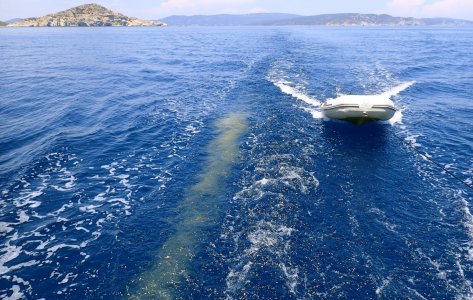
Top tip re towing your dinghy

Another top tip, Tie a bridle to the D rings which are normally fitted lower down than the handle, and tow with a rope attached to that. Retain the painter attached to the handle but very slightly looser as a secondary / safety rope.

Oh and remember / look behind before engaging engine in reverse :-)

PS. Must have been some curry!
 
Another top tip, Tie a bridle to the D rings which are normally fitted lower down than the handle, and tow with a rope attached to that. Retain the painter attached to the handle but very slightly looser as a secondary / safety rope.

Oh and remember / look behind before engaging engine in reverse :-)

PS. Must have been some curry!
That was a charter boat, and I have set my own dinghy up with the bridle arrangement so if something came undone on the dinghy, I've got a second line there.
 
Two tips, use a long line so it lays flatter in the water, less drag. Second tip, secure to cleat on opposite side to black water tank outlet ;)

View attachment 204909
This reminded me of a conversation had between myself and my wife just off of a Greek port, just after I'd opened the holding tank seacock:

Me: 'Missus; what have you been eating???'
Missus: 'F**k off'...
 
I have towed a dinghy for years, the only time it needs to be at a distance is in a big following sea when it surfs down the waves and tries to head butt the transom of your boat. Apart from that someone tacking down a narrow channel will probably not see the painter and try to get in between. You know what they are like, they try to miss you by a couple of meters if they can.
 
I have read, and tried to achieve, that a painter should keep te dinghy just in front of the peak of the second or third stern wave so it's always going downhill and not causing drag. I can see the logic but my own observations are not convincing. And why not the first wave? I can't remember the source for this nugget.
 
My towing tip for inflatables is not to rely on the painter that comes with it. At least two of mine had a kind of white string which was slippery enough that knots couldn't be relied on.

Oh, some Muppet didn't tie his dinghy on properly.

Oh, that's odd, looks like the same model as mine

Oh...
 
I have twice had painter fittings on inflatables come adrift - not painter breaking but whole ring attachment coming off dinghy tube. Once on an elderly Waveline and once on a near-new Quicksilver. My boat and my dinghies, but boat in use on charter at these occasions. I really avoid towing dinghies after once being hit in cockpit by a complete very wet Avon - this was downwind in a bit of a blow. It did save lifting it aboard to deflate it.
 
mmmmmmm first thoughts ... what are you doing with an inflatable on such a long painter ?? Inflatables should be hauled up against transom - to stop them flipping over in seas. Hard dinghys are towed on long painters.

Therefore I call into question the OP's 'top tip' ..... :eek:
I only copy others as it seems to work for them. This is after a decade chartering multiple times in Greece, Croatia, Gibraltar, BVI, Bahamas & the Whitsundays.

If you haul the dinghy up to the transom, the stern & motor leg digs into the water at a steep angle introducing a lot more drag. The gel coat will also get scuffed/scratched if the tender was banging up against the stern all the time. Personally, I've never had an inflatable dinghy flip even in larger seas of up to a half a metre. Any bigger seas/winds, we stay in port or stow the thing on the foredeck.

I'm looking at upgrading our own 3D to a hard hull rib type but then I'd need davits for storage.
 
mmmmmmm first thoughts ... what are you doing with an inflatable on such a long painter ?? Inflatables should be hauled up against transom - to stop them flipping over in seas. Hard dinghys are towed on long painters.

Therefore I call into question the OP's 'top tip' ..... :eek:
My thoughts exactly. The pull on the line is dramatically reduced when I do that.
 
I have read, and tried to achieve, that a painter should keep te dinghy just in front of the peak of the second or third stern wave so it's always going downhill and not causing drag. I can see the logic but my own observations are not convincing. And why not the first wave? I can't remember the source for this nugget.
I believe that 2 waves back was the old seamanship rule - but back in the days of heavy clinker built dinghies, to stop them crashing into the stern of the mother ship.
With rubber dinghies, as some others have suggested, on modest sized sailing boats (cant speak for fast motor boats) it is often best to remove the outboard and then tie the bow hard up or close to the stern, lifting the font clear of the water.
PS. And as post #3 above, always 2 ropes, the primary to the D rings via a bridle and the painter to the handle a secondary.
 
Last edited:
I have towed a dinghy for years, the only time it needs to be at a distance is in a big following sea when it surfs down the waves and tries to head butt the transom of your boat. Apart from that someone tacking down a narrow channel will probably not see the painter and try to get in between. You know what they are like, they try to miss you by a couple of meters if they can.
If I'm tacking up a narrow channel, you'll be lucky to get 20cm to spare, if you're motoring. You're supposed to keep clear, though I am all for give and take where possible. Keeping your tender close when in a narrow channel is a part of that give and take, if you must tow it. We never, ever tow ours. It's inefficient, potentially dangerous, you might lose it, and it slows you down. It's one of my pet hates, it makes my teeth itch to see it done. Unseamanlike, IMHO
 
Your opinion and certainly not mine. I have towed a dinghy for thirty years and will continue to tow a dinghy. Why should I keep clear of a boat that continually changes direction. And if there is more than one of you people tacking down a channel what a pain. Continually changing course when other boats are around is unseamanlike. In my opinion, which does not necessary include you the boats I see doing it are probably too nervous to go out to sea and enjoy a proper tack/sail.
 
Why should you avoid a boat that changes direction? Because the colregs say you should. It’s movements are fairly predictable, and understandable. I won’t expect you to have a helicopter on standby to do it, but if I absolutely need to cross your bows, say, I would expect you to ease the throttle. 20cm is enough. Thanks in advance.
 
And if I am sailing down the middle of the channel on a starboard tack, minding my own business, the boat charging at me on a port tack still thinks he has right of way.
Poor sailing in my opinion.
 
And if I am sailing down the middle of the channel on a starboard tack, minding my own business, the boat charging at me on a port tack still thinks he has right of way.
Poor sailing in my opinion.
If you’re sailing, sure. I did mention motoring. If you’re sailing on starboard, you do indeed have right of way, and I’d let you know I was taking appropriate action. Of course, if the close hauled boat is on starboard, you’d be windward boat and should keep clear. But surely there’s some give and take, nobody should make life difficult on purpose. The only time we have any trouble in this scenario is when we are, by virtue of our speed, keeping pace with someone who is motoring to the same general destination, and we’re repeatedly crossing them. That is a pain in the ass. Solvable by the motoring vessel speeding up or slowing down for a bit.
 
When in a channel ... I am a great believer in :

1. Slow down to meet general conditions of others and the channel you are in ...
2. Be prepared to act quickly and smartly when you meet that idiot who thinks he has god given right

Too often scrapes occur because two idiots insist on their right of way .. instead of accepting the channels limits and acting accordingly.
Remember that ColRegs state clearly that action by the GIVE-WAY vessel alone may not be suficient and then STAND-ON vessel is also obligated to take avoiding action to lessen the consequences.
 

Other threads that may be of interest

Top