Took the mast down, top sheaves but no exit point?

Just a few points. If the rig is old no matter how good the stay wires look I would say replace them. I have seen many fail without warning when old. Insurance companies say 10 or 15 years, I think 15 years a good safe life the wire is not expensive but the new mast will be.
Spreader ends should capture the wire well. I use locking wire. String or tape is just not good enough. The stay always goes loose on the leeward side. if it drops off the spreader tip you are in trouble. As I have seen. The spreader should be fixed by its base to face upwards a little and the wire allowed to slide in the tip a little (on a small boat) to allow for tension adjustment.
I think I would go for internal halyards and make exit holes about 1 metre above deck and staggered in height from the deck and not above one another. ie one each side. Then to a turning block on deck back to a winch. regards olewill
 
I dont think internal halyards are feasible as the top plate is welded on so internal access is very limited to feed things through.
 
Took some pics today, first 2 pics with old phone and then later a thrird as new phone arrived that has an amazing camera. The mast has a very simple section with nothing up the middle apart from cables. The shroud pictured is the worse that I can see although still lokks ok to me.

Hr8Rk4wt.jpg


vFHRk4wt.jpg


RkfSk4wt.jpg
 
Looks a typical layout for the era and boat size/type. Rig it as discussed, halyards over the top and topping lift on one of the dangly blocks. I'd rig the spi halyard, even if you don't have a spi. Might come in handy for a cruising chute and it's a backup for the other lines.

You mentioned block sizes, size 3 blocks would probably be OK for you, but for an extra fiver each i'd go for size 4 (Barton).
 
I would advocate you remove the sheaves. I think that screwed on plate will have an axle attached like mine.
I would try to feed an old rigging wire or similar through the sheave hole bending to get it down the middle of the mast.
Once you get it out the bottom you can cut hole(slots) for exit and fish the halyard or messenger wire out.
That would give you 2 sheaves at the back topping lift and main halyard and 2 sheaves at the front for jib and spare.
Note spin halyard sheave must be above and froward of the forestay but could then perhaps go into mast via spare front sheave. olewill
 
I would advocate you remove the sheaves. I think that screwed on plate will have an axle attached like mine.
I would try to feed an old rigging wire or similar through the sheave hole bending to get it down the middle of the mast.
Once you get it out the bottom you can cut hole(slots) for exit and fish the halyard or messenger wire out.
That would give you 2 sheaves at the back topping lift and main halyard and 2 sheaves at the front for jib and spare.
Note spin halyard sheave must be above and froward of the forestay but could then perhaps go into mast via spare front sheave. olewill

After messing around doing all of that he'll have to re-arrange things at the bottom of the mast to ensure fair leads to winches and cleats etc. I don't see one single advantage in having the lines run through the mast.
 
I would advocate you remove the sheaves. I think that screwed on plate will have an axle attached like mine.
I would try to feed an old rigging wire or similar through the sheave hole bending to get it down the middle of the mast.
Once you get it out the bottom you can cut hole(slots) for exit and fish the halyard or messenger wire out.
That would give you 2 sheaves at the back topping lift and main halyard and 2 sheaves at the front for jib and spare.
Note spin halyard sheave must be above and froward of the forestay but could then perhaps go into mast via spare front sheave. olewill

After messing around doing all of that he'll have to re-arrange things at the bottom of the mast to ensure fair leads to winches and cleats etc. I don't see one single advantage in having the lines run through the mast.

I would leave things as they are.

My little boat has internal halyards. The Westerly I used to crew had external halyards very similar to the OP's Tomahawk 25. The only benefit I can see in the internal halyards is that one cannot lose the ends of them.

All those cable loose inside the mast would to me be a good reason not to put the halyards in there too.
 
internal halyards less windage and less potential for noisy clanking in the wind without complicated tie back arrangements ( the working ends can be clipped well away on boom end or on pulpit. Thinking about the comment from William H, I do believe that is how we fed ours into the mast, by using one of the old rigging wires as the 'mouse' feed, pulling a messenger through and hooking it from the newly cut exit hole(s) with a bit of bent wire.
 
Robin did you convert to internal halyards then? Seems feasible and easy enough to do to fit exit boxes but does it affect mast strength?
 
Robin did you convert to internal halyards then? Seems feasible and easy enough to do to fit exit boxes but does it affect mast strength?

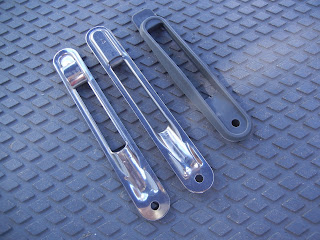
YES it wasthe mainmast on a w33 ketch bsck then. Our local rigger marked the place to make the exit cutouts for me which were staggered so as not to be in line vertically or across and when I had cut them ( drilled and filed out smooth) proprietary polished S/S exit plates were riveted in place in them giving an even smoother pass for the halyards and probably even adding strength. IIRC the main halyard one was the highest to give room to hand heave ho on that halyard before completing the job on the mast winch. The roller genoa one went through a jammer before the winch which freed that winch for the main and left the second mast winch t'other side free to use for the spinnaker halyard or any other task, like the slab reef lines also led through jammers on the mast end of the boom.
 
Robin did you convert to internal halyards then? Seems feasible and easy enough to do to fit exit boxes but does it affect mast strength?

If you do decide to convert to internal halyards you would be well advised, IMHO, to install a conduit for all those cables. You really don't want one of them to become tangled with a halyard :(
 
If you do decide to convert to internal halyards you would be well advised, IMHO, to install a conduit for all those cables. You really don't want one of them to become tangled with a halyard :(

IN my case on the W33 some cables were not in the conduit ( PO laziness)and I took the opportunity with the mast down to replace the tricolour light, VHF antenna and even the combined steaming light/deck flood and re-route all cables through theinstalled conduit as they should have been. Result complete silence at anchor if rolling and no voltage drop to lights etc as the new cables were upsized appropriately too.[/SMUG]
 
Last edited:
Regarding a mast strength and concerns about cutting slots for halyard exits. A mast's most vulnerable points are midway between the supports. ie for 2 sets of stays rig halfway between the top shrouds and intermediate shrouds and halfway between the intermediate shrouds and the bottom. Or cabin top if it is keel mounted and chocked.
That means that with a parallel sided mast any loss of strength near the bottom is no real concern compared to any holes in the vulnerable areas. So keep the holes lower than about 1.5 metre and no concerns but do stagger them. olewill
 
To those that have converted over did you use blocks or plates on the exits? My mast has only 1 winch on the genoa side, mainly I believe because the mainsail is very small in comparison.
 
To those that have converted over did you use blocks or plates on the exits? My mast has only 1 winch on the genoa side, mainly I believe because the mainsail is very small in comparison.

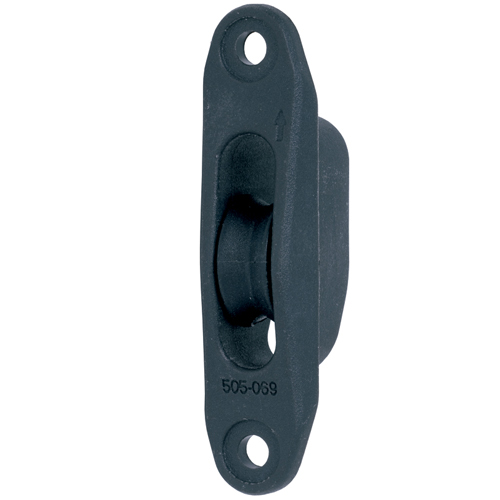
Google for "halyard exit sheave box" and you will see what is required.
 
Prefer the integrity of the sheave bos rather than just a plate but do they still work pulling down? Seems these are used at the bottom of the mast when lines are led aft to cockpit? Trying to find pics of similar masts & boats with internals but no luck yet.
 
Prefer the integrity of the sheave bos rather than just a plate but do they still work pulling down? Seems these are used at the bottom of the mast when lines are led aft to cockpit? Trying to find pics of similar masts & boats with internals but no luck yet.

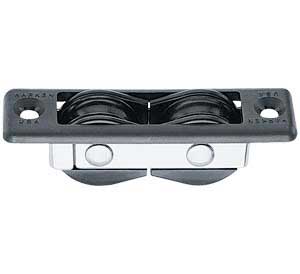
I have 5 internal halyards with 2 coming out of the mast with sheave blocks as VicS pointed at the bottom, halyard coming upwards to the winch.

selden_halyard_exit_box_plain_sheave.jpg


a_morch.jpg


2 have twin sheaves to guide the halyard out of the mast and downwards to the winch and my spinnaker halyard comes out of the mast above the winch using a stainless deflector plate.

DSCN0870.JPG
 
Prefer the integrity of the sheave bos rather than just a plate but do they still work pulling down? Seems these are used at the bottom of the mast when lines are led aft to cockpit? Trying to find pics of similar masts & boats with internals but no luck yet.

The simple exit box can lead a halyard to a deck organiser ( or singe turning block) and then back to the cockpit, or up to a cleat on the mast above the exit .

If you want to exit above a winch and run down to the winch you will need an exit box with two in line sheaves so that the halyard exits between them, running behind the top one and in front of the lower one

H089.jpg


You are only going to save a small amount of windage and a few moments work with a bungee by putting the halyards internally. Stick with what you already have and put the effort into something more worth while
 
Last edited:
You are only going to save a small amount of windage and a few moments work with a bungee by putting the halyards internally. Stick with what you already have and put the effort into something more worth while

Completely agree.

Windage will be tiny. We're only talking 4 x 8mm, maybe 10mm lines, and not all 4 will always be catching the wind.

It takes me about a minute to tie the lines away from the mast with two short lengths of 8mm braid. If my lines were all in the mast i'd have to take the main halyard somewhere, the spi halyard somewhere and i'd have to tie the jib halyard back. Methinks that's more work/time.

Seems bonkers to me to spend a load of time and money to gain nothing worth talking about.
 
Top