To Southerly or not to Southerly

These last 3 are a big concern for me and I feel they should be repaired which should reduce the price of the boat! Please any advice much appreciated.
http://www.luckybeanz.com/img_20180815_142850/
http://www.luckybeanz.com/img_20180815_142838/
http://www.luckybeanz.com/img_20180815_140509/

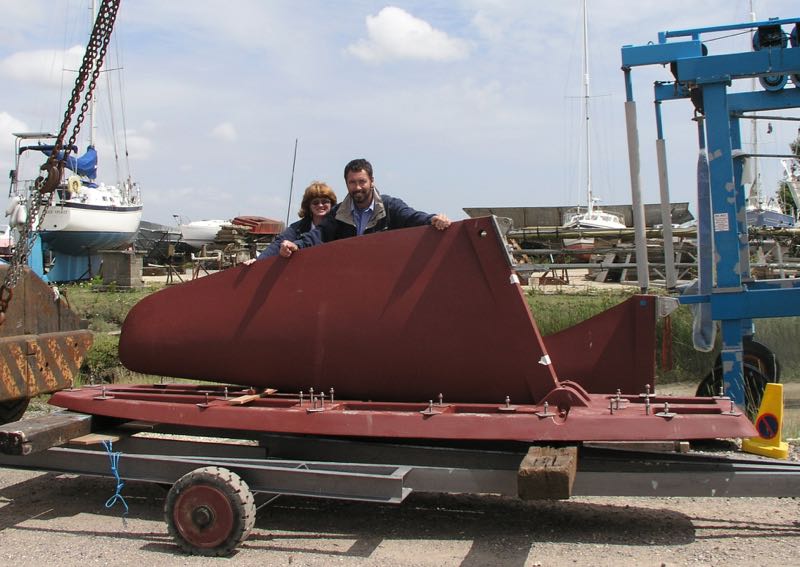
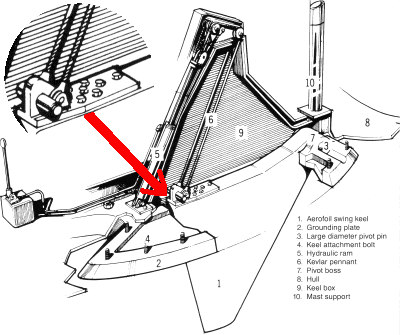
Not sure there is anything to be "repaired" there. You (and your surveyor) need to understand how the boat is constructed. The centre part of the bottom of the boat is a large iron casting which incorporates the lifting keel (also iron) and sits in a recess in the hull. It is bolted through the hull to the structural members inside. The casting is bedded in sealant and what you are seeing is just the edge of the sealant which has started to break away, probably through age.

It is normal maintenance to clear out this sealant and recaulk it as necessary. Suspect it has not been done for a few years which is why it looks far worse than it probably is. Your surveyor will obviously take a closer look at this and advise the remedial work needed if any. The ultimate solution is to drop the whole assembly, have it blasted and epoxy coated, but this is a massive job, would cost an amount out of all proportion to the value of the boat and no 100% guarantee of success.

It is the same with the corrosion on the keel. Rust happens on cast iron in water and keeping it under reasonable control is just part of owning and maintaining a 30 year old boat. The key thing on the keel is to ensure the lifting mechanism is working and in good order. it is not clear whether it is just hydraulic or electrohydraulic, but in either case it is the ram and lifting strop that need close inspection.

Overall the boat looks in reasonable nick with good gear. However be aware that there is a lot of gear on it which is getting on so expect to have an on going repair and replacement schedule, particularly if you are going to live on it and travel a lot.

BTW don't worry about VAT. Despite what the broker says, VAT will almost certainly have been paid in 1987. It is just lacking the receipt which is quite normal for those days as it was not considered important to keep it and it is still not a legal requirement to have it. Its prime use is as proof that it is an "EU" boat that is free to travel, but nobody ever checks except in Croatia and sometimes Portugal and you can get an EU form T2L which does the same thing. Details on the RYA site. There is no way you are required to pay VAT as this is a private transaction. Just make sure you get all the back documentation, particularly Bills of Sale.
 
Really difficult to comment helpfully.
The photos, although close-in to show detail don't give (me) a wider context. From what I remember of Grehan #1 there was a clearly discernible joint line between keel plate and hull - I can't see that in the same in your pics. Wish I had taken some photos but if I did I can't find them.
As Tranona says, the essentials consist of two massive cast iron items, the keel and the plate through which it rotates. Unlikely IMHO that either can degrade to a fragile degree although rust/scale is to be expected and we cleaned/wire brushed off to the best degree possible.
It is possible that the plate-hull junction might have suffered from a knock but generally with a Southerly the keel just kicks up and damage there is avoided. But obviously wise to check and it looks to me like some opening up where that joint is (where your photos are) could be advisable.
The other component is the bearing/seating/pin where the keel pivots on the plate - I can't remember quite how that is and whether it's liable to degradation. Finally of course, the less robust things like the pendant ropes and fittings musty be inspected - the ropes are supposed to be (kevlar? - particular even if that's wrong) replaced at intervals.
cool-keels---8.jpg

Pic is of Distant Shore's keel assembly - yacht new this year
KeelNew256.gif

and
http://www.mistroma.com/MistromaOriginal/GalleryKeel.html

8707HollandKeel.jpg

That lift bracket to keel top surface is a potential vulnerable thing.
8707HollandKeel_2.jpg


An 'ordinary' surveyor may not be aware of how the Southerly keel comes together, works and be ok - or not ok As you can see from the pics, it's a fairly simple, very heavy, assembly.
With all said even though this Southerly has apparently not been used much for a few years, there could indeed be problems . . but impossible to judge one way or the other. Caveat Emptor ! (and good luck)
 
Last edited:
Construction is as other have said. Surveyor who looked at my S95 was completely clueless and said, amongst other things, that the "bottom casting" had been badly fitted, padded out with sealant and should be dismantled before assembling without sealant.

I told the buyer to pass this on to Northshore. Of course they said (after laughing had stopped) that it would sink if assembled without sealant and early keels all stood a little proud of the hull, so nothing at all to worry about.

The bracket shown in my pics above was a standard item from Northshore. It lasted about 19 years and was replaced with a custom bracket made from 2" thick steel. You can compare both brackets by looking at this link. http://www.mistroma.com/MistromaOriginal/LiftKeel.html

I'd actually forgotten about the detailed pictures in the other link given above (http://www.mistroma.com/MistromaOriginal/GalleryKeel.html). Worth looking at these pictures to get a closeup of each area.

OP is looking at the wrong bits, he needs to take pictures through the internal access port on side of the keel housing, then also examine the lifting pennants and hydraulics. The expensive job is to split the hull and grounding plate. You only need to do this to replace the pivot bearing or lifting bracket. The lifting bracket can be examined easily enough but I suspect they always look pretty rusty.

If keel has been repaired before, you MUST be certain that some cretin didn't use the wrong type of sealant (i.e. NOT an adhesive). From memory, Northshore used to specify an ARBASIL product. I think it was either 1080 or 1082 but I can't remember the correct number so will need to check. However, the stuff in your pics shows a gap to probably OK.

I still remember when pics above were taken. The guys helpfully craned Mistroma back alongside so we could sleep aboard until parts arrived and wouldn't need a ladder. My wife was horrified as she was dangling about 12' above the water when the tide went out. You could see the water through the holes in the bottom of the hull and my wife refused to stay on the boat until they lifted her back on solid ground. :D:D
 
Last edited:
+1 for the comments above.

They didn't cast the keel or mould the hull so that the two were a precision fit - that is why sealant was invented :encouragement:. I recall a fairly big gap between the two and all you have is the sealant has dropped out - no doubt in the heat and dry conditions.
Check the mechanism works (if needs be by hoiking her up in a crane, but it looks like you can do it in that cradle) and, if it works you are fine, brush off the rust on the keel and plate, buy a few tubs of sealant and get it in there lad. Antifoul (if it is not coppercoated, cannot tell) and get sailing.
Boat looks rather nice and a seriously decent price. With a clean bottom, you will be pleasantly surprised at how she goes.
 
Perhaps these comments will help you assess the risks associated with unknown state of lifting keel. Please note that I'm talking about the S95 but I'm assuming that model you are looking at will be very similar. Owners of that model may be able to correct any errors in location of access points and so forth.

1) Hydraulic system can be removed from boat when afloat and taken ashore for repair. You don't always need to lift the keel so no rush to repair and seals should be easy to find. It won't stop you sailing.

2) Pennants can also be fixed in water or land as long as you don't wait until they both break. There are 2 pennants and each is capable of lifting if the other breaks. You do get an unfair twisting load on the pulley block on the ram so not a good idea to lift unless actually replacing parts. There should be a pin somewhere on board (probably rusty and slightly bent). It goes through a hole underneath the access port in side of the keel housing. The port is usually hidden behind a large circular plastic cover. You might have problems removing the pin holding the pennant thimbles. I had to drill a hole to the other side of the bracket. It came out inside a cupboard and I was able to hammer the pin out after loosening with diesel. I sealed the hole afterwards but it's well above the water line. You can unbolt the top pulleys and remove that assemble to help see pulley bracket.

3) Keel pivot pin can only be replaced by lifting hull away from grounding plate, that is the only way to get access. I think early models didn't have bushes and the keel would make a clunk when sailing with it partly up. The pin was meant to be some aviation grade material as far as I can remember (at least that's what Northshore once claimed). I doubt the pin would be damaged but bushes could be worn. However, the keel sits in a chamfered slot when fully down and I doubt that it would move at all even with worn bushes. I don't think worn bushes would require immediate replacement and wouldn't really affect normal sailing. I wouldn't expect much wear anyway as few people try to sail with the keel part lifted and bearing isn't stressed at other times. Even complete failure won't cause the keel to fall off (and I can't imagine complete failure).

4) Lifting bracket at rear of keel should be your biggest worry. It can only be replaced after lifting the hull up from the grounding plate and therefore quite expensive. I'd make a guess at 2,000 - 3,000 euro but that's just a stab in the dark based on UK prices many years ago. You'd need to get a new bracket made. Original models had a casting as part of the keel but these all failed after 4-5 years and Northshore started fitting a bolt on bracket. At least you can see the bracket through access point inside the boat. I'd bet the bolt heads will appear to be almost rusted through. Mine were but actually had quite a bit of metal left after 19 years. Very difficult to coat them in anything to stop rust (I tried). Keel bracket failure will be a problem as keel will drop down out of the slot and hang by the pivot pin. This will stop you sailing and require a quick fix.

5) Keel jamming and not lifting. This is possible if you really try, I did it once. I'd always used the boat in shallow water and keel was up and down regularly. Mistroma was kept on a deep water mooring after moving to west coast of Scotland and I didn't raise the keel once during the entire season. I hadn't antifouled inside the housing that year and build up was like concrete. DO KEEP INSIDE OF HOUSING CLEAN and use a long handled brush to antifoul inside. I used to reach up from underneath and down via access hatch. Never had any problems afterwards.

I hope that this is of some help.
 
Last edited:
Firstly thank you, thank you, thank you for all the detailed information, time spent and comments, it really makes one feel like there is hope in the world, especially after the week I have had with trying to get this deal done which is now at a halt. The broker I have been dealing with from Network Yacht Brokers Ionian has not been the most pleasant person to deal with and basically came out saying look I have 200k boats I am trying to sell and don't need to spend time on you, such that I would rather not be dealing with them.

Back to the boat. I had the survey done by a surveyor who has apparently surveyed a number of these boats. The plan was to survey the boat and lift it up to do a sea trial if the survey was good. Though we didn't get that far as the survey through up the following points listed here https://docs.google.com/document/d/1d148fh4I_XlGD8JfqEm77fYNiRLBIt01HQJgjmiQwGs/edit?usp=sharing which he suggested would be a no deal. Since the boat is not mine yet I cannot even get a quote to see how much this work would cost. From all the replies on this post, I am less concerned about the keel now but who knows how bad the deck is. I am actually a little disappointing with the surveyor for not completing a hammer test on the deck. I have no idea how much it might cost to repair this, all I know is the mast will need to come down to do it.

At this point I am not sure if I should just walk away ( I can do so and get my deposit back) or if the keel is really not a big issue and if I go ahead with the boat at a lower price and get the deck fixed I might end up with a great example of one of these fine vessels at a very good price. I do adore the boat, having been in her now, the layout is just fantastic.

Any insights much appreciated as always. Mistroma' you mention looking at the keel mechanism from the inside, I did take off the circular cover and could easily slot the key into the hole, but did not check the mechanism and really couldn't see much. Looking through the plexi glass window at the kevlar rope, it looks in decent condition, but does have some salt residue and fading on it, so not sure if this could be an indication that it is getting on. I could probably get some more pictures tomorrow, but really don't know what I am looking for.

Waiting for my SOA account to be activated and will post there as well to see if there are any Southerly owners in the area who could advise.

Thanks again for your help all.
 
I had a quick look at the survey, not so easy to make sense of some of the pictures. I think the following comments are reasonable but it would be worth getting comments from other owners.


● The keel lift mechanism should be inspected and repaired
Yes, but surveyor is looking at wrong parts (i.e. Bits you can't assess without dismantling first and also least likely to be a problem). I doubt he's ever seen one being assembled. I'm not certain what he means by keel being out of alignment and possibly causing wear on the mechanism.

There's always a gap as far as I can remember and the keel won't always be dead centre when lifted (could be wrong). However, I can't imagine the pivot pin being bent. I always reckoned that the keel would snap before you'd bend that pin. It isn't stressed when keel is fully down. Huge leverage on it when raised a few inches if you drive a sledgehammer against the trailing edge. I guess you could lock the keel tip between rocks and be smashed sideways by rocks. I still think the keel would fracture before the pin bent I did say that you need to keep inner faces of the slot clear (rust, antifoul, growth) but normal use of the keel tends to scrape back most things. I only had a problem when keel wasn't moved for 8 months.


● The sealer between the keel housing and the hull was in very poor condition with the antifoul being painted over the corrosion.
It does look like a poor job. I think that someone has used filler to cover the gap and that will always end up looking poor. I preferred to use an adhesive type sealant in the slot around the grounding plate as that could be made to stick reasonably well for quite a few years. MUST NOT use adhesive sealant to bed the hull on the plate as you'll never be able to take the hull an plate apart again.

● There is what appeared to be a 350 mm long scratch or crack in the starboard side of the keel housing.
● The potential crack in the keel housing should be investigated and repaired if necessary
I couldn't make out where this was but assume he means a scratch on the surface of the grounding plate. The plate is about 6" thick near the centre section at the bow and probably only 2" thick at the edges on aft section. It is a pretty chunky piece of metal. We regularly grounded on rocks in drying harbours/anchorages. Our average anchoring depth was probably around 2m at low water and on East coast we usually dried out completely. I never once worried about damage to the plate, the rock had a worse time. At least it should be easy to check if this is a surface scratch. I wouldn't even contemplate repairing a complete fracture through the grounding plate in the unlikely event one exists. It would be interesting to find out exactly what the surveyor thinks could be done to repair an actual crack through the plate.

● What appeared to be grounding damage was found on the skeg, just forward of the lower rudder bearing mounting bracket.
I can't comment on the damage he found as the picture wasn't clear enough. The boat is designed to be grounded so this part is pretty strong. I notice that this is the fixed rudder version, these don't sail very well in stronger winds as the small rudder stalls and boat rounds up into wind. You'll need to reef earlier than indicated by heel angle. On bright side, you do get prop-wash to help with low speed turns in a marina.

I'd still focus more on the internal lifting components. I'm guessing the surveyor knew nothing about them and didn't bother to check. It would involve poking around inside the keel box and he probably wouldn't know what to expect.


All the other comments seem valid. Surveyor on our old S95 was useless and also made comments about high moisture content. That was on basis of measurements taken 10 minutes after lifting from the water. Even then, he didn't mention that his higher readings were normal for the type of material used in 80s. Measurements mentioned on this boat are all on the deck area. It gets very wet in Preveza over winter and then the boat will bake in the sun for months. High readings would indicate water trapped in the core. I had one very small leak in a non-structural area and the core turned to sludge for a few inches. It was an easy fix because the damage was limited. Leakage over a larger area would have been a major job to fix.
 
Last edited:
my only comment in addition to the above would be about the depression under the mast step. I don't know the exact details of the structure there, but it is common to have a harder pad immediately under the mast step rather than just a core and it is not uncommon for water to get in and degrade the reinforcement. however he also notes that there is no sign of any movement in the compression post which suggests the loads from the mast are still being transferred correctly.

This clearly needs investigating further and is not usually difficult to repair, but you can't tell exactly what needs doing until you cut the outer skin off.
 
It is impossible to comment sensibly from a distance, from photos and descriptions, like this.
But, my ill-informed thoughts follow Tranona and Mistroma. I'd make the maximum noise about these potential "horrendous problems" and use the resulting reduction in price to pay for anything truly necessary to get fixed. There are plenty here on YBW in and around Greece able to point you in the direction of the good and the bad. There might even be a member or two of the SOA able to let you have sight of the member list (although since none have yet emerged in this topic, maybe not).
I don't think you've said where, how and when you'd be sailing but I guess all our comments relate to fairly benign use, not high latitudes exploration.

[caveat] . . . and there is always the chance, boats being boats, that our comments (even if carefully qualified) might be wrong, so please take your own advice, make your own decision.

[a second thought, elephant in the room]
Goes without saying that you'd want to raise and lower the keel quite a few times to check operation, hydraulics, etc etc - not sure if that got mentioned. Quite apart from engine operation, steering, sails, etc. of course.
 
Last edited:
Thank you again all. I wish the people I was dealing with on this side were as forthright and transparent as you. Quite frankly the whole process of actually buying the boat has me questioning whether it is worth it (Then the drive around the isles today confirmed it is). The broker has been less than friendly and helpful to work with and having walked around the yards, I have now gained an understanding that he has a bit of a reputation for being difficult. I paid GBP600 for a survey that didn't even test the keel mechanism. The surveyor had said he had experience with Southerlys but wasn't able to look at the internal mechanism like you all comment should be done and did not want to try lift it unless it was in the sling. He asked if I wanted to go ahead with the sea trial or not considering the issues, to which is said no as it seemed the issues were likely deal breakers. Now reading the comments here, my gut feel is that the Keel is probably fine (electric mechanism needs a fix but manual should work no problems) and the coach roof probably should be repaired but not urgent.

My eventual plan would be to take her back to the UK and on to South Africa. So sailing ground would be greater than the idle waters of the med. This is one of the reasons the Southerly is so appealing as she is a solid boat and this particular one, if the issues are taken care of would be a potential good buy. Does everyone buying a boat for the first time go through such a jungle of deception?
 
So would like to spend sometime in the Med getting used to her before taking her further a field.

Just a word of caution. Some of the strongest winds I have encountered were in the Med. I was holed up in Bonifacio when it blew 88 knots outside.
 
Yes, you are not alone in the trials and tribulations of buying your first boat, particularly one so big and relatively complex as this. You have to remember that it is thirty odd years old and you are paying around 10% of what it would cost to buy a similar new boat - last Southerly 38s built about 4 years ago with all the gear such as this one has (and with essentially the same keel!) came it at ell over £350k.

You will get the basis of a very good boat, but expect to achieve your ultimate plans you will need to undertake a running refit - that is the boat will be usable but you will discover things that need fixing as you start to use them. The way the current owners used the boat is not ideal. Boats should be used, not left on shore for most of the year.

Not excusing the broker's behaviour, but he is not going to earn big bucks out of the sale and has probably had to deal with a steady stream of dreamers and timewasters along the way as well as an absentee seller!

Stay positive and probably in a year's time when you have some experience of sailing where you are you will see the experience as one of those things you have to go through to get onto the good bits.
 
Thanks for the positive vibes Tranoa.

After getting a heavily discounted price I decided that I'd rather take her on than see her go to rot in the yard. Now I am deep into figuring out what I have taken on. Halfway through replacing two seacocks and have moved on to the rudder skeg while the paint dries http://www.ybw.com/forums/showthread.php?507345-Southerly-115-MK-1-Skeg-Cracks&p=6546185#post6546185

Thanks all for the advice and encouragement helping me get this far.

I was wondering which seacocks you replaced. The original ones for the heads were good quality and maintainable, unlike modern ball valves. They could usually be freed and dismantled ashore even when seized.

Were the replacements like for like (expensive). If not, were they, Bronze, Marelon, DZR or unspecified?

Good luck with your new boat.
 
Hi Mistroma, I replaced the one that drains the kitchen sink, the ball was completely eroded away. As I'm in Greece there was not much selection as to what to replace it with so like for like had to do. The Blakes, well I'm not entirely sure what it drains. In the original southerly plan it would be for the aft head, but mine does not have an aft head. It was stuck solid with corrosion, I removed it and cleaned it up with a wire brush and some fine grit sandpaper. After grading it is pretty smooth again and going back in tomorrow.
 
Hi Mistroma, I replaced the one that drains the kitchen sink, the ball was completely eroded away. As I'm in Greece there was not much selection as to what to replace it with so like for like had to do. The Blakes, well I'm not entirely sure what it drains. In the original southerly plan it would be for the aft head, but mine does not have an aft head. It was stuck solid with corrosion, I removed it and cleaned it up with a wire brush and some fine grit sandpaper. After grading it is pretty smooth again and going back in tomorrow.

Sounds good, I was worried that someone had persuaded you to replace the old seacocks to sell you modern rubbish (or perhaps decent but expensive replacements).

The Blakes do tend to seize up if ignored but are tapered and usually easy to free off. I used to remove ours every couple of years, clean up and lap in a little with fine grinding paste. I did use coarse paste the first time, followed by fine. It was always a quick job and cleaning off traces of paste took longer than lapping in surfaces. They were always smooth to operate given even a little maintenance and a small amount of grease.

Both the engine and galley seemed to have been fitted with horrible gate valves from new. Really odd as the fittings on heads were top quality. I replaced both with good quality ball valves when the boat was about 8 years old, big improvement.

I assume that the seacock is connected to a hose. Was a holding tank fitted? Your head must have a seacock nearby. If you haven't found one, then the Blakes one probably connects to it. The S95 bowl was almost sitting on top of the seacock, so impossible to miss, I think that your layout is the same. It was easy to see the hose from bowl going directly to the seacock. If you can't follow about 1-2 feet of hose it is likely that there's a holding tank. It is possible that the seacock you mention is for the optional 2nd head but I'd have though it unlikely to have no hose connected or have a hose leading to an open end.

Good luck, sounds as if you are making decent progress.
 
Last edited:
Got it all done and fixed, the one in question was for the holding tank. Launched and ended up discovering a leak from the transducer which resulted in hauling out again. I then went and resealed all the through hulls to make sure I wouldn't end up in the same position again. After a little while on the water noticed the bilge filling but could not figure out where it was coming from. Being salty I figured it must have been from outside the boat. Though eventually started to hear a drip and discovered that it was actually the holding tank leaking. Solution is not to use it, I want to build a composting toilet anyway.
 
Got it all done and fixed, the one in question was for the holding tank. Launched and ended up discovering a leak from the transducer which resulted in hauling out again. I then went and resealed all the through hulls to make sure I wouldn't end up in the same position again. After a little while on the water noticed the bilge filling but could not figure out where it was coming from. Being salty I figured it must have been from outside the boat. Though eventually started to hear a drip and discovered that it was actually the holding tank leaking. Solution is not to use it, I want to build a composting toilet anyway.

Good to know you got it all sorted out, not the best time of year to launch but no queues for lift in. I might run into you next year if we head back to Ionian and out of Greece.

What type of shaft seal is fitted to your boat? The original ones were packed seals and would have been worth repacking before launch. Not a big job if you have good access. There's always a slight drip from these seals, even when adjusted properly. It should be minor when motoring and stop when stationary. It would be worth keeping an eye of the seal and changing to a dripless seal at some point if it annoys you. It is a common source of water in the bilges on older versions. I can't remember if it was mentioned in earlier posts but thought it worth mentioning just in case. Don't worry about it if you do find a drip as it can be tightened or have a little extra packing added to manage it until next lift out.
 
Top