To all leisure navigators

For the rock in the op,my navionics electronic chart actually shows it as a cluster of 5 rocks, with (not surprisingly) a wreck just to the north east of the most northern Rock on the chart.
 
Thanks for honestly relating your experience Hurricane. It's a timely reminder that even experience, skill and diligence has the potential to get caught out when circumstances conspire to lull us into feeling secure.

A timely reminder to all of us to 'keep sharp' and always have more than one means of knowing position is safe. I've been down your road too. :)
 
Another one that regularly catches leisure boaters out (mostly yachties - it is a bit deep for mobos) - In the Baldricks

Menorca - just south of Ciutadella.

Here is a the Admiralty (leisure) chart of the area

Menorca1_Small_zpsehocx4jk.jpg


This is the best resolution of a BA leisure chart (raster chart from my PC Plotter)
As you can see - Paper Isn't Always Best.

Menorca2_Small_zpslqf6t58t.jpg


This is the CMAP (vector chart) of the same area - clearly shown

Menorca3_Small_zpsnusjcsua.jpg


This one is from the Tula (pilot books) of the same area - easy to identify

Menorca4_Small_zps0rwbgp2d.jpg


And this is from the Navionics web site - again very easy to see.

Menorca5_Small_zpss2sd2mua.jpg


So, IMHO, in this case, the Navionics is the best and the paper chart is as much use as a chocolate teapot.
As I say, IN THIS CASE.
It just shows how different charts can be.
And those of you who have said that they prefer paper charts, please think again.
The Navionics data is collected from users at sea - don't poo poo the electronics.
Best to use everything that is at your disposal.
 
I have received comments before about having two chartplotters on the go as a good thing for redundancy. The truth is one is zoomed in for the detail the other zoomed out for bearing and routing. It's a pet peeve that the details of contours etc disappear when zoomed out enough to place yourself accurately enough against corroborating landmarks or to compensate for cruise speeds on the small screens at my disposal. Could really do with a large MFD but have no space for one.
 
I have received comments before about having two chartplotters on the go as a good thing for redundancy. The truth is one is zoomed in for the detail the other zoomed out for bearing and routing. It's a pet peeve that the details of contours etc disappear when zoomed out enough to place yourself accurately enough against corroborating landmarks or to compensate for cruise speeds on the small screens at my disposal. Could really do with a large MFD but have no space for one.
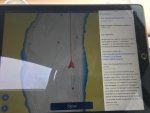
An ipad to the right of your wheel would do the trick...
I'm currently working my way back to Porto on the Douro river and am completely reliant on IOS as there is no data on my navionics cmap...
Nice thing about the iPad Pro is that it can do split screen so I've got email on one side and charts on the other, when i get to the marina later I can add a rear camera view for coming alongside, also it's far cheaper than an e120....

IMG_3736.jpg
 
Last edited:
As you can see - Paper Isn't Always Best.
Not sure I agree with that. The dotted line clearly indicates a submerged rock with a known depth of 1.2m depth (if I'm seeing the figure correctly). It would certainly be enough to alert me. And in any case you're not comparing apples with apples. Admiralty are not the only supplier of paper charts out there. I'm willing to bet that the Spanish hydrographic service produce more detailed charts of the area

Lets not forget that an electronic chart is basically just a scan of a paper chart, at least the type we leisure sailors use, presumably the most detailed and accurate chart the electronic cartography company can find, but a paper chart all the same. Yes additional information may be added to electronic charts or indeed taken away but in the end the basic data for most electronic charts comes from a paper one

Also the data source that many leisure sailors seem to ignore these days is pilot books which are published in most countries and contain very useful information and often chartlets showing all major harbours and anchorages along with advice on passage planning

Whilst most people including me use their chartplotter as their basic navigation tool, it is only one source of navigational information amongst a range of others
 
An ipad to the right of your wheel would do the trick...
I'm currently working my way back to Porto on the Douro river and am completely reliant on IOS as there is no data on my navionics cmap...
Nice thing about the iPad Pro is that it can do split screen so I've got email on one side and charts on the other, when i get to the marina later I can add a rear camera view for coming alongside, also it's far cheaper than an e120....

View attachment 59931

I'm not an iPad fan
OpenCPN now runs on Android so all my charts (2500 of them) that are on the ship's PC also run on my Android Tablet (in fact also on my Android phone)
As to a tablet being a good item to have for nav - only if you don't have anything else.
The advantage of the PC on our boat is that the Raymarine displays that output the PC's video are proper daylight screens.
So much better than a tablet's display - IMHO
However, my phone and tablet are good for planning etc and they do have their places on the boat.

The phone, for example, is my early warning system, at anchor.
I connect it to a 12v battery supply (cigarette lighter socket) and put it in the window in our cabin.
From there it gets a good GPS signal for the Anchor Watch program and I also connect it to one of these:-
http://www.navis-anemometers.com/pdf/windy_smartphone_anemometer.pdf (the "wind only model")
I then set alarms for both the anchor watch and the wind.
Last summer in the Baldricks, we were blown around a lot and it was always the wind alarm that went off first - followed 5 mins later by the anchor watch.
Sorry, I digress - back to the point - yes tablets and phones have their place but bespoke nav kit (Garmin, Raymarine, Simrad etc....) are much better and easier to use.
 
Not sure I agree with that. The dotted line clearly indicates a submerged rock with a known depth of 1.2m depth (if I'm seeing the figure correctly). It would certainly be enough to alert me. And in any case you're not comparing apples with apples. Admiralty are not the only supplier of paper charts out there. I'm willing to bet that the Spanish hydrographic service produce more detailed charts of the area

Lets not forget that an electronic chart is basically just a scan of a paper chart, at least the type we leisure sailors use, presumably the most detailed and accurate chart the electronic cartography company can find, but a paper chart all the same. Yes additional information may be added to electronic charts or indeed taken away but in the end the basic data for most electronic charts comes from a paper one

Also the data source that many leisure sailors seem to ignore these days is pilot books which are published in most countries and contain very useful information and often chartlets showing all major harbours and anchorages along with advice on passage planning

Whilst most people including me use their chartplotter as their basic navigation tool, it is only one source of navigational information amongst a range of others

Mike
For a few years now the likes of Navionics have been taking data from enthusiastic users who report on dangers.
This means that the electronic chart suppliers are becoming more up to date than the old paper suppliers.

For example a few years ago, the rock in this pic wasn't particularly well documented by Navionics.
Using leisure reports from users, Navionics now have good coverage of that particular rock.

Menorca5_Small_zpss2sd2mua.jpg


IMO, this "user intervention" will provide better and more accurate charts.
Reprinting and redistributing paper charts (even if you do add the updates) is a difficult and slow process.
10 mins download across the internet and you could update the entire Med's charts.
I think paper chart's days are numbered.
 
The phone, for example, is my early warning system, at anchor.
I connect it to a 12v battery supply (cigarette lighter socket) and put it in the window in our cabin.
From there it gets a good GPS signal for the Anchor Watch program and I also connect it to one of these:-
http://www.navis-anemometers.com/pdf/windy_smartphone_anemometer.pdf (the "wind only model")
I then set alarms for both the anchor watch and the wind.
Btw thanks for the tip on both of those. I now use Anchor Watch and the Navis anemometer myself when at anchor and generally they work well. The only issues I've found is that if you're in a marginal mobile phone signal area the Anchor Watch can give a false alarm when it loses position and sometimes my phone loses its bluetooth connection with the Navis anemometer. But overall v pleased with what is a good and cost effective set up for monitoring your boat when at anchor overnight

Also btw how are you getting on with your Rocna anchor? I'm delighted with mine. I have used it many times this season in many different anchorages in a wide variety of seabed types and occasionally in very windy conditions and it has stuck like glue to the seabed. It just sets hard and immediately and then just stays there. Definitely a step up from the Delta IMHO. Only downside is that it looks like a lump of scaffolding on the front of your boat:)
 
IMO, this "user intervention" will provide better and more accurate charts.
Reprinting and redistributing paper charts (even if you do add the updates) is a difficult and slow process.
10 mins download across the internet and you could update the entire Med's charts.
I think paper chart's days are numbered.

Well yes I partially agree with that but if you're diligent you should be regularly updating your paper charts from the Notices to Mariners. Of course most people don't do that, including me, but then I'm not updating my electronic charts either because I'm idle

Nope I don't think that paper charts will disappear for one good reason and that is screen size. You are simply never going to get the same overall perspective of your route on a 12" screen compared to a 36" paper chart and even the best chart plotter can't redraw as quickly as you can move a paper chart
 
You are simply never going to get the same overall perspective of your route on a 12" screen compared to a 36" paper chart and even the best chart plotter can't redraw as quickly as you can move a paper chart

We will have to agree to disagree with this one.
In my experience, you need several charts to get the scales you want.
With my OpenCPN's scanned charts. I can zoom and pan exactly the same charts that you use in a fraction of the time it would take to find where you are on a different paper chart.
The great thing about properly georeferenced raster charts is that you instantly know where you are.
And, in my case, I can switch instantly between (say) CMAP, Admiralty and local raster charts.

This year, I'm doing a bit of an experiment.
I've accurately grabbed and georeferenced Google Maps satellite images for all of Ibiza.
I'm hoping that we will get the opportunity of a late season cruise round Ibiza and I want to see how useful these Google scans running on my PC OpenCPN plotter will be.
Earlier this season, I set a yachtie friend's system up with these Google charts - he also uses OpenCPN on a ship's PC.
He has reported that they were very useful.
I now need to find out for myself.

Here's an example of my Ibiza charts that I uploaded to Photobucket a few months ago.

North tip of Ibiza (Portinatx)

OpenCPN-Google1_Small_zpsm9drskum.jpg


OpenCPN-Google2_Small_zpsnrbe9jx4.jpg


Again, the purple lines are our track/anchoring position.
 
UGC on the N iOS app is amazing and just one more nail in the coffin for paper form; it's the kind of functionality that really will save lives.
btw - Raymarine will update through the app on a wifi connection so it doesn't matter if you are a little lazy.
Re the size of a chart, I just can't see an A1 sheet being easier to handle or quicker to use than a digital version.
On the other hand, paper charts do make nice wall decoration when framed and can be quite effective as an insert on a glass coffee table :)
 
Also btw how are you getting on with your Rocna anchor? I'm delighted with mine. I have used it many times this season in many different anchorages in a wide variety of seabed types and occasionally in very windy conditions and it has stuck like glue to the seabed. It just sets hard and immediately and then just stays there. Definitely a step up from the Delta IMHO. Only downside is that it looks like a lump of scaffolding on the front of your boat:)

Not really put it to the test yet but every time I've used it, it has "just gone in - first pull".
That anchorage on the Cap de Creus, we were in about 12m of water and dropped it into what look like sand.
In fact, it was a kind of shale with a crust - again, it just dug in and held.
I know the Delta would have had problems in those conditions - and I certainly wouldn't have had any confidence in it.
When pulling back on the stern rope attached to the rocks, we were able to apply a serious load using our stern winches.
The Rocna didn't budge.
As I say though, not fully put to the test - maybe over the next three weeks it will prove itself.
All my yachtie friends say I will really notice a difference.
 
We will have to agree to disagree with this one.
Yes we are going to have to agree to disagree. Those Google maps are pretty but IMHO of limited navigational value. Maybe one day I'll move into the modern age but until then I'm happy with my basic electronic charting backed up by paper charts and pilot books. I'm not a luddite when it comes to electronics, maybe its just tougher to convince me of its value;)
 
Yes we are going to have to agree to disagree. Those Google maps are pretty but IMHO of limited navigational value. Maybe one day I'll move into the modern age but until then I'm happy with my basic electronic charting backed up by paper charts and pilot books. I'm not a luddite when it comes to electronics, maybe its just tougher to convince me of its value;)

Yep, I agree - those Google charts aren't for navigation.
They are to help find those nice safe little anchorages and, maybe, to help find the same places that we've been anchored before.
The georeferencing of these Google images is really "spot on".
The ones on our home berth not only lead right up to the Google photo of the boat but they actually match up to the radar arch on the boat where the Raymarine GPS mushroom is located.
That accuracy means I can use them in anchorages - especially where there are rocks - and actually see the rocks on the chart plotter.
Anyway, as I said, it is all an experiment that I hope to do later this month - weather permitting.
 
That was before you knew the highly sophisticated pilotage technique that is common practice in Sardinia, i.e. just look forward from the flybridge.
I have yet to see any chart, electronic or not, anywhere near the level of detail provided by crystal clear water - and even better with good polarized sunglasses! :D :cool:

I'm confused that none +1 this comment tbh!

I'm still not very familiar with the local waters, when I reach 10m depth and explore a bay or small isle, I always drop to idle at around 4kn or so and go to the f/b and just carefully thread my way.
FWIW, I've not yet bothered to install a plotter on the f/b (time and aesthetics...) but I never felt I'm missing something on clear waters and sub 4kn...

Of course completely different on any chop and/or dark but I'd not reach an unknown bay at night to anchor, still want to see my anchor on the bottom before calling it a day.

cheers

V.
 
Just been looking at the Navionics iPad app. The rocks show on the chart as soon as the zoom level gets above base map level, so I feel the geeks probably got that bit right, at least on the app.
Yup, for the record, the geeks got it completely right on Garmin charts. Hurricane's near miss rock shows clearly on Garmin even if you are zoomed out so far that you have 30miles+ of chart across the width of your screen

Cap Ferrat has a hidden rock SE corner ( not sure if it's marked ?) it like Hurricanes example catches boats and super yachts.
Eh? You sure? Unless you are so close to the shore that you have your fenders out to protect your topsides, you aren't going to hit anything on SE corner of Cap Ferrat. Never heard of a superyacht clanging anything on that corner. Do you have a reference/link to this possibly uncharted rock?

Not that I'm disagreeing with Hurricane's excellent message, which is be 10x careful and be aware that chart zooming out can make things disappear from your screen
 
Last edited:
Top