Tiller or wheel for bluewater?

easier to sit with a foot on a tiller than be standing attending to a wheel for hours on end ..

Our inboard autopilot does 95% of the steering while we relax. Nothing is foolproof though, friends had windvane break twice on Atlantic crossing, then the linear drive packed up and last resort, a tiller pilot on emergency steering, also failed. Hand steering for the last several hundred miles in 2 hour shifts worked well though :)
 
Well I have crossed oceans and mostly singlehanded and my preference is for tiller on a transom hung rudder, rudder of course being protected with long keel or substantial keg. Add a decent wind vane self steering system and its pretty hard to beat for simplicity, ruggedness, less to go wrong, easier to fix and does not drain your batteries.
 
Well I have crossed oceans and mostly singlehanded and my preference is for tiller on a transom hung rudder, rudder of course being protected with long keel or substantial keg. Add a decent wind vane self steering system and its pretty hard to beat for simplicity, ruggedness, less to go wrong, easier to fix and does not drain your batteries.
I think what you have works fine on smaller boats. Tillers tend to be more common place on smaller boats. Once boat size goes up then a wheel starts to makes sense. With more space you can have more systems. Powerful below deck autopilot, wind self steering as well, large battery bank, lots of solar and a lot more creature comforts. There is nothing wrong with either system but you would struggle to find many larger boats with your setup
 
for me the clincher would be the ability with a wheel to have the ability to turn on the autopilot instantly at the touch of a button for short periods - perhaps when you want to go forward to adjust something - I don't think you can do that with a tillerpilot which is a slight faff to attach each time- unless things have changed in the past few years.
 
for me the clincher would be the ability with a wheel to have the ability to turn on the autopilot instantly at the touch of a button for short periods - perhaps when you want to go forward to adjust something - I don't think you can do that with a tillerpilot which is a slight faff to attach each time- unless things have changed in the past few years.
I’ve never found it too hard to put a tiller pilot on and off - but with smaller boats. I use the autopilot pretty much all the time except in and out of harbours so have never been in the position of moving from hand steering to suddenly needing to go up.
 
I have a tiller, and find that it gives more feel than a wheel. I can steer a straight line without looking. But a wheel is nice too, and on other boats I sail or have sailed with wheels, it is often easier the bigger the boat.
 
I believe one of the reasons Noelex, who contributes here, opted for a tiller on his recent new build was for the extra space afforded in the cockpit when the tiller was raised.
Not an option with a wheel.
 
I believe one of the reasons Noelex, who contributes here, opted for a tiller on his recent new build was for the extra space afforded in the cockpit when the tiller was raised.
Not an option with a wheel.
Interesting. One reason I like wheels compared to my previous tiller boats is that you don’t lose cockpit space whilst sailing. In harbour also little cockpit space is used but getting on and off the boat does involve swinging yourself past the wheel which is a bit annoying, but expensively solvable by having a folding wheel.
 
Interesting. One reason I like wheels compared to my previous tiller boats is that you don’t lose cockpit space whilst sailing. In harbour also little cockpit space is used but getting on and off the boat does involve swinging yourself past the wheel which is a bit annoying, but expensively solvable by having a folding wheel.
Many of my cruising friends with wheels in the cockpit that get in the way at anchor simply take them off. Its not hard to make them quick release?
 
Just to be perverse (actually it's not, it's a really good little solution), I'm building myself a skiff with whipstaff steering at the moment.

I've often wondered why long distance, JESTER-style solo sailors didn't rig up some kind of foot pedal set up like an airplanes.
 
Just to be perverse (actually it's not, it's a really good little solution), I'm building myself a skiff with whipstaff steering at the moment.

I've often wondered why long distance, JESTER-style solo sailors didn't rig up some kind of foot pedal set up like an airplanes.

Maybe because they spend 99% of the time under wind vane?
 
I don’t understand the question. If you are blue water sailing you don’t need ever to touch either a tiller or a wheel. You only need an autopilot.
 
.... and nowadays they spend 99.9%of the time under autopilot
They're allowed electrical systems? Far too modern.

This is a serious line of thought. Most boats aren't designed for sailing. Their design conventions are a compromise, somewhere between the small traditional coastal or day fishing boats they were designed from with a roof; and 1960s/70s caravans, more built for the 'see', than the 'sea'.

Think it through. In human beings, after the female jaw, which are the strongest, most exercised muscles in the body? Obviously, the legs. And what do we do with them sailing? Pretty much nothing on a small boat set up for singlehanding; adding, no doubt, to weak sea legs at the other end of a long passage.

You say 99.9%, which I don't think is quite true, but when is hand steering required? Perhaps 99% of the really critical stuff. Especially, in sails like the JESTER, the busy waters until one gets out into open sea.

Presumably the convention of a tiller comes from the upright working position of a traditional small-scale fisherman; reinforced by taking the missus out to see the cliffs; and I'm guessing the wheels have worked their way down from large, post-whipstaff style galleons (I don't know when they were introduced), where you can work out your "lashed to it in a storm" Cap'n Ahab fantasies. Like the guys doing Roaring Forties runs.

Now, when Hasler was given a blank slate to design an actual SAILING boat, based on his experiences with Jester, he came up with the North Atlantic 29. Note the small cockpit and dual pramhood sailing positions.

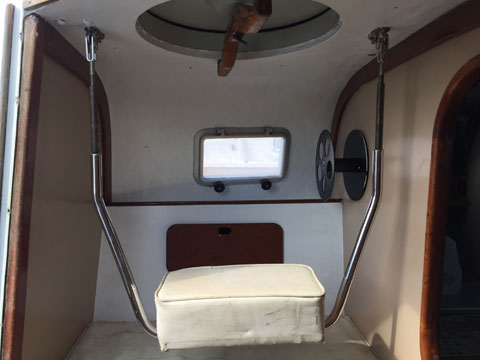
One of its features are two(?) gimballed seats from which to sit in the dry, saddle-style, presumably working the sails (and vane controls?), as I can't see how you can steer from them. By why two? At the very least, it's a waste of space (see below).

So, what I'm proposing would be far better, or the next step, is to use a single, central, gimballed, semi-reclining sailing position, a bit like a racing car driver's, using airplane like pedal control (and cockpit), that would keep the legs occupied while leaving the hands from for other jobs, like trimming, lighting a pipe, holding a mug etc.

Now, for the serious sailor, going sailing, the real benefit of this arises during those most risky phases where some kind of near constant watch is required. It would allow for dozing off in position, rather than having to go below to a bunk, and then having to wake and get up again.

An art one develops during long distance , night-time, motorway journeys (bad joke).

I looked into the idea and it's possible to buy airplane control really cheaply for their over-engineered build as after a few years, they are no good to that industry. Even cockpit perspex. Haven't tried to iron out any design problems that would arise, but hydraulic steering system are pretty well-tested and failsafe these days.

You wouldn't want, as per Donald Campbell, as steering wheel because it adds too much dangerous clutter. Just some foot straps over the pedals.

Check out the link to the Hasler boat, or here, if you don't know it. It was designed in response to requests for a boat like Jester that could accommodate two persons cruising in comfort and I think should have been much more popular. I think it was just ahead of its time, and not enough people were doing this kind of sailing.

picnorthatlantic101i.jpg


27230D_03.jpg
 
Last edited:
Top
