Tiller on mooring

Yealm

Well-Known Member
Joined
13 Apr 2017
Messages
5,352
Visit site
Wondering best position to leave my tiller when boat (Contessa 32) on swing mooring?
Set up on purchase was tilted vertically, tied against backstage (allowing movement).
Should I secure (horizontal position) - and if so can it be to one side, or should it be midline, and if latter, with rope, or bungee?
many thanks :)
 
I lash my tiller to one side horizontal - basically to the pushpit rail .... its not good to have rudder moving while moored .. which it can do if tiller vertical and lashed ..

I only now put tiller vertical to get it out of way when guests / sitting out in cockpit ... its another reason I like tiller vs wheel !!

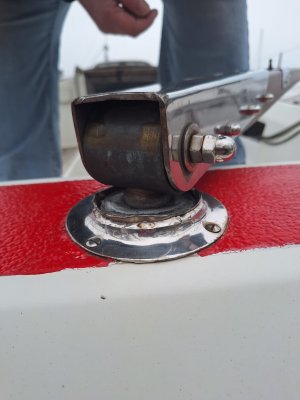
My 38ft'r - I made mistake of lifting tiller up and lashing ..... the fashion plate over the top bearing suffered badly and now I have asked yard to see about replacing ...

WhatsApp Image 2026-03-18 at 14.42.32.jpeg

The tiller bracket to rudder shaft when you lift it - it clicks and holds itself up by friction with that fashion piece. Because I left the boat on mooring with it up - even though lashed ... you can see it damaged the fashion plate.
 
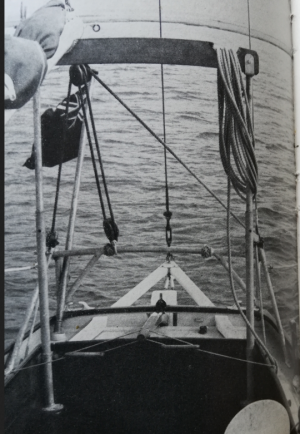
I used this simple system for 27 years, ]illustrated by Eric Hiscock in his book "Cruising Under Sail"].

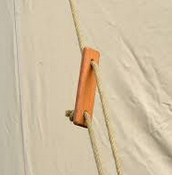
Two guy ropes, with simple hardwood tensioners. It cost nothing to make and never worked loose.

View attachment 208413

View attachment 208414
The modern version is called a whoopie sling. I made mine from dyneema but I don't have a picture.
 
On the topic of centre or lashed to one side - this advice would vary if there is any tide running at your mooring. You don’t want to be lying contrary to your neighbouring boats.
 
You could fabricate a plywood or timber bar, maybe 5in * 3/4 notched to take the root of the tiller and sized to be a tight fit across the footwell As it bears against the stainless "wings" of the tiller attachment, it will not damage the wood.

This has the advantage that you can still use most of the cockpit and walk across the seating without ropes getting in the way. In a particularly rough spot a light line across the tiller head will keep it in place in all conditions.

.
 
I'd be wary of lashing the tiller in a raised position, as this would put excess strain on the hinge area (pins and cheeks).

But I'm on a fore-and-aft in a tidal river where the stream puts huge pressure on the rudder when it's running 'astern' so to speak, whereas the OP says he's on a swinging mooring, so maybe less of an issue?

I simply lash my tiller dead straight in the horizontal position with a line between pushpit stanchions - the lashing is a clove-hitch so easily adjustable before making off the end on the stanchion.
 
I don’t think the position, central or slightly offset matters much. For this kind of fastening I prefer to include a bungee section, with a looser backup if for longer than than overnight.
 
Wih my CO32 I lash the tiller (inside its cover) with a bowline from one spinnaker winch, several turns round the tiller then a couple of turns round the other winch finishing with a rolling hitch back to the line. Tension on the rolling hitch lifts the tiller and keeps it central without any side to side movement. Has worked for many a year!
 
Wondering best position to leave my tiller when boat (Contessa 32) on swing mooring?
Set up on purchase was tilted vertically, tied against backstage (allowing movement).
Should I secure (horizontal position) - and if so can it be to one side, or should it be midline, and if latter, with rope, or bungee?
many thanks :)

I'd say yes, definitely secure it. Stopping movement to avoid wear to the rudder shaft/bearings is more important than the actual position.

Centrally seems best to me, unless there's a particular reason to have it off (so to speak!) to one side. Having the rudder centrally presents least resistance to the tide/current, and the boat will likely range around less like that, but I don't there's a lot in it. (I think I did secure mine to one side when I had a trot mooring that hadn't been laid exactly in line with the current (or the current had shifted), to avoid ending up too near the shore and aground in certain conditions.)

I think rope or cord, rather than bungee. You want as little movement as possible. I've done it on every boat I've had, and always found some suitable cleat, winch or whatever either side to secure the tiller to. Clove hitch or several turns round the tiller to avoid the tiller moving inside the rope and causing wear (as someone reported above).

It's good, though of course not essential, to find or make yourself a suitable lengthen and thickness of rope or cord for the particular job, rather than forever messing about with lines that are way too long, or just that bit too short, for the job, or scrabbling in the rope locker for something suitable. I know because on occasion I've put off doing so for too long after changing boats.

Another handy tip born of my hard won experience - don't forget to untie it before you cast off! 😁
 
Last edited:
The boat i was sailing today we tie a rope from seat to seat via the tiller to hold it.
My boat hopefully launched next week, has Jackstaff steering, a lever each side, just needs an elastic tie from one of the levers to the arm of the chair in the middle.
 
Unless you are in a tide race ... lashing tiller to one side is not an issue ...

What current do you have at your mooring ? If its a two point trot mooring fore and aft ... the boat will just angle itself and sit ... if its a single point swinging mooring - the boat will sit at a slightly different angle .. but as long as tiller is secure - all is fine.

But if you have serious current flow .. ie mooring buoys laying over and half submerged !! then I suggest centreline lashing ... but make it SECURE !!

If you moor to pontoon / alongside berth / Medit or Baltic moor ... then lash to side is fine as there basically is no flow to worry about.
 
I have two jamb cleats , one each side outboard of the seats and two prepared lengths of 5mm rope with loops which go over the end then pull tight, centralises and prevents all movement. Noithing worse than a rudder swinging about on the mooring, looks very un-seamanlike.
 
When we were on a swinging mooring we were required to tie our tilllers to port to try to make all boats turn the same way and to prevent shearing about at wind over tide times. Tie the tiller to pulpit with a bit of strong, doesn't need high tech. If I forgot, the yard foreman would let me know, loudly.
 
Some clubs/boatyards with moorings
state that tillers must be tied to starboard. If you were moored close to a yacht with not much in the water. this possibly could aggravate the problem.
 
Top