Thornycroft 90

Smiling Ben

New Member
Joined
30 May 2021
Messages
8
Visit site
Hello all, my first post here, so go easy!

I have recently acquired a UFO 34 with a Thornycroft 90 engine. She had been laid up in a yard for at least 18months, if not longer. On launching her, and with a bit of effort priming her, the engine would run easily on low revs in the marina.

When she went out on her maiden voyage, as soon as I increased revs, she cut out and wouldn't restart. Having been towed back into the marina, I found a very dirty primary filter. So, new primary and secondary filters were installed, and I still couldn't get her to start.

I then disconnected the hose from the primary filter and inserted it into a 5litre can of clean diesel with injector cleaning fluid added for good measure.

She was primed, and after a number of attempts, she started and ran for only 3 or 4 minutes on medium throttle.

On both occasions that she ran there was a slight fluctuation in her revs before she cut out. Slightly faster, then slower, then faster, then stop.

So. With no engineer being available for a few weeks at the earliest, what would you recommend a first time amateur mechanic like myself do next?

There is a minor leak in the top of the injection pump, and also a fairly sizable leak of sea water from the back of the impellor pump, which looks like it has existed for years due to the corrosion underneath it.

Any ideas?!

Thank you for any suggestions
 
It sounds like the fuel system is at fault. The speeding up before cutting out is often caused by an air leak somewhere. If you've got a CAV type fuel filter, that's where I'd look first as it's tricky to get the O-rings in correctly.
It would be a good idea to give the engine a complete service - new water impeller, check filters again etc. .
 
There is a minor leak in the top of the injection pump
These engines can be absolute dogs to bleed as the slightest air bubble in the system stops it from starting or will stop it.
Your minor leak could be allowing in air, stopping the engine.
I assume you know the correct bleeding procedure for these engines, like the two bleed points on the injector pump?
 
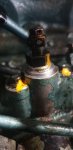
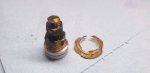
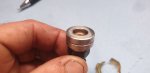
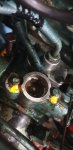
I have only found one bleeding point on the injector pump, an 8mm screw in the side of the main pump housing. I followed the instructions in the original handbook and attempted to loosen what I thought was the second bleed screw in the top of the pump, only to then loosen the whole union valve and break the "glue" seal that had been applied. This is where it now leaks, so I have applied a new adhesive seal.

20210806_123551.jpg20210806_123551.jpg20210806_123620.jpg20210806_123641.jpg20210806_123656.jpg
 
That small bolt on the top of what you have removed is the 2nd bleed point and your side bolt the first. Once they are both bubble free you can then crack two injector pipes and once bubble free your engine may start.
I've found it can sometimes take up to three bleeding sessions before it fires up.
You need to hold the nut underneath to stop it rotating when you undo the top bolt as turning the whole assembly will mess with the injector pump settings.
The fuel lift pump can have a perforated diaphragm which will also cause running and starting problems.
 
I have found that on my engine it's not necessary to bleed the two nipples on the injection pump. Once I discovered this bleeding the system became very straightforward. Just loosen the plug on the top of the filter and pump the lift pump until diesel flows free of air bubbles and tighten it up again. Then continue pumping until fuel can be heard trickling back into the tank via the return. Crack open 1 and 3 injector unions and crank until fuel dribbles out. Then it will start.
 
I had a Thorneycroft (BMC Diesel) in a Colvic Watson I bought. Although it had a Lift Pump for the Diesel I actually considered fitting an Electric Pump as I thought that it would be easier to not only bleed the engine but if there were any air/diesel leaks they would be easier to see as the electric pump would have the diesel to the injector pump under constant pressure.
I would have kept the Lift Pump bolted on as a spare.
One thing I noticed with these very old fashioned lift pumps is the lever which goes up and down on the camshaft lobe is made out of soft metal, or metal softer than the camshaft lobe as it is designed to wear the lever rather than wear the camshaft lobe. as one engine I worked on the lift pump lever had considerable wear and as such the lever was not going the full distance up and down due to having lost thickness in the lever.
So its worth checking.
 
I would put an outboard type squeeze bulb pump on the input from the tank. Makes bleeding much easier and shows leaks too. Not mentioned above? But how clean is your fuel? If left for 18months or even longer? There might be some crud in the fuel that is giving the filters some trouble and ecouraging air to get in from dodgy joints.
 
Crack open 1 and 3 injector unions and crank until fuel dribbles out.
Thats all well and good if you just need to bleed due to a little air ingress but the manual warns about cranking the engine or tow starting to remove air .
I guess if youve changed filters and not allowed any bubbles to go towards the injector pump then thats a great idea.

If the injector pump has not been serviced for a very long time then its also advisable to have this done as the pump contains old rubber seals that cannot cope with modern biodiesel content, leading to possible diesel leaking into the sump from the injector pump and ending in a runaway diesel.. I paid £220 to have mine serviced a few years ago which includes changing all the seals for nitrile ones.

I see from the pics where you have removoved the metering valve/governor setup there is crud in the hole and it doesnt look that clean inside? If any of that goes any further inside it will probably never run right.

A delphi fuel lift pump complete is only £30..
 
Last edited:
All good advice.

Diesel tanks condense water from the air, which may explain the brown crud referred to by Rappey. Drain the tank if its straightforward or suck out the contents into a suitable container.

A dip tube may be the connection to the tank in which case it would be as well to take that out and examine it as there's sometimes a gauze strainer hiding at the bottom of that.
 
Thats all well and good if you just need to bleed due to a little air ingress but the manual warns about cranking the engine or tow starting to remove air .
I guess if youve changed filters and not allowed any bubbles to go towards the injector pump then thats a great idea.

The manual says to open the unions of two injectors and crank the engine. Step 5 in the bleeding procedure on page 7.
 
On the plus side when everything is sorted the engine will run forever, is quite frugal on fuel and parts are probably cheaper than any other engine.

The manual says to open the unions of two injectors and crank the engine. Step 5 in the bleeding procedure on page 7.
But that is only after you have completed steps 2,3 and 4.

From the manual -
WARNING - as the fuel injector pump is lubricated by fuel under pressure, no attempt should be made to bleed the system by towing a vehicle in gear
(which for a boat i would say is the same as continually cranking) ?
 
Last edited:
On the plus side when everything is sorted the engine will run forever, is quite frugal on fuel and parts are probably cheaper than any other engine.


My workshop manual is on the boat so cant read up but surely that step is after the injector pump has been bled as it relies on the diesel to lubricate it.

Yes, that's right but I have found it's not necessary to open the two bleed nipples on the injection pump to bleed the pump, just pump the lift pump until fuel comes back through the return to the tank. So I do it by the book except for opening the bleed nipples on the injection pump.

I discovered this by accident after I had been doing it by the book for ten years. Not quite sure how it works but it has done on my engine for the last twenty five years.
 
Not quite sure how it works but it has done on my engine
I wonder if something as simple as how the pipes are angled from the fuel filters could be key, as in the fuel can run out or not when the fuel filters are removed?
Ive never had any success with short cuts Mine is a real pita to bleed and half the time it never fires up first time after bleeding.. Ive ended up with blisters on my fingers pulling that damn hoop on the fuel lift pump.. An electric option sounds good, but if its not broke then dont fix it !
Other than bleeding its been a brilliant and totally reliable engine which is 56 years old and had a rebuild in 1983.
I also run a calorifier and car heater from mine with no loss of engine temp.. You can buy the weird thread size screw in bit for the back of the head to take out heated water and can buy a silicon hose with inlet that goes on the front of the heat exchanger for adding car heaters, radiators or calorifiers.
 
I wonder if something as simple as how the pipes are angled from the fuel filters could be key, as in the fuel can run out or not when the fuel filters are removed?
Ive never had any success with short cuts Mine is a real pita to bleed and half the time it never fires up first time after bleeding.. Ive ended up with blisters on my fingers pulling that damn hoop on the fuel lift pump.. An electric option sounds good, but if its not broke then dont fix it !
Other than bleeding its been a brilliant and totally reliable engine which is 56 years old and had a rebuild in 1983.
I also run a calorifier and car heater from mine with no loss of engine temp.. You can buy the weird thread size screw in bit for the back of the head to take out heated water and can buy a silicon hose with inlet that goes on the front of the heat exchanger for adding car heaters, radiators or calorifiers.

The metal hoop thing is a bit painful so I cut it off the lift pump and just operate the lift pump by lifting the lever by putting a finger underneath. Sometimes the engine stops with the lift pump on the cam which requires turning the crankshaft half a turn with a socket. Other than that it should be straightforward to bleed the system.

If you're just changing filters there's no need to bleed the pump, just bleed the filter via the top plug and start her up.
 
I'm new to bleeding diesel engines (had to do so for the first time this year) and don't have this model, but I found that mine would keep stalling shortly after starting if I didn't give it a little throttle. I would start, increase the throttle and let it run for a few minutes before letting the throttle back into idle and it was fine after that. It sounds like your engine might be a more sensitive to bleeding than mine, but I guessed that any small amount of air in the system causes less effect if the engine is running faster and quickly gets flushed out.
 
"Surge And Die", where the engine reacts exactly as you say is usually either a blocked filter or air in the system. Fuel flow is disrupted, the governer in the injection pump tries to keep the engine on a steady revs but can't, engine dies.

As Rappey says that is the top of the governer assembly you removed. It looks pretty grim in there and that bit isn't normally removable. The top bleed screw is possibly seized, so when you tried to undo it, the whole assembly turned out. Clealiness is really important, and it doesn't look clean. I think it'll also probably be still letting in air through wherever you've bonded, there probably (and I cant remember) should be an "O" ring in that groove.

I'd take the pump off, get it resealed, recalibrated then refit and start again bleeding.

I've had T90 (1.5) and the T108 (1.8) for quite a while now and found the best way to fully bleed is to check it from the tank to the engine. If at any stage you end up with bubbles in the system it's normally that or the preceding stage that's at fault. usually bleeding a filter change or after a sedimenter clean is more straightforward. Although they have a reputation for being difficult, I've never have an issue (but I'm sure I've been lucky and will have a nightmare next time I try!)

1. make sure the pre-filter is clean and airtight, use the lift pump to get it full of fuel or fill it by hand before refitting, then bleed using the lift pump as it's quicker.
2. check and clean the lift pump, make sure it reliably pumps fuel using the hand lever. (the pre-filter should stay full with no air).
3. check the filter is tight and not leaking and that it is clean with the "O" ring seated properly.
4. crack the bleeder on the filter (or the outlet pipe from the filter) and use the lift pump to pump fuel through until it's free of bubbles.
5, crack the bleeder on the injection pump and use the lift pump to pump fuel through until it's free of bubbles
6. crack the feed pipe to two injectors (as Rappey said) and crank the engine until it fires and then tighten the pipe and just crank until it goes.

Pumps are fairly easy to remove (heavily score mark the position first, in two places) and take to a diesel injection specialist and they can reseal and recalibrate it. I've had two done, one because of high biodiesel content where I was cruising caused diesel to push through into the oil as has previously been described. One because the bit that came off on yours came off and deposited diesel everywhere. Refit the pump EXACTLY in the same position and of course, you have to bleed it :)

keep everything really clean, and wipe diesel off everything so you can tell where any leaks come from.

While the pump is away, check all the filters and sediment traps you've disturbed to make sure they are airtight, no trapped seals etc. Don't tighten them too much, that can distort the seals and make them worse. And keep everything clean, did I say that already :)

check everything you haven't disturbed, to make sure they're "appropriately" tight.

Andrew
 
Thank you all for your excellent responses. I have had her running on two more occasions, and on both, she has cut out. The top of the governer won't seal, and now when I try cranking the engine, it is cranking really fast. Would that be because I have moved the governor assembly?
 
Top