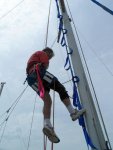
This has probably been done to death, but what do you use to up the stick?

To put things into perspective..
I had a genoa halyard jam on me once. We didn't have a climbing harness on board so I tied a sail tie onto a loop. Put it behind my back then through my legs and bought all three loops together in front and went up on that pulled up by a racing crew.
 
I too tend to use a rather less sophisticated approach, since the A24 mast is sufficiently short and the winches sufficiently small that I ascend by gripping it and shinning up, monkey-style—I have a rope harness with two safety lines, which I get two people to tail (each round a winch) at the bottom. I think that this harness would injure me seriously were I to fall into it with any speed, so I ensure that both lines are kept with some tension on. As with other posters, the halyards used are tied off to the harness (rather than using the snap-shackles provided—I wouldn't want to risk that) and run through different sets of blocks. I usually use the main halyard, which is in substantial (10mm?) cruising Dyneema, and the kite halyard, which runs through the other side of the mast at the top and the foot, and is rather older—I believe it is polyester—but I am confident both would take my weight with a safety factor of at least 20.

I have never liked heights, and avoid going up by and large, but must confess I quite enjoy it when I do so—having taken steps to manage the risk of falls and injuries due to arrested falls, and trusting the gear and the crew, I find myself quite relaxed except at the very top (a dizzying height of some 7m or so above the deck :eek: ). I have not yet sent anybody else up the mast, and would not do so with this system.
 
To put things into perspective..
I had a genoa halyard jam on me once. We didn't have a climbing harness on board so I tied a sail tie onto a loop. Put it behind my back then through my legs and bought all three loops together in front and went up on that pulled up by a racing crew.

It says in old sailing books that you can use a double bowline (the sort that generates two loops) as an emergency bosun's chair. I don't think I would feel very safe, but maybe one could take a line round the hoist and one's shoulders or chest.

There Is no way of getting people who are really scared of heights up a mast. A friend of ours is very scared, and on one occasion we, his assembled friends, decided not to volunteer when he lost a flag halyard. We winched him up to well below the lower cross-trees on his boat, by which time he was dripping sweat, athough he appeared to have scarcely left the deck. I think that everyone should have a go at getting up their mast if at all possible.
 
A slightly crazy mate of mine was onboard (luckily!) when the leach line of my headsail became snagged at the first set of spreaders end cap while beating up the Medway, meaning we couldn't tack or furl the sail.

Before I could stop him, he had free climbed the spinnaker halyard and was standing on the first set of spreaders undoing the problem.

Was quite impressive!
 
I was impressed by a guy at Port La Forêt who walked up the mast hauling on the shrouds. I handed a safety halliard but is was only as a back-up, not used for lifting.
 
Don't think it's clear what happened. However I have used a climbing harness and 2 Petzl Ascenders with an etrier for my feet- off the lower ascender, lower short loop and carabiners to stop swinging . Usually climb the main halyard with the spinnaker halyard as back up. I have gone up on my own a few times but prefer somebody on the 2nd halyard and winch. I have no great problems with heights, but I do take considerable care in how I go up and down. The major hazard as always is being 20metres up without the right tools!
 
I have used an assortment of prussik loops, clog ascenders, petzels etc and although an ex climber well used to ascending ropes I never feelcompletely comfortable up a mast. The nicest way I find is to haul a ladder up the main halyardto the top, then prop another ladder up to the bottom of the hauled ladder and climb up attaching to the mast. the ladders with short lengths of line. The rungs at the top make standing there comfortable. I would use an ascender on another halyard if on my own or get someone to tail a safety line for me.Inevitably I have to go down to gett something but then I am all set up!
 
Can you use it with the main rigged (i.e. no track available)?

Not with the main hoisted, obviously. Can't see why you couldn't use it with the sail bent on as long as the stowed sail doesn't come up past the track gate. If it does, you'll have to remove cars or sliders until all the sail is below the gate, but this should only be a few of them if it's necessary at all.

Pete
 
Mast ladder -

No, you need to remove the sail slides.

Not really. I've set it free many times. I've also used it with the main up, under way. You just need to tension it hard. Put 500-1000 pounds on it with a winch and it isn't moving.
Clearly, it is not in the track.I'm rapping down--it's faster than climbing down.
4. rapping down is easier and safer than climbing down.jpg
 
Last edited:
Not really. I've set it free many times.

Yours isn't the type that Doug and Graham are talking about, though.

b141d9ca9fc9.jpg


(The Kinleven one could presumably be hoisted free-flying, but it seems like it would lose quite a bit of its stability.)

Pete
 
You must surely be thinking of some other device - perhaps an asap?
A Stop will not roll down a rope.

My bad.
I will have to go and look at it. I thought it was called Stop? It has a wheel that locks if the rope is pulled hard but otherwise rolls both ways. It is a pain to unlock if you decide to test it.
 
Yours isn't the type that Doug and Graham are talking about, though.

b141d9ca9fc9.jpg


(The Kinleven one could presumably be hoisted free-flying, but it seems like it would lose quite a bit of its stability.)

Pete


It would, many things that are possible are not necessarily an attractive idea.

Anyone thinking about a ladder should clock the fact that it is much harder on the knees than climbing a standard item against the side of a house. Being vertical means the leg has to articulate outwards, in a bandy fashion; tho the Kinleven model makes it fairly easy to use the arms to help take the strain.
 
Last edited:
Definitely different than climbing a household ladder. Forget everytyhing you know about ladders and read up on rope ladders. For example, using the Mast Mate (blue above) you put your hands around the mast, not on the rungs (rubber-faced gloves help), meaning your legs do most of the of the work. The Kinleven style does not allow this, which I dislike. You put your hands around the mast for stability (the reason I can climb it flying free), but you also to avoid leaning back. On a dead-vertical ladder, if you use your arms on the rungs, you will be leaning way back and swaying. Instead, with the Mast Mate, you keep your body close to mast, not leaning back. You can also use the shrouds and spreaders, when they are handy.

I can climb a 60-foot mast in about two minutes without rushing.
 
About 30 of these: https://www.calibramarine.com/hardware/deck-hardware/mast-steps/ with 3 Monel rivets in Duralac each.

For safety a Spinlock Mast Pro attached to a stainless tree climbing fall arrester that automatically follows me up and is easy to slide down (or up) with one hand. It opens and attaches to an existing halyard.
Do take care with the mast steps. I have three each side to help work at boom height and have had two snap under my weight (under 100 kg fully togged up). They have a 150 kg stated weight limit.
 
Do take care with the mast steps. I have three each side to help work at boom height and have had two snap under my weight (under 100 kg fully togged up). They have a 150 kg stated weight limit.

Is this a common problem? Nylon, even reinforced, is not a great material for long-term strength in the sun. I wonder what the initial BS is?
 
For example, using the Mast Mate (blue above) you put your hands around the mast, not on the rungs (rubber-faced gloves help), meaning your legs do most of the of the work. The Kinleven style does not allow this, which I dislike.

Why doesn’t it allow it? I’d certainly expect to put my hands around the mast when using the Kinleven ladder, and I don’t see why it shouldn’t work. My shoulders are wider than those rungs.

Pete
 
Top