Thin wire connectors

Many thanks for all the replies. My real problem is that the space available is not large, around the central support, and only 40mm deep, and about 15mm wide by 10mm.
It also has to house connections for the vhf aerial, 3 wires to the masthead lights and another 3 to the steaming /deck lights. All connections have to be made above my head, and also need room for 10-12mm tails to everything. It would be nice to have a 4 wire connection in one unit. I cannot seem to find a small chocolate box connection.

On an old boat I had a lovely small flat one with soldered pins for one side, with a connection to small "screw in" heads for the other wire.
Unable to find one of them though.
Get the VHF correctly joined with a proper connector.

For the rest terminal strips or even choc boxes do work in spite of what the professionals say. Soldering is now out of fashion for connectors (for good reason) the modern alternative would be a crimp and connector. So you could crimp ring or fork connectors onto the wires and use a terminal strip, or connect the wires directly without the crimps - or crimp on spades and use a spade block. That is what I use at the base of the mast (inside the boat) as pulling off a spade terminal is much easier than fiddling around with small screws through a small hole above your head.
 
Get the VHF correctly joined with a proper connector.

For the rest terminal strips or even choc boxes do work in spite of what the professionals say.

Professionals, Pah! What do they know anyway ? Far better to take advice from amateurs who advocate using the wrong connectors, in the wrong manner and bodge their electrics. It's not like those "professionals" spend all day, everyday, making tidy, resilient electrical installations, is it ?

Soldering is now out of fashion for connectors (for good reason)

Soldering still has a place. I don't solder much, bit there are times when it's a good solution.

the modern alternative would be a crimp and connector. So you could crimp ring or fork connectors onto the wires and use a terminal strip,

Correct, i said this previously.

or connect the wires directly without the crimps

Great if you're trying to avoid a professional job, in preference to an amateur bodge.

- or crimp on spades and use a spade block. That is what I use at the base of the mast (inside the boat) as pulling off a spade terminal is much easier than fiddling around with small screws through a small hole above your head.

Spades and spade blocks, or male/female spades contained within plugs/sockets are another acceptable method, depending on the circumstances.

Avoiding choc block connectors usually eliminates the need to fiddle with screws overhead.
 
I solder mine. Just cut if you want to disconnect. A loop in the wire will give enough length for 20 years or so of connect disconnect cycles. Very quick, cheap and reliable pretty resistant to water and compact. I was very sceptical about buying a USB rechargeable soldering iron from Lidl but it's an excellent tool to use on the boat for instrumentation connections.
 
Not restricted to thin wires, the use of chocolate block connectors, which i absolutely hate.

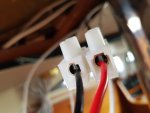
This picture was taken onboard a boat where the wiring had recently been "tidied up" before my customer purchased the boat. The choc blocks used are typical of the ones i come across, plated steel screws, to leafs under the screw, designed for domestic cabling that doesn't have multiple fine cable strands and isn't exposed to a marine environment. So, the screw chews the wire strands, as can be seen here. You can see that the wire marked "7" has been splayed by the screw and most of the strands are not under the screw, they have been displaced, up the side of the screw and are making a very poor connection. Needless to say, whoever did this has made a pigs ear of the whole job.

choc1.jpg

Same boat. Note the wire to the right of the single choc block. You can see where the screw splayed the wire, similar to wire "7" above, but in this case none of the strands stayed under the screw, so with the slightest disturbance the wire pulled out of the connector.

choc2.jpg

Bootlace ferules would have protected the strands, but and an additional tasks and more costs these are still mild steel screws.

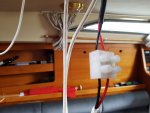
The following pictures are from a different boat. The large choc block connector just lying on top of the head lining, totally unsecured. The connector looks like it's for 10mm cable, whilst the wiring is 2.5mm. A pair of 2-way Wagos, epoxied to the deck head, would have required no additional connectors, crimping or time and would have been nice and secure and vastly tidier.

choc3.jpg

choc4.jpg

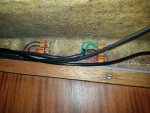
Mast light wiring, using Wagos epoxied beneath the deck head. No crimping, soldering or screwing. Sound connection, neat, tidy and secure.

wagos.jpg

This isn't to say that Wagos are the only acceptable way, in this, or any other situation, there are several other acceptable methods, some mentioned in this thread. Choc blocks just aren't one of them, IMO.
 
Last edited:
Not restricted to thin wires, the use of chocolate block connectors, which i absolutely hate.

This picture was taken onboard a boat where the wiring had recently been "tidied up" before my customer purchased the boat. The choc blocks used are typical of the ones i come across, plated steel screws, to leafs under the screw, designed for domestic cabling that doesn't have multiple fine cable strands and isn't exposed to a marine environment. So, the screw chews the wire strands, as can be seen here. You can see that the wire marked "7" has been splayed by the screw and most of the strands are not under the screw, they have been displaced, up the side of the screw and are making a very poor connection. Needless to say, whoever did this has made a pigs ear of the whole job.
Now I agree entirely with you on choc boxes - no place for them on a boat - or anything involves the rotating part of the screw coming directly into contact with stranded cables. But some terminal blocks - including the more upmarket choc boxes - don't work that way. They secure the cable between two pieces of metal neither of which rotate
 
Now I agree entirely with you on choc boxes - no place for them on a boat - or anything involves the rotating part of the screw coming directly into contact with stranded cables. But some terminal blocks - including the more upmarket choc boxes - don't work that way. They secure the cable between two pieces of metal neither of which rotate

Yes, i'm aware of such connectors, hence my comment "The choc blocks used are typical of the ones i come across, plated steel screws, no leafs under the screw, "

The ones in pictures 3 and 4 are of that design. Still not for me, too clumsy, too much fidding around with screws etc.

I'll stick with pic 5 for the OP. But, for correcting pics 1 and 2 i'll use something different to Wagos.
 
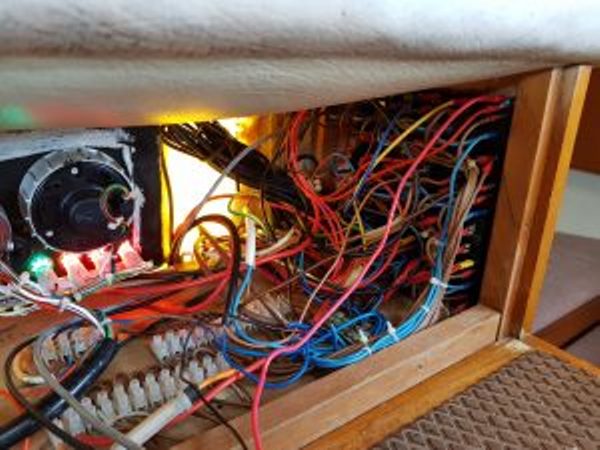
Why use crap connectors:

Westerly-Fulmar-Switch-Panel-3.jpg


When you can do the job properly ?

Westerly-Fulmar-Switch-Panel-4.jpg
 
Some of those pictures also show wire that is not tinned. Personally, I only and always use tinned wire on boats.
 
I solder mine. Just cut if you want to disconnect. A loop in the wire will give enough length for 20 years or so of connect disconnect cycles. Very quick, cheap and reliable pretty resistant to water and compact. I was very sceptical about buying a USB rechargeable soldering iron from Lidl but it's an excellent tool to use on the boat for instrumentation connections.
Especially is space is limited solder with some heat shrink. Simple and reliable.
 
Some of those pictures also show wire that is not tinned. Personally, I only and always use tinned wire on boats.

Yes, the same un-tinned wire that is used on all production boats that i have ever seen.

Same un-tinned wire that my boat was wired with 40 years ago and still has some original wire.

Same un-tinned wire that was on the two 1964 boats i rewired in the last couple of years, lots of which was still serviceable, were it not for the years of mods etc.

Only place i've heard of a whole boat wired with tinned cable is on internet forums.
 
Yes, i'm aware of such connectors, hence my comment "The choc blocks used are typical of the ones i come across, plated steel screws, no leafs under the screw, "

The ones in pictures 3 and 4 are of that design. Still not for me, too clumsy, too much fidding around with screws etc.

I'll stick with pic 5 for the OP. But, for correcting pics 1 and 2 i'll use something different to Wagos.
My problem with Wagos is that they tend to float about loose and don't work so well (in organising) when making multiple connections. Even in your example you are taking a lot of space so they don't really scale

For 1 & 2 why not go for screw terminal blocks (with proper crimped connectors in that case)?

(and as an aside the one thing worse than using choc box connectors is putting multiple wires into a choc box connector)
 
Only place i've heard of a whole boat wired with tinned cable is on internet forums.

All of my boat wiring has been with tinned wire. In my experience the difference is phenomenal, I have seen so many boats with hideous blue/green corrosion extending up the wire from rotten joints. I believe that using tinned wire prevents this, but I would be happy to be proved wrong?
 
My problem with Wagos is that they tend to float about loose and don't work so well (in organising) when making multiple connections. Even in your example you are taking a lot of space so they don't really scale

For 1 & 2 why not go for screw terminal blocks (with proper crimped connectors in that case)?

(and as an aside the one thing worse than using choc box connectors is putting multiple wires into a choc box connector)

Sigh, the Wagos in the picture are not "floating about" are they ? They are fixed in place and space isn't an issue, is it ?

I have several options for removing the choc block connectors, terminal blocks are one such option. There are about 20 choc block connectors, so Wagos are not the answer in this case.
 
All of my boat wiring has been with tinned wire. In my experience the difference is phenomenal, I have seen so many boats with hideous blue/green corrosion extending up the wire from rotten joints.
Tinned cable is more corrosion resistant and is generally worth the extra expense, in my view. Glue lined heat shrink over all the joints is also singnificant help.
 
Top