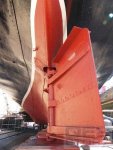
The Waverly

I remember once I was diving under Swanage Pier (Collecting loose change from the bottom under the slatted floor by the booking office!) when she came in. Certainly not quiet from underneath!!

 
Two of the 'old-girl' from this year...

Waverley_1_zps9688077a.jpg


Waverley_2_zpse2366da1.jpg
 
+1 for nostalgia. Saw her young, saw her old - most recently in Harwich. She gets about. Never was aboard her, but share memories of the Maid of the Loch on Loch Lomond. Maid of the Loch Balloch to Rowerdennan. Up Ben Lomond, and the Maid back home again.

The Maid of the Loch is looking very good these days. I hope they raise the Big Wad of Cash required for a new boiler soon. The Waverley has been cursed by inept management for years. There are some signs of hope, though ... their website is now just about usable.
 
About 6 years ago I did the trip from Glasgow to Oban in May - I commend it to all.

In Cambeltown I wondered how the crew would turn her. Warp her round, as they had when leaving her Glasgow berth?
No. she set of backwards down Cambeltown Loch.
Just as she was starting to pick up speed a fishing boat shot out of the harbour at about 10 knots and preceded her down the loch and it was obvious that the skipper of the fishing boat hadn't spotted the Waverley at all.
We rapidly overhauled the fisherman and passed him at about 15-16 knots. In reverse.
Fisherman's face was priceless. He reacted by slowing down and returning to Cambeltown harbour.
I wondered if he thought it was a drink-fuelled imageining?

She turned much further down the loch. An experience - backwards down the loch flat out.
Apparently she can do 18 knots in either direction
 
We had a trip on her down the Thames to Southend Pier and back a few years ago, a great experience although the weather was not too special.

A particular memory is approaching Southend pier. We were travelling at what seemed a considerable speed and thought that she must be doing a pass and then coming back to moor, not a bit of it, as the pier came almost alongside she went hard astern on her paddles and just stopped, amazing!!
 
A bit of nosing around the internet suggests she was built in 1946. Why on earth would you build a ship using technology that's been obsolete for the best part of a century?

The only possible reason I can see is because she can have a shallower draft than a prop-driven job and can take the ground, but neither is an insuperable problem for a prop ship.
 
A bit of nosing around the internet suggests she was built in 1946. Why on earth would you build a ship using technology that's been obsolete for the best part of a century?

The only possible reason I can see is because she can have a shallower draft than a prop-driven job and can take the ground, but neither is an insuperable problem for a prop ship.

Because she was built as a direct replacement of an earlier Waverley that was built in 1899, and was sunk at the evacuation of Dunkirk in 1940 (see http://en.wikipedia.org/wiki/PS_Waverley). As a boat always intended primarily for a tourist trade, the nostalgia value of steam engines and paddle-wheels should not be discounted! Even in the highly rational air of Switzerland, steam driven paddle-steamers are still very much in demand for tourist trips on ThunSee and BrienzerSee.

Incidentally, Arthur C Clarke makes an oblique reference to her in his autobiographical novel, "Glide Path". In it, the principal character (representing Clarke) says his father was Captain of a boat that is recognizably the 1899 Waverley, including details of its loss at Dunkirk. I don't know whether this is correct, or whether it is just "local colour" put in to what is mainly a novel! But Clarke was from Somerset, and the Waverley has a strong association with Somerset. Some of the story is clearly fiction - Clarke's father died in 1931 - but the connection withthe Waverley might be worth checking out.
 
A bit of nosing around the internet suggests she was built in 1946. Why on earth would you build a ship using technology that's been obsolete for the best part of a century?

Paddle steamers survived on the Clyde for various reasons. One was draught; a lot of the piers had very restricted water available so shallow draught vessels gave flexibility of operation. For excursion use the sponsons gave additional space for gangways and so on, allowing more deck space for customers, and the large slow-revving engines were always important features. Later on turbine steamers took over most of the ferry/commuter routes, but paddlers were popular for excursion trips until that market faded out in the 60s. After the Waverly left Caledonian MacBrayne they tried to keep on cruising with the Queen Mary II (originally the Queen Mary, renamed when Cunard made an unrefusable offer), the Keppel and later the Glen Sannox, but none of them could arrest the decline.

Oddly enough, paddles may yet have the last laugh. Almost all the CalMac Clyde ferries use Voith Schneider propulsors, which are basically paddle wheels with a vertical axis and adjustable feathering gear to direct thrust in any direction. Now who's obsolete, eh?

The latest Rothesay ferries, Argyll and Bute, have propellor pods underneath, and it's noticeable now very much less manoeuvrable they are than the VS-equipped streakers, Jupiter, Juno and Saturn, which went before.
 
I like the way she leaves Rothesay. She drives her bow round the end of the pier on a bow spring then goes out backwards to turn well out in the bay. Must be unnerving if your on the outer visitors pontoon and see the boy coming round towards you.

Saw her just past Toward on Sunday heading in Rothesay direction. The wind and waves didn't seem to phase her. Fortunately we were going East. Can see why little ship was snuck in and resting.
 
She's such a gem.

Love to see her on our East Coast each summer too. The skipper and crew must have the best collective knowledge of every port in the Uk .

I think her biggest worry is the cost of fuel. Let's hope the good weather in the peak summer period has produced many paying customers.
 
Its about 50 years ago when I was a young lad that most of my associates used to go on the September weekend to Aran for a session of camping carousing and the other . the Clyde steamers featured in this event . I even have a hazy recollection of the Piping competitions at Dunoon and stepping off the Waverly to more carousing . The reciprocating steam engines pounded in and out and round and round to the theme of a rude Engineers song current at the time .

I even did my engineering apprenticeship with Weirs who trained a lot of the marine engineering officers in their training centre on closed feed systems and apart from marine desalination plant assembled turbines and steam direct acting feed pumps of all sizes Shell was the last of the big tanker companies to stop using steam driven ships .
Another steam ship currently operating is the Sir Walter Scot on Loch Katrine . Nice wee compound engine inside it but costs a lot to run
 
Last edited:
The Board of Trade banned counter rotating paddle wheel manoeuvres in the 30's or 40's due to the number of instances of paddle steamers almost turning turtle.

Exactly right and I only know because a Naval Architect explained it to me twenty years ago. Counter rotating paddles seem intuitively to be a good idea, but actually turn the ship upside down very easily.
 
I have dim memories of Sunday school trips on, I think, the Talisman from Gourock to Millport. We found that if enough kids rushed from side to side at the paddle boxes the result was a zig-zag course and the captain gets a tad annoyed.
 
Seen an ad in today's EADT for a trip on the Waverly, Ipswich to London on 2 October, sounds interesting for East Coast fans?
 
I have dim memories of Sunday school trips on, I think, the Talisman from Gourock to Millport. We found that if enough kids rushed from side to side at the paddle boxes the result was a zig-zag course and the captain gets a tad annoyed.

My father was the purser on the Talisman, which was the first diesel electric paddle ... erm ... steamer?
 
Top