
The purpose of storm jib hanks over a headfoil, and the optimum solution

If you start from scratch the ideal is to have an inner forestay with its own halyard dedicated to use by a storm jib. Unfortunately most masts are not designed to take an inner forestay as the mast would need to offer support, runners is one option, to the 'new' inner forestay. But with a dedicated inner forestay the storm jib can be attached in advance or can be attached at the time without the need to alter anything on the forestay itself. Best with an inner forestay with a Highfield lever - than you can pack it away and thus be able to tack, easily.
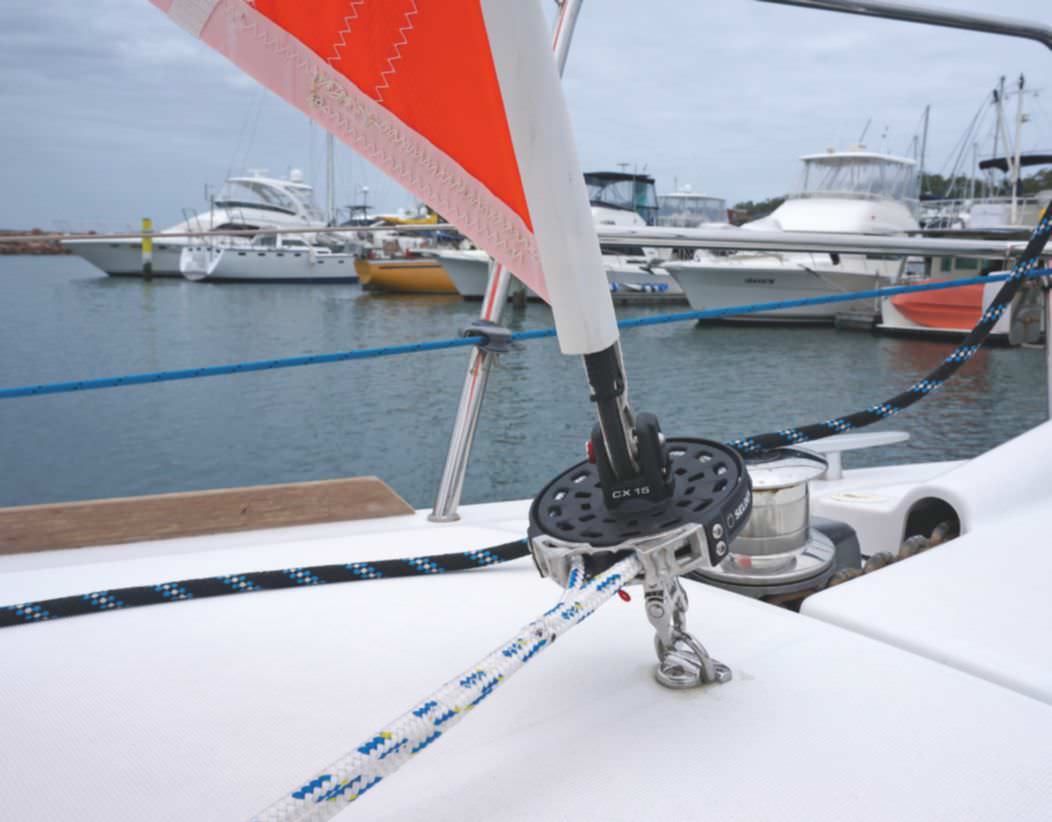
Old school thinking. The new way is to have a storm jib with a dynema luff on a furler. You hoist that and tension it with a winch, then unfurl the storm jib.

1491810899535.jpg


How-to-rig-a-storm-jib-without-an-inner-forestay.jpg


A good proportion of offshore boats are going that way, especially shorthanded boats, as it also allows the storm jib to be used as a staysail inside either a jib or a jib top on a reach.
 
Old school thinking. The new way is to have a storm jib with a dynema luff on a furler. You hoist that and tension it with a winch, then unfurl the storm jib.

1491810899535.jpg


How-to-rig-a-storm-jib-without-an-inner-forestay.jpg


A good proportion of offshore boats are going that way, especially shorthanded boats, as it also allows the storm jib to be used as a staysail inside either a jib or a jib top on a reach.
Obviously new school thinkers have lots of money for unnecessary furlers - they must race as most cruisers don't hanker after the extra 1/10th of a knot.

If you are really not suggesting dyneema luffs are new.

Jonathan

Jonathan
 
Obviously new school thinkers have lots of money for unnecessary furlers - they must race as most cruisers don't hanker after the extra 1/10th of a knot.

If you are really not suggesting dyneema luffs are new.

Jonathan

Jonathan
Buying a furler and getting a dynema luff sewn onto a storm jib is no more, and possibly less, expensive than buying a new stay and mast attachment, and highfield lever....

Look... I've sailed with an inner forestay exactly as you describe - my Dad's boat had that setup. I've also sailed with a storm jib on a roller furler. There's no doubt at all in my mind which was the easier and faster method of deploying a storm jib separate from the forestay.

If one costs more, then that's a factor. Doesn't change at all that you no longer require the inner forestay and highfield level to achieve the same effect.
 
Of course you don't need a new forestay and high field lever - its an option.

Priorities here tend to be financially and simplicity driven. Many here are not so interested in 'fastest' - many potter about, some cruise, those that race would raise 'fastest' issues on a dedicated forum where 'fastest' is important. Many here would also follow their father's practices His methods are tried and tested. Inner forestays and Highfield levers are simple and foolproof, furlers, specially single line furlers are not fault free and when they fail they are difficult to overcome, short handed.

We offer options - the OP has to sort out which options suit him - and the more options the better. Your and my short debate has opened a new opportunity for him, dyneema stayed sail - which might not otherwise have been aired (as dyneema luffed headsails are not common practice for cruisers).

And we have not mentioned hi torque luffs :)

Jonathan
 
Of course you don't need a new forestay and high field lever - its an option.

Priorities here tend to be financially and simplicity driven. Many here are not so interested in 'fastest' - many potter about, some cruise, those that race would raise 'fastest' issues on a dedicated forum where 'fastest' is important. Many here would also follow their father's practices His methods are tried and tested. Inner forestays and Highfield levers are simple and foolproof, furlers, specially single line furlers are not fault free and when they fail they are difficult to overcome, short handed.

We offer options - the OP has to sort out which options suit him - and the more options the better. Your and my short debate has opened a new opportunity for him, dyneema stayed sail - which might not otherwise have been aired (as dyneema luffed headsails are not common practice for cruisers).

Jonathan
Yet the OP has clearly stated that he cruises with a tuff luff and no furler. So inner forestays on highfield levers are completely irrelevant to him.

Storm jib on a furler and a dynema luff only then makes any sense if you want to use it as a staysail as well. Which seems unlikely in the OP's position.
 
I can in fact easily attach a new padeye on deck where there is a strong spot above the chain locker bulkhead. (I'll be replacing that bulkhead next month so hopefully I'll be sure that it will be strong enough!). Then I could hoist the storm jib with its own dyneema stay, tensioned with the (only) jib halyard of the boat. That does need a modification of a storm jib. We don't use it that often, so that's very unlikely.

Though that's again a distraction of the point of the thread - which is about the use of hanks when flying a storm jib on a headfoil / tuffluff.
 
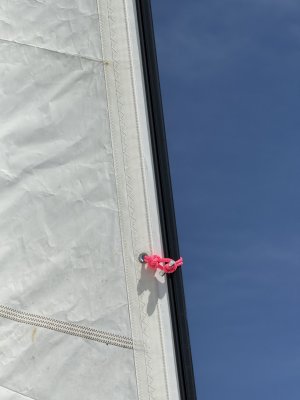
If anyone is interested, here is the setup I settled on: a dynerma loop with a diamond knot and home-turned aluminium dog bones. The dyneema slides on the foil nicely and doesn’t cause any stress on it.
 

Attachments

  • IMG_1151.jpeg
    IMG_1151.jpeg
    1.1 MB · Views: 10
When I bought my Moody33 mk2 several years ago, there was an inner forestay fitted near the mast head but no attachment to the deck and a storm jib with hanks & a rusty luff cable. I had the luff replaced with rope and hanks replaced. I fitted a Wichard twin deck eye above & below foredeck near anchor bulkhead. A turnbuckle connected the inner eye to the reinforced anchor bulkhead, inline with the forestay. The inner stay was fitted with a turnbuckle & Highfield lever. The storm jib had an extra rope to raise off the deck and I used the spinnaker halliard for tensioning. Also twin sheets. Tested in moderate conditions and worked well, but never tested for real, as I don't go out when gales forecast.
 
Top