The Old Ways

I suppose I did, although your question is getting near the level of terminology I don't understand.

I wouldn't suggest this if it wasn't extremely easy, but if you like putting pictures on the forum, get yourself a Flickr account. It's so uncomplicated, you can almost smell Stockholm tar when you're using it. (y)
 
I suppose I did, although your question is getting near the level of terminology I don't understand.

I wouldn't suggest this if it wasn't extremely easy, but if you like putting pictures on the forum, get yourself a Flickr account. It's so uncomplicated, you can almost smell Stockholm tar when you're using it. (y)

Thanks for that. I use Flickr all the time so that is no problem.

Previously I have emailed photos that are too large to myself and it has always worked
 
Ishould imagine river or sheltered water bargescould load to the gun whales but coasting surely had load line restrictions
A quick Google suggests the plimsole Line started to be introduced in the 1930s but that was for international craft. I'm guessing legal protections against overloading were somewhat limited. I have read that tired wood vessels were on occasion deliberately overloaded and sunk for insurance purposes.

I wonder how many Thames barges were owner operated. I'm guessing not that many.

It's easy to romanticise and it must have been a very hard life at times, but as I commute into London I imagine they must have felt a symbiotic closeness to the natural world around them,,, at times.
 
bugger knew i should give the forum a miss first thing ...thats most of the morning gone for burton :(
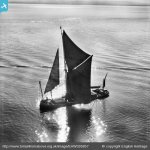
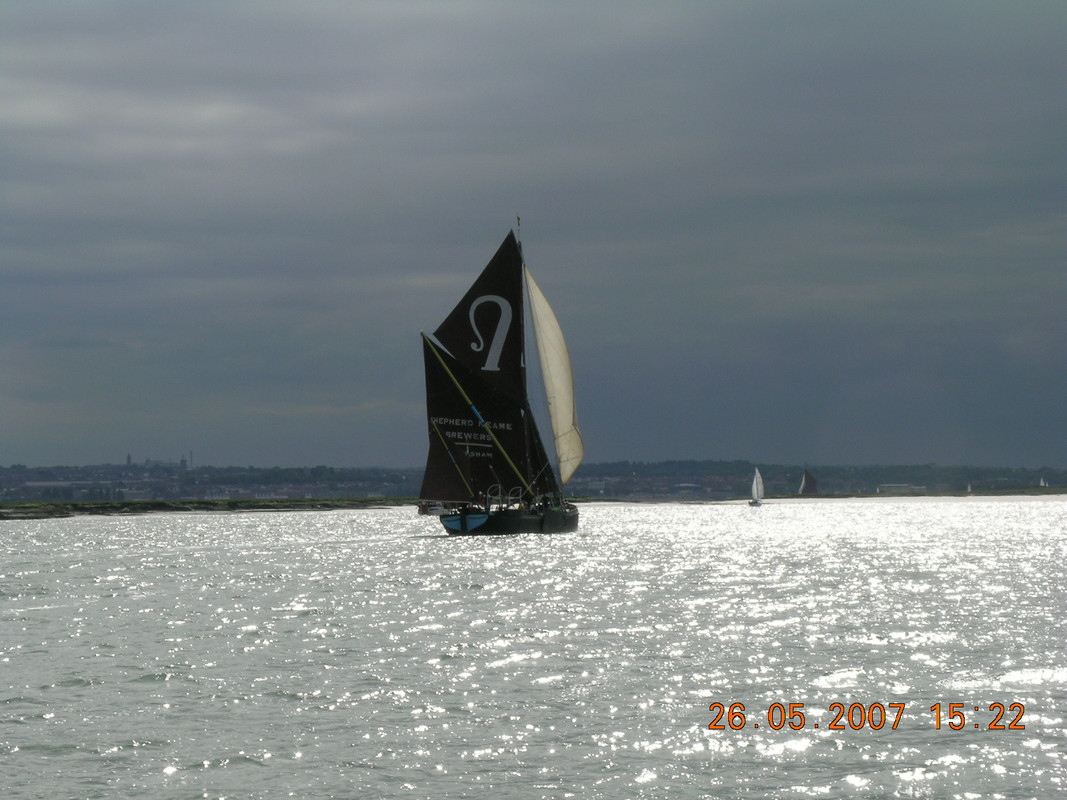
Medway Barge Match.

.......as for getting under low bridges...Hufflers !
 
A quick Google suggests the plimsole Line started to be introduced in the 1930s but that was for international craft. ...

Being pedantic, I think ‘plimsole’ (rather than ‘Plimsoll’) is used only for the rubber shoes, though both the shoes and the line have their origin in Samuel Plimsoll. I did not remember (as everybody else probably did) that the plimsole shoe is said to have got its name from the resemblance of the coloured band joining the upper to the sole - and/or perhaps because if water got above that line the wearer got wet. Plimsoll shoe - Wikipedia

(And as a chemist I should have realised that it is the Plimsoll symbol (a circle with a horizontal line extending through and beyond it) that is used as a superscript to designate a thermodynamic quantity in the standard state.)
 
Last edited:
[...]

(And as a chemist I should have realised that it is the Plimsoll symbol (a circle with a horizontal line extending through and beyond it) that is used as a superscript to designate a thermodynamic quantity in the standard state.)
I don't really know what you're talking about but, once again, I am impressed by the breadth of knowledge and experience demonstrated by many of the people who contribute to these forums.

I also like the way new topics of interest emerge as people add their thoughts to a post.

(y)
 
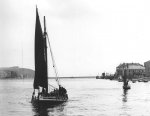
Have you any more information about the first picture and where it was taken? The vessel shown is not a spritsail barge.


The picture was taken in Plymouth with the boat heading towards Sutton Harbour. I expect it was a Tamar Barge but I have no specialist knowledge. There is at least one early example still sailing:

Tamar Barge | Lynher 1896

For those who have not seen it here is Dick Durham on the last of the working trade:

 
I don't really know what you're talking about but, once again, I am impressed by the breadth of knowledge and experience demonstrated by many of the people who contribute to these forums.

I also like the way new topics of interest emerge as people add their thoughts to a post.

(y)

It just appeared as I looked up Plimsoll/plimsole - and the connection with the idea of Plimsoll's 'standard' line is pretty obvious (Why was a Plimsoll symbol chosen to indicate standard state?). However, for those with similarly convoluted minds to my own, the London Underground roundel seems to have no connection with Plimsoll. Apologies for the drift.

Having just struggled with some barge terminology in Benham's Down Tops'l, I found several posts here interesting from that particular aspect - in addition to enjoying the visuals.
 

That looks like the “Will Everard” at Colchester Hythe. She is still with us, but she lost her surname. If I am right on the location I once saw a working barge just there.

Anyway...

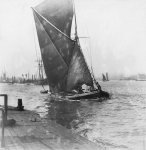
1. Barges can drop their gear including the mainmast and sprit to the deck to get under bridges.

2. The barges in the first picture look to me to have hauled their gear up after passing a bridge but kept their topmasts housed; this was normal- the sprit was used for working cargo. I can actually recall seeing barges at East Mills in Colchester doing this.

3. Tiller steering was normal in the 19th century wheel steering was an additional expense but was adopted in the 20th.

4. You will notice that the barges in the first picture have their mizzen masts mounted on the rudder head and sheeted to the rudder; this was also 19th century practice - the job of the mizzen was to help the barge to wend.
 
Have you any more information about the first picture and where it was taken? The vessel shown is not a spritsail barge.

I think I was the one who oginally posted that picture. And I got it from this thread
nick

If it is important I'll try to trace it back to the original source. Actually I wonder if it came from David Gilmour's barge/studio on the Thames?
 
Last edited:
I think I was the one who oginally posted that picture. And I got it from this thread
nick

If it is important I'll try to trace it back to the original source. Actually I wonder if it came from David Gilmour's barge/studio on the Thames?
l'd be interested but pleae don't go to a lot of trouble tracing it.

I wonder if the Plymouth barge might be something to do with the Navy. An auxiliary used to supply the fleet; a job later carried out by steam puffers.

Somewhere I have a picture of a sailing barge in Portsmouth harbour used to carry ammunition.
 
Some fascinating history in this thread.

I wonder if we might persuade the Forum administrators to start a "Maritime History" forum so we could have all this sort of thing in one easily accessible place.
 
They were known as "stumpies."
Quite right but if you look carefully, the barge in the foreground does have a topmast, lowered (as they did) down the front of the mainmast.
It is indeed laden, and I would guess the rig is raised to allow loading or unloading, either there at anchor or at a wharf nearby. They certainly would have had to dip the rig shooting London Bridge.
 
Top