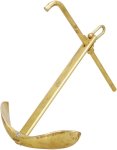
The Herreshoff Anchor

Status
Not open for further replies.
.The sharp points, (Obvious rust issue if the tip hits even a small rock or debris), do improve the speed at which they set and reset, although the increase in the tip weight ratio is often more significant. From that point of view, high tip weight results in swapping good set and reset performance, for final holding performance, which is very important in a storm.

Why Is the holding performance lower?
 
Why Is the holding performance lower?
I should have said that issue only applies to plows, and it's more noticable in soft mud, where you want the anchor to go down as far as possible into the mud. If the tip points down too much, the shank and its connecting shackle start to interfere with the way the mud flows over the anchor.

I can remember having real trouble weighing anchor with a CQR in soft mud several times because of how well it buried itself, the Bruce fans that I met that had used a CQR before in soft mud, regarded that as a problem, which I suppose it is in some way for normal anchoring. Amongst the US sailors circumnavigating, about half used the Bruce, with a steel Danforth for a secondary. The EU and other overseas boats nearly all used a genuine CQR, with a steel Danforth as secondary. About a third of the various boats carried a fishermans of some sort, although I never heard of anyone carrying a Herreshoff, apart from one German boat, had one as secondary. The present new generation anchors were not around, and most local fishing boats used homemade grapnels. The folding grapnel was popular as a dinghy anchor, but you would see a small Danforth with tennis balls on the end of the cross bars on bigger RIB's.

It's very different with anchors like a Danforth, as there is no significant weight on the tip, so it's all about the design and hinge performance, in addition to shank strength concerns.

Still no luck with finding a 3 part bronze Herreshoff so far, and I suspect the J.M.REINECK & SONS might not be in business from the mess their web site is in, If that is the case, used old bronze ones will command the same price as new. I've sent them an e mail to check, as they might be too busy to sort out issues with their company web site.

JM Reineck & Son (bronzeblocks.com)

(3) JM Reineck & Son | Hull MA | Facebook (Alas no info on anchors)
 
I guess a galvanised Luke would not be acceptable - it has to be a bronze Herreshoff?
Storm Anchors, Maine. Rocky and coral bottoms. P. E. Luke, Full Service Boatyard.

The Luke in question is a copy of an early model Herreshoff, and I've not seen any filmed test results of how good they are or not. The real bronze Herreshoff has a complex curve shape to help increase the basic designs holding in mud and sand. Bronze does not corrode, although it does tarnish, but the seriously important strength test issue concerns the locking pin and cross bar slot that keeps the 2 arms with the flukes apart will be interesting.

The copy of an early model Herreshoff I have is fully folding but might be made of cast Iron, and the chains were not galvanised hence the need to replace them. If the main locking pin bends, or fails if jammed beteen 2 rocks and subject to a serious force, it could be game over in a storm. I'm confident that the main pin and slot that holds the cross bar in place for the real bronze version will not break before the chain fails, BUT it would be good if both types could be fully tested for both strength and holding, and it's the performance in mud or sand that is of real interest. A real storm anchor must function in any type of sea bed, and as the grnuine steel CQR does not hold well in cobblestones, rocks or to a lesser extent heavy weed, it needs a second unbendable or breakable main that functions well in that type of bottom, BUT it would be far more useful if it could also function reasonably well in mud and sand. The late model Herreshoff is the solution.

Not sure which exact model of the Herreshof was involved in the Practical Sailot tests, but if it was not a current bronze model made by J.M.REINECK & SONS, they tested an early model. There is a copy in the US making bronze Herreshoff anchors to order, but no idea if they are any good or which model they are making.

The Luke anchor is listed as a storm anchor for rocks, heavy weed and coral. Alas heavy storm anchors which quite a few boats carry when involved in more serious cruiising and anchoring out of range of rescue services, or with a lee shore that could prove fatal if you drag, like a cliff or large rocks, often do not get deployed in time. This is why I differentiate between a storm main and a normal secondary anchor. A storm main must not bend or break before the chain fails, and in the real world where you get taken by surprise by an innacrate weather forecast, (Local winds are very difficult to forecast), serious squall line or the National Weather Service marking an online doppler radar return with a circular arrow, (Rotation observed), you will not have time to assemble and deploy a storm anchor. Alas in most cases once the wind has increased, you will not even be able to deploy a second anchor. That's one of the reason why I deploy 2 mains when the consequences of dragging might be serious.

Off topic a bit:
If you look at the picture of a late model Herreshoff you will see a stainless locking pin. Stainless steel is normally far weaker than normal mild steel in shear, (Better in tensile strength terms). That pin is of real concern with any copy, as a real good high grade stainless clevis pin that has been subject to correct post production treatment, (Annealing, work hardening and Nitriding of genuine 316S etc), would cost as much as most copies.

PS: The larger Herreshoff has a trip eye on the other end of the shank, as does my folding copy of an early model.
 

Attachments

  • Dinghy Herreshoff.jpg
    Dinghy Herreshoff.jpg
    31.1 KB · Views: 4
Last edited:
With many great anchors the very first version was problematic in terms of the type of steel or Zinc coating. The very first CQR was made from cast Iron, not steel, so they rust or even break, but luckily the second version was made from one of the very best steels and a seriously good depth of Zinc.
Quite astonishing. Only a few weeks ago you were unaware that a cast iron CQR existed. Now you are telling us that the first ones were made by this method.

The early CQR anchors were fabricated. In this 1934 US patent the precise details are given, shape of the flukes is defined and the welding process detailed.
  • US Patent 1,974,933 “Anchor” [CQR] G. I. Taylor, USPTO September 1934
The intention of the development was lighter anchors for seaplanes, which did happen, but Taylor was a keen yachtsman and soon used them himself. CQRs produced up to WW2 were all fabricated. At the outset of war the military developed the drop forging method and apparently made 60,000 of them. I believe that the cast version did not appear until after the war but I am not certain of this. Lewmar have now reverted to the original fabrication manufacturing method.

In fact the corrosion resistance of cast iron is usually far superior to steel. Sewage outfalls, pier columns and the like in cast iron can last a century. Incidentally the Luke anchor is made in cast iron, spheroidised, like brake drums. An extremely tough material.
 
A real storm anchor must function in any type of sea bed, and as the grnuine steel CQR does not hold well in cobblestones, rocks or to a lesser extent heavy weed, it needs a second unbendable or breakable main that functions well in that type of bottom, BUT it would be far more useful if it could also function reasonably well in mud and sand. The late model Herreshoff is the solution.

It is interesting to hear from someone who has extensively used these anchors, but it is very hard to imagine this anchor with its limited fluke area and design that strongly resists burying below the shank having resonable holding power in softer substrates. Even the “good test” you site as proof of the value of this anchor model notes:

“In sand, its weak point is holding. It dragged at 300 lbs., 100 lbs. short of the 400-lb. requirement. It essentially is a rock anchor.”


That's one of the reason why I deploy 2 mains when the consequences of dragging might be serious.

You need to be careful that your resulting swing circle does not cause conflict with other boats that are lying to a single anchor. Also keep in mind that if other boats drag the chance of them hooking onto your anchor chain is greater.

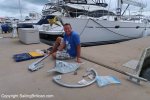
I found a photo of some tough anchors just for you TNLI. You are not going to bend these, but unfortunately they do not work well (as you can see). This is no doubt why the boat dropped two anchors in light conditions. While he has managed to drop them close together, they still form the equivalent of large fishing net ready to snag the anchor of any dragging boat.

img_1947294_0_70d220bcb69ab98e43bbc06ef350bed6.jpg
 
..... A real storm anchor must function in any type of sea bed, and as the grnuine steel CQR does not hold well in cobblestones, rocks or to a lesser extent heavy weed, it needs a second unbendable or breakable main that functions well in that type of bottom, BUT it would be far more useful if it could also function reasonably well in mud and sand. The late model Herreshoff is the solution.
Is there such an anchor as a real storm anchor then? As you say, storms can be unpredictable and local effects are significant so you are most likely to use the best anchor you have by default. If there was such a thing, we would all have the same storm anchor and anchor threads would be a thing of the past. The only all singing and dancing anchor is as far as I can ascertain, the latest of the Stevpris range of anchors, which need adjusting to suit the seabed and are rather larger and awkward for any yacht, even the mega ones. There are so many variables in anchoring, I wonder if there can be any such thing as a storm anchor, just a selection of anchors of suitable size for the given vessel and a rode to suit. How long a rode you need is I suppose a matter of debate, but if you are venturing into areas where the water is deep, you carry sufficient warps that could be bent on to your existing rode.
 
Is there such an anchor as a real storm anchor then? As you say, storms can be unpredictable and local effects are significant so you are most likely to use the best anchor you have by default. If there was such a thing, we would all have the same storm anchor and anchor threads would be a thing of the past. The only all singing and dancing anchor is as far as I can ascertain, the latest of the Stevpris range of anchors, which need adjusting to suit the seabed and are rather larger and awkward for any yacht, even the mega ones. There are so many variables in anchoring, I wonder if there can be any such thing as a storm anchor, just a selection of anchors of suitable size for the given vessel and a rode to suit. How long a rode you need is I suppose a matter of debate, but if you are venturing into areas where the water is deep, you carry sufficient warps that could be bent on to your existing rode.

I used to think that a real storm anchor did not exist, even though companies like Luke say their version of an old Herreshoff is a storm anchor, and publish weight vs LOA tables for which version to buy. Some cruisers with room for extra large anchors would carry a seriously large genuine steel CQR or Bruce, but they only work in mud or sand sea beds, although the Bruce is sort of OK in rocks or cobblestones.

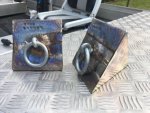
It's only when you look at the figures for the Herreshoff that you will sea it's fairly good in mud and just a bit below par in sand. It's also a fast set and reset anchor, so can be used without setting as a secondary, or primary main. It was used as a general purpose anchor before WW2, So I'm convinced the 3 piece bronze Herreshoff should be classified as a real storm anchor, although weight and size do matter. Obviously size matters, but some sailors really have no clue about the incredible forces that are put on an anchor in a bad storm, and it's not the wind that is the real issue, but the direct wave or breaking swell action if you get unlucky with an anchorage that is open or has a big fetch. The picture below is a real classic, as it's a modern kit built anchor that is far too weak, as the bolts would either fail or pull out if jammed into the rocks in particular.

Most of the more damaging incidents at anchor develop so fast there is no time to change or deploy a different or additional anchor, so in an ideal world both mains should be capable of being left in place during a storm, and be of capable of covering all types of sea bed. A combination of a genuine CQR, or a Bruce if you are using an anchorage where a longer scope is not possible due to overcrowding, and a Herreshoff would be real good, and would also work in deep water. I used to use a CQR and a Danforth for main anchors in a storm, BUT the Danforth can be bent, and neither anchor is good in rocks or heavy weed. So I'm convinced the solution to the secondary main is a Herreshoff set at least 30 degrees apart on a second chain rode.

The Stevpris is an interesting design, but I've not seen one I could lift yet:
Stevpris anchor - Stevpris Mk6 - VRYHOF - for offshore platforms (nauticexpo.com)
Anchors that need adjusting are no good in a storm where you might drag into a different type of holding, or simply make a mistake over which type of sea bed. Some anchorages are just described as mixed, so you are going to be wrong over the setting at times.

I did use a couple of homemade pyramid anchors on one fishing boat in deep water to stop us drifting too much and they work with an almost vertical rode, but only in light mud or sand. They were normally part of the ballast in the bilges, but 2 chaps could lift one out. Fairly cheap to make but not real storm anchors and can be used as angels, (Lots of other names), to hold the last part of the chain rode flat, or as an anti snatch weight when deployed at the mid point.
 

Attachments

  • Bad storm anchor.jpg
    Bad storm anchor.jpg
    55.9 KB · Views: 17
  • s-l500.jpg
    s-l500.jpg
    37.7 KB · Views: 17
A “storm anchor” is traditionally a larger anchor similar to the design that is used for normal anchoring.

In the days before powered anchor windlasses this was traditionally stored, as is was too large to manage for general day to day anchoring.

These days with the development of powerful electric anchor windlasses, most yachts even with a small crew can manage a large anchor with the push of a button.

Therefore, many cruising yachts have switched to using their “storm anchor” for general purpose anchoring. If you carry a “storm anchor” why not use it for day to day anchoring if it is easily managed? If it is not easily managed will you be able to deploy this in a storm?

Unexpected bad weather always seems to arrive in the early hours of the morning and who wants to rig up and deploy additional anchor equipment in these conditions?
 
FGSDXed.jpg


I'm really concerned about that 'whatKNOT' used by Noelex. Surely a wizened ol' seadog like him could do better...?
And where's the Kong swivel and/or 3-link Boomerang?
 
It is interesting to hear from someone who has extensively used these anchors, but it is very hard to imagine this anchor with its limited fluke area and design that strongly resists burying below the shank having resonable holding power in softer substrates. Even the “good test” you site as proof of the value of this anchor model notes:
“In sand, its weak point is holding. It dragged at 300 lbs., 100 lbs. short of the 400-lb. requirement. It essentially is a rock anchor.”
You need to be careful that your resulting swing circle does not cause conflict with other boats that are lying to a single anchor. Also keep in mind that if other boats drag the chance of them hooking onto your anchor chain is greater.
(Picture removed due too large and off topic)
The results from PS were for a Mk 1 Herreshoff, the very last model is supposed to be better in sand and mud, it's already good enough in mud, and I suspect the 100lb short of being designated as acceptable for use in sand by PS, could well be achieved. Nothing is perfect in terms of an unbreakable general purpose short scope storm capable anchors, but the Herreshoff is as close as any anchor around, but alas the back order situation seems hopeless for anyone looking to buy a new one, so I'm stuck with a cheap and nasty folding Mk 1.

Swing circles and the number of anchors in use is a regular issue in any crowded anchorage, so I've always taken a look at any nearby boats or called them to ask what they have set up for anchor or anchors, or what they intend to do when a storm arrives. Most problems were caused by local boats on long Polyprop. rodes, (It floats so does not get wrapped around coral heads or cut off by coral), and issues relating to how a multi hull will swings around with wind changes. Headsail blow outs caused a few issues with boats dragging across other anchor chains. Obviously mixing power and sail boats when in a river estuary with wind against tide sometimes caused a number if damaging meetings.

Most problems with boats hooking up each others chains occurs when weighing anchor, when they trip another boats only main anchor, cos they arrived first. The way I deploy a secondary main 30 degrees off and don't set it, makes very little difference to the swing circle, if I put it 60 degrees out and set it, then it would.
 
Last edited:
A good number of years ago, I purchased a galv steel Folding Fisherman anchor from the MD of the Tennamast company, of Ayr. He'd been exhibiting it at the So'ton Boat Show, had no takers, and sold it to me on the last day to avoid having to haul it back up north again.

It had large flukes, weighed about 60lbs, and I'm certain would have made short work of penetrating the forests of seagrass where precious seahorses lurk. I eventually gave it away to a member of this congregation, who has a very solid traditional wooden boat.
 
I used to think that a real storm anchor did not exist, even though companies like Luke say their version of an old Herreshoff is a storm anchor, and publish weight vs LOA tables for which version to buy. Some cruisers with room for extra large anchors would carry a seriously large genuine steel CQR or Bruce, but they only work in mud or sand sea beds, although the Bruce is sort of OK in rocks or cobblestones.

It's only when you look at the figures for the Herreshoff that you will sea it's fairly good in mud and just a bit below par in sand. It's also a fast set and reset anchor, so can be used without setting as a secondary, or primary main. It was used as a general purpose anchor before WW2, So I'm convinced the 3 piece bronze Herreshoff should be classified as a real storm anchor, although weight and size do matter. Obviously size matters, but some sailors really have no clue about the incredible forces that are put on an anchor in a bad storm, and it's not the wind that is the real issue, but the direct wave or breaking swell action if you get unlucky with an anchorage that is open or has a big fetch. The picture below is a real classic, as it's a modern kit built anchor that is far too weak, as the bolts would either fail or pull out if jammed into the rocks in particular.

Most of the more damaging incidents at anchor develop so fast there is no time to change or deploy a different or additional anchor, so in an ideal world both mains should be capable of being left in place during a storm, and be of capable of covering all types of sea bed. A combination of a genuine CQR, or a Bruce if you are using an anchorage where a longer scope is not possible due to overcrowding, and a Herreshoff would be real good, and would also work in deep water. I used to use a CQR and a Danforth for main anchors in a storm, BUT the Danforth can be bent, and neither anchor is good in rocks or heavy weed. So I'm convinced the solution to the secondary main is a Herreshoff set at least 30 degrees apart on a second chain rode.

The Stevpris is an interesting design, but I've not seen one I could lift yet:
Stevpris anchor - Stevpris Mk6 - VRYHOF - for offshore platforms (nauticexpo.com)
Anchors that need adjusting are no good in a storm where you might drag into a different type of holding, or simply make a mistake over which type of sea bed. Some anchorages are just described as mixed, so you are going to be wrong over the setting at times.

I did use a couple of homemade pyramid anchors on one fishing boat in deep water to stop us drifting too much and they work with an almost vertical rode, but only in light mud or sand. They were normally part of the ballast in the bilges, but 2 chaps could lift one out. Fairly cheap to make but not real storm anchors and can be used as angels, (Lots of other names), to hold the last part of the chain rode flat, or as an anti snatch weight when deployed at the mid point.
I think you missed my point, the fact that highly efficient anchors with a legacy of extensive science and experience like the stevpris cannot cope with any seabed without adjustment. There is no anchor that can cope with every seabed. Why? Because of relationship between fluke angle, the geometry of the shear plane in the seabed and size of the effective fluke/seabed interface

Anchoring in rocks is simply to be avoided in my opinion
 
A “storm anchor” is traditionally a larger anchor similar to the design that is used for normal anchoring.

In the days before powered anchor windlasses this was traditionally stored, as is was too large to manage for general day to day anchoring.

These days with the development of powerful electric anchor windlasses, most yachts even with a small crew can manage a large anchor with the push of a button.

Therefore, many cruising yachts have switched to using their “storm anchor” for general purpose anchoring. If you carry a “storm anchor” why not use it for day to day anchoring if it is easily managed? If it is not easily managed will you be able to deploy this in a storm?

Unexpected bad weather always seems to arrive in the early hours of the morning and who wants to rig up and deploy additional anchor equipment in these conditions?

Yes I did come across some yachts doing just what you suggest, but in my case I don't need a windlass and the extra weight a good manual one would result in extra ballast for self righting and that slows the boat. My main anchor is a 15lb CQR with 6mm chain and I can pull that up by hand. The smallest Herreshoff is 7.5kgs which is perfect, (The dinghy one is 1.5KG). Alloy lifeboats are light and and tend to ride over waves in an anchorage, rather than digging in and submarining the bow like my last steel yacht.

If you get unlucky with debris or drop the giant storm anchor in poor holding like a patch of cobble stones or small rocks, it still fails to hold, also what is your plan B if the windlass fails, as electric ones are not as reliable as hydraulic units, although I must admit to having a top of the range hydraulic one fail in a big Oyster whilst weighing anchor, although it was just an auto shut down due to oveheat of the fluid. Had to wait half an hour for it to cool down with half the rode dangling. I didn't think it was funny at the time, although the owner had warned me they had suffered a similar failure before. It lacked any real means of cooling the fluid.

PS; (OFF TOPIC A BIT): I've been looking through some of the past anchoring disasters in various places to see what went wrong, and the most common reason for a boat dragging where none of the gear had failed in terms of chafe or snapped off swivels, was weed. The main anchor started dragging, but seemed to fail to reset cos it had collected too much weed to function. Obviously in some cases they dragged quite some distance. Most of the anchorages concerned are not listed as having significant weed, but alas they had enough that an anchor that is dragging could collect enough for it to cause a failure to reset. The Herreshoff as a secondary main should have prevented thaat type of loss
 
I'm really concerned about that 'whatKNOT' used by Noelex. Surely a wizened ol' seadog like him could do better...?

And where's the Kong swivel and/or 3-link Boomerang?

I appreciate your concern, but I am more KISS when it comes to anchoring.

A large and good quality modern anchor (but one that can still be comfortably managed) is attached to the chain with a rated shackle. Simple.
 
Quite astonishing. Only a few weeks ago you were unaware that a cast iron CQR existed. Now you are telling us that the first ones were made by this method.

The early CQR anchors were fabricated. In this 1934 US patent the precise details are given, shape of the flukes is defined and the welding process detailed.
  • US Patent 1,974,933 “Anchor” [CQR] G. I. Taylor, USPTO September 1934
The intention of the development was lighter anchors for seaplanes, which did happen, but Taylor was a keen yachtsman and soon used them himself. CQRs produced up to WW2 were all fabricated. At the outset of war the military developed the drop forging method and apparently made 60,000 of them. I believe that the cast version did not appear until after the war but I am not certain of this. Lewmar have now reverted to the original fabrication manufacturing method.

In fact the corrosion resistance of cast iron is usually far superior to steel. Sewage outfalls, pier columns and the like in cast iron can last a century. Incidentally the Luke anchor is made in cast iron, spheroidised, like brake drums. An extremely tough material.

I plead guilty to not knowing the full history of the CQR, BUT cast Iron is one Iffy material to use if it is for a company making poor copies, (My folding Mk 1 Herreshoff has a rough surface so is probably badly finished cast Iron), as they will use Chinese or possibly Indian recycled Iron that is badly contaminated with all sorts of other metals to make the cast Iron, and I can assure you the ultra cheap cast Iron rusts far faster than a good steel. It just depends on the quality as poor quality steel also rusts very quickly.
With cast Iron the surface finishing process makes a huge difference to the rate at which it rusts, so a real good finish might indeed be better than most steels. Luke do not have a good reputation, so I would not trust anything they say about which material is used or how it was finished before being galvanised. Cheap brake drums rust overnight if exposed to salty air.
Cheap cast Iron parts can crack when dropped, and I understand from previous comments that it can happen to anchors, although I've never met anyone who cracked an anchor. I suspect Lewmar know what they doing in making sure the best material and best finishing is used.
 
BINGO !!! Just got a reply from J.M.REINECK & SONS and they are still making 7.5 lb and a 17lb bronze 3 piece Herreshoffs, I misread a page in a fine print PDF of their products and thought it was 7.5Kgs, but 17lb is just perfect for a secondary storm main.
So I've got a name and a direct e mail address, and will enquire as the price and how long a wait I will have, as I was informed they worked on a made to order basis. I wonder if they will reply in the manner that the marketing manager of Gates LearJet said when asked how much a new Lear 35 would cost. He simply stated that if you need to know how much, then you won't be able to afford one.
 

Attachments

  • Yes-2.jpg
    Yes-2.jpg
    15.6 KB · Views: 0
Status
Not open for further replies.
Top