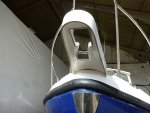
The finer points of bow roller design.

Joined
27 May 2002
Messages
11,172
Visit site
Anchoring is my yachting achillies heel and this can be attributed in part to the woeful undersized clip-on bow roller that my racer/cruiser is currently equipped with. This seasons main mission is to spend more time at anchor using a brand new bow roller that I have to design and get fabricated. One upside is that I can remove the clip-on bow roller socket which then gives me a clean sheet for a custom replacement bow roller.

So far I have concluded:

  1. My plumb stem will require about 8" to 10" of projection, I might get away with less because when my new furlex was fitted last month an extra link raised it well above deck height to avoid obstructing the anchor shank during launch and stow operations.
  2. The most mechanically demanding moment during anchor retrieval is when the top of the shank pivots over the roller from vertical to horrizontal. A large bow roller wheel diameter helps but a double roller is much better. Rocna recommend a 10cm diameter for their 15Kg anchor.
  3. Which leads onto whether a pivoting (hinged) double roller design is needed and this is my main point of confusion. Would I be correct in thinking that a modern anchor design such as my 16kg Delta will self launch and stow on a fixed double roller bow fitting if it is matched to the dimentions of my Delta?
  4. I have noticed that the latest production yachts, designed to accommodate modern anchors, feature non hinged double rollers in what I term a "drop-head" profile i.e. the main forward roller is below deck level. This drop-head profile seems to negate the need for a pivoting double roller arrangement.
Have I overlooked anything?
 
Have a look at the latest Bavaria's. They have plumb stems and fit self stowing Delta anchors as standard. My 33 has a 10 kg but I think the 37 and 40 have a 16kg. Mine works well with the shank dropping down into the anchor locker so the dimensions are important.
 
A projection of 8 to 10 inches will creat a huge load on the bow through leverage. You will need a heck of a large fabrication to make it strong enough. I had the same problem on my mobo which is used mainly for fishing, which involves anchoring often in some very unfavourable conditions. When I did the refit of my Harley 25 I copied the design of an anchor bowsprit I had on a previous American built boat and had a substantial anchor bowsprit buit in fibreglass

BowRoller.jpg
 
A projection of 8 to 10 inches will creat a huge load on the bow through leverage. You will need a heck of a large fabrication to make it strong enough.
That's true but fairly typical on most production yachts built in the past 5 years. Your post prompted a nocturnal and somewhat furtive tour of my current marina, armed with a tape measure I confirmed that 8-10 inches projection is standard on newish 35 to 40 foot yachts. These all had near plumb bows and Delta look-a-likes were the standard choice. I found one example with a 7" projection and this required a strike plate on the hull where the tip of the stowed anchor impacted the hull. "projection" for this survey was hull to axis of the lead roller.

I could drop an anchor size because my 34ft yacht sits on the border of 10Kg and 16Kg anchor sizing charts. My boat will never spend weeks at anchor in blue water locations or high latitude stuff, 3 to 4 days fair weather anchoring willl be the norm. I currently own a 16Kg Delta and 10Kg Rocna.

If you are tuned in Mr Smith, where is your 12Kg Rocna? In British terms 22 lb to 35 lb is a large jump which does not suit the 34ft to 37ft range.
 
Last edited:
As I said earlier my Bavaria 33 came with a genuine Delta 10 kg and 8mm chain as standard. The boat weighs over 5 tons and that is well within Delta recommendations.

The extended bow roller was a blessing as it made the length just over the minimum to allow me to keep the same club berth that I had for my earlier 37 - but still just on 10m for visiting other marinas!
 
The 2 roller bow roller, the forward roller lower than the other is in order to reduce the shock load that can occur when the anchor turns from vertical to horizontal - commonly the shank hits the roller as it protrudes. The lower roller simply takes the vertical to horizontal in stages.

Most 'cheap' bow rollers have just one roller.

It might be possible, as you are custom designing and making, to use the lower roller to also house the fluke such that is does not hit the stem.

If I was designing from scratch I'd use a 2 roller design, forward roller 45 degrees below the other - if I had room.

The anchor does not need to be retrieved such that it sits hard and tight on the bow roller (this will strain the windlass anyway and should be avoided) You could pull back by hand but the anchor needs to be secured on passage and not left to be held by the windlass (in case the windlass rebels). You could use a pin through the shank (there are holes for tandem anchoring and for backward retrieval), or lash it down - and this can mean the anchor can sit further forward on the roller.

Jonathan
 
Anchoring is my yachting achillies heel and this can be attributed in part to the woeful undersized clip-on bow roller that my racer/cruiser is currently equipped with. This seasons main mission is to spend more time at anchor using a brand new bow roller that I have to design and get fabricated. One upside is that I can remove the clip-on bow roller socket which then gives me a clean sheet for a custom replacement bow roller.

So far I have concluded:

  1. My plumb stem will require about 8" to 10" of projection, I might get away with less because when my new furlex was fitted last month an extra link raised it well above deck height to avoid obstructing the anchor shank during launch and stow operations.
  2. The most mechanically demanding moment during anchor retrieval is when the top of the shank pivots over the roller from vertical to horrizontal. A large bow roller wheel diameter helps but a double roller is much better. Rocna recommend a 10cm diameter for their 15Kg anchor.
  3. Which leads onto whether a pivoting (hinged) double roller design is needed and this is my main point of confusion. Would I be correct in thinking that a modern anchor design such as my 16kg Delta will self launch and stow on a fixed double roller bow fitting if it is matched to the dimentions of my Delta?
  4. I have noticed that the latest production yachts, designed to accommodate modern anchors, feature non hinged double rollers in what I term a "drop-head" profile i.e. the main forward roller is below deck level. This drop-head profile seems to negate the need for a pivoting double roller arrangement.
Have I overlooked anything?

I designed and had fabricated this bow roller for a 16 kg Delta. It has double rollers similar to what you are considering. The pin matches the hole in the shank. I find it works very well, but important to mention that I have no windlass, so always present on the foredeck to launch and retrieve. Also, the bow shape on my boat is very different from yours, so no need for the roller to project very much.

bowroller1.jpg


bowroller2.jpg
 
I would suggest you have a look at the rocking double bow rollers that used to be fitted to the older Bavarias. (2002-2006?) and longer than 38.
I have a Bav36 which had the single bow roller but with a larger Spade anchor this was putting considerable stain on the winch when the anchor stem moved from vertical to horizontal. I therefore made a double roller rocker which fitted into the original stem fitting and used the original pulley bolt. This has solved the over-straining of the winch problem but also moved the anchor further away from the stem. Also it made my wife very happy as if the anchor comes in upside down, it swivels on the rocker and always comes in the correct way up! Only down side is that it rattles a bit when the anchor is pulled in.
I have no idea why Bavaria do not still fit these on their newer boats? Cost? Designed for Marina living?
 
I designed and had fabricated this bow roller for a 16 kg Delta. It has double rollers similar to what you are considering. The pin matches the hole in the shank. I find it works very well, but important to mention that I have no windlass, so always present on the foredeck to launch and retrieve. Also, the bow shape on my boat is very different from yours, so no need for the roller to project very much.


What a great bow roller!

You do not mention it but I assume those buttons down the aft end of the roller constrain the shank and stop the anchor from wobbling when at sea. You really need to decide on your anchor before you have one custom made like that.

The pivoting bow rollers, where the lower forward roller is tipped up after being cantilevered by the aft roller are also very good, but more complex (and I'm guessing) more expensive.

Jonathan
 
I agree Baba Yaga has a great bow roller.

I designed my own after doing a lot of reading.

One thing we must consider in Australia in a cruising yacht that you could be a long way from a sheltered port when strong foul weather blows up so a heavy anchors are extremely important. ( have a 60lb CQR and a 35lb Danforth and 80 metres of 10mm chain). The expert cruising yachtsman (and author A J Lucas) says the bow roller and bow has to be strong enough to you to use the motor to "bully" the anchor out in case of emergency
I have two rollers - one for rope and one for chain. The roller for chain has a groove in it as it is easier on the winch motor under extreme load. They used a 1000 ton press to bend the stainless steel (but I think it could have been done with something less?)

View attachment 56911
 
What a great bow roller!

You do not mention it but I assume those buttons down the aft end of the roller constrain the shank and stop the anchor from wobbling when at sea. You really need to decide on your anchor before you have one custom made like that.

The pivoting bow rollers, where the lower forward roller is tipped up after being cantilevered by the aft roller are also very good, but more complex (and I'm guessing) more expensive.

Jonathan

Indeed a very nice design.

I have something similar but with a double pivoted roller. The pivot is slightly aft of half way, so that the front roller drops when the anchor is out or off, this marginally reduces the projection. The double roller also has the advantage of adjusting to different anchors, so that you are not restricted to design to a specific model.
 
Top