
Testing Perkins 4108 lift pump

pcatterall

Well-Known Member
Joined
2 Aug 2004
Messages
5,507
Location
Home East Lancashire boat Spain
Visit site
lift pump test (1).jpg

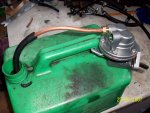
Here's a picture of my new lift pump. The one on the engine would not work so I took it off and tried it as per the photo it wouldn't work so I got a new one.
The new one also does not work and I am scratching my head again.

It is connected to the 'in' port so I would expect that operating the priming lever or the 'internal arm' should eventually get fuel flowing from the 'out' port.

I tried starting it off with a rubber bulb and forced fuel into the pump but subsequent hand pumping would not force any more fuel out.

The diaphragm seems to be flexing as it should and I am stuck for ideas.

Any suggestions please?

yes, I will be fitting an electric pump as a primer/emergency pump but want to keep the mechanical one for normal use.

Thanks
 
Try elevating the tank and double checking that the inlet line is full of fuel. Your wiggle rate may be insufficient to lift the fuel out the tank. After each stroke the fuel just drops back down. If I bleed my engine I normally bleed to the lift pump by opening the union and allowing fuel to free flow out, otherwise I wiggle away and nothing happens.
 
Are you sure that the lever at the engine end is in the right position to enable the manual lever to work and, if you are trying the engine lever, are you operating it quickly enough? I've operated a car mechanical fuel pump by hand and it did work but it needed a lot of vigorous pumping to clear the air through it before it started pumping fuel a lot more efficiently.

Richard
 
Try elevating the tank and double checking that the inlet line is full of fuel. Your wiggle rate may be insufficient to lift the fuel out the tank. After each stroke the fuel just drops back down. If I bleed my engine I normally bleed to the lift pump by opening the union and allowing fuel to free flow out, otherwise I wiggle away and nothing happens.

Ahh! ... I understand what you are saying but on my boat I have always been able to get fuel up a 'dry' pipe from the secondary filter ( low down) via the pump and into the primary filter.

Trying to get my head around this...… I guess that if my pipe went to a fitting at the bottom of the tank then gravity would be assisting and each 'suck' would move the fuel further along the pipe?
 
Are you sure that the lever at the engine end is in the right position to enable the manual lever to work and, if you are trying the engine lever, are you operating it quickly enough? I've operated a car mechanical fuel pump by hand and it did work but it needed a lot of vigorous pumping to clear the air through it before it started pumping fuel a lot more efficiently.

Richard

Thanks Richard ( and Old Boots ) for these suggestions. Does the engine end lever have to be in a certain position for the hand lever to work then? As I 'wiggle' the hand lever I see that the 'engine lever' is moving up and down in sympathy. I have read that when in situ the engine could be stopped at a position where the hand pump would not work ( I guessed/thought) that this could be when the actuating rod was fully up and thus holding the pump in a closed position.
 
Thanks Richard ( and Old Boots ) for these suggestions. Does the engine end lever have to be in a certain position for the hand lever to work then? As I 'wiggle' the hand lever I see that the 'engine lever' is moving up and down in sympathy. I have read that when in situ the engine could be stopped at a position where the hand pump would not work ( I guessed/thought) that this could be when the actuating rod was fully up and thus holding the pump in a closed position.

In that position there is no reason it would not work.

I would remove the pipe from the inlet and put a finger over the inlet port and pump the lever. You should feel some suction on you finger. You should be able to force fuel through without pumping just with an outboard bulb in the inlet line. If not the inlet or outlet valves are jammed or blocked.
 
Thanks Richard ( and Old Boots ) for these suggestions. Does the engine end lever have to be in a certain position for the hand lever to work then? As I 'wiggle' the hand lever I see that the 'engine lever' is moving up and down in sympathy. I have read that when in situ the engine could be stopped at a position where the hand pump would not work ( I guessed/thought) that this could be when the actuating rod was fully up and thus holding the pump in a closed position.

It should, indeed, work in that position. I wonder whether you have an air lock in the pump as these pumps do not pump air very well unless you pump quickly and there is no air leak on the inlet side.

As someone said, raise the fuel level so that it is above the pump and prime the pump by sucking the outlet with the bulb whilst pumping. Once the fuel is pumping lower the fuel container and see if it keeps pumping "uphill".

Richard
 
Thanks Richard ( and Old Boots ) for these suggestions. Does the engine end lever have to be in a certain position for the hand lever to work then? As I 'wiggle' the hand lever I see that the 'engine lever' is moving up and down in sympathy. I have read that when in situ the engine could be stopped at a position where the hand pump would not work ( I guessed/thought) that this could be when the actuating rod was fully up and thus holding the pump in a closed position.

This occurs when the engine stops with the pump operating arm on the toe of the cam. The spring in the pump is then almost fully compressed and little further movement is possible by using the manual lever.

There is no "closed" or "open position" of the pump. It is a diaphragm pump with one way valves in the inlet and outlet . Moving the diaphragm down against the internal spring should draw fuel in. When the lever is released the spring should return the diaphragm to its original position forcing fuel out of the outlet connection.

It should easily draw fuel up from your can although the higher it is above the fuel level the more effort will be needed to operate the lever.

The discharge pressure, or head, will be limited by the strength of the spring.

If you can easily push ( or pull ) fuel though the pump with a priming bulb there is no blockage. If it will not then pump using either the engine operating arm or the manual lever, especially having already been primed with the bulb, there is something wrong with it.

TAKE IT BACK !
 
VicS says "
There is no "closed" or "open position" of the pump. It is a diaphragm pump with one way valves in the inlet and outlet . Moving the diaphragm down against the internal spring should draw fuel in. When the lever is released the spring should return the diaphragm to its original position forcing fuel out of the outlet connection.

Read more at http://www.ybw.com/forums/showthread.php?506293-Testing-Perkins-4108-lift-pump#s8UyYsSTJm1Ly1Xw.99

Thanks, looking inside one of them I see the diaphragm in the base pumping up and down and assume those little valves in the head will open and close under pressure or 'suction'. I will give it all another try.
The kit came with brass connectors and rubber ' olives' . I can't say I like them but assume it gives a tight fit .
 
I u derstand what you trying to do , but why not just stick it back on the engine , leave the exit pipe off and give the engine a good turn over and see what happens .
I just don't think your pumping fast enough .
 
The engine isn't running yet, it's a spare that is being reconditioned. I would try fitting a short length of flexible pipe and filling it with diesel through a funnel then try operating the lever as quickly as you can, if nothing comes out it's faulty.
I u derstand what you trying to do , but why not just stick it back on the engine , leave the exit pipe off and give the engine a good turn over and see what happens .
I just don't think your pumping fast enough .
 
Tried just about everything! Took the pump off the 'spare engine' and tried that without success. So that 3 pumps on test. One from a known working engine One new one and one with less provenance I cant really believe that all 3 are duff!!
The diaphragms are all intact and seem to pump up and down with the levers. The little valves seem to work under pressure from blowing. Fuel will flow through when using the hand bulb.
I must be doing something basically wrong with my test. As stated I am using the correct port!
 
I appreciate this is repeating what I said many posts ago in #3 ..... but when I tried this with a mechanical car pump I could not get the fuel to pump through. After a bit I realised that the pump does not self-prime very well when drawing fuel up about 2 feet from the can. I finally pumped like a mad thing for 60 seconds or so without stopping (if you stop for just a second it just drains straight back) and the fuel finally reached the pump and flushed through all the air. After that it pump like a good 'un. :)

Richard
 
Tried just about everything! Took the pump off the 'spare engine' and tried that without success. So that 3 pumps on test. One from a known working engine One new one and one with less provenance I cant really believe that all 3 are duff!!
The diaphragms are all intact and seem to pump up and down with the levers. The little valves seem to work under pressure from blowing. Fuel will flow through when using the hand bulb.
I must be doing something basically wrong with my test. As stated I am using the correct port!

Are you sure you are moving the operating arm in the right direction and far enough to move the diaphragm fully downwards against its spring ?

e5itt4.jpg
 
Thanks VicS for your perseverance with this.
Your diagram is interesting. It is the one in my manual. When the first pump did not work I dismantled it to check the diaphragm. There was no H shaped piece between the diaphragm and the valves!
This concerned me as at that time I thought that part somehow acted on the valves and it was why I bought the new pump.
The new pump is also missing that part and ( partly thanks to you) and also Appling logic ! I assume that was the old way of holding the in and out valves in position.

I have operated both levers to their maximum extent and also observed how much lever movement is needed to work the diaphragm.
It is baffling I was kept awake last night thinking of the processes involved but there was no 'eureka' moment!

3 simple pumps including a new one all checked internally, a simple 'back to basics' test set up there must be a simple explanation!

I note that neither of the engines here have that spacer between pump and casing but that has no impact on our testing set up.

On the boat it takes about 100 pumps on the lever to get fuel from tank to secondary filter, through the pump and filling the primary filter, I am giving at least 100 pumps on my test and that is just a short pipe and little gravity issue.

I will report back even if it means more egg on face!!

Thanks again
 
Thanks VicS for your perseverance with this.
Your diagram is interesting. It is the one in my manual. When the first pump did not work I dismantled it to check the diaphragm. There was no H shaped piece between the diaphragm and the valves!
This concerned me as at that time I thought that part somehow acted on the valves and it was why I bought the new pump.
The new pump is also missing that part and ( partly thanks to you) and also Appling logic ! I assume that was the old way of holding the in and out valves in position.

I have operated both levers to their maximum extent and also observed how much lever movement is needed to work the diaphragm.
It is baffling I was kept awake last night thinking of the processes involved but there was no 'eureka' moment!

3 simple pumps including a new one all checked internally, a simple 'back to basics' test set up there must be a simple explanation!

I note that neither of the engines here have that spacer between pump and casing but that has no impact on our testing set up.

On the boat it takes about 100 pumps on the lever to get fuel from tank to secondary filter, through the pump and filling the primary filter, I am giving at least 100 pumps on my test and that is just a short pipe and little gravity issue.

I will report back even if it means more egg on face!!

Thanks again

The H piece holds the no return valves against the double O seal. If the valves are not held against the double o seal the pump will not work as the valves are totally ineffective unles the valces are held in some other way.
 
Thanks Roger,
No H pieces in any of mine including the new one! I will need to get my magnifying glass out but I think they are now held in by one of those 'washers' ( I call them!) which are dished but when forced in hold the valve in place.
 
Thanks Roger,
No H pieces in any of mine including the new one! I will need to get my magnifying glass out but I think they are now held in by one of those 'washers' ( I call them!) which are dished but when forced in hold the valve in place.

I have just dug the lift pump out of my garage from my old 4 108 and my trying to take it apart at the mo.

I tried to blow into the inlet and air came out the outlet but when I sucked at the inlet air came out where it should not. This shows me that on my pump at least the inlet valve is not working. Will need to check the outlet valve which should operate in reverse I should be able to suck and not blow.

Try yours that way.
 
Thanks VicS for your perseverance with this.
Your diagram is interesting. It is the one in my manual. When the first pump did not work I dismantled it to check the diaphragm. There was no H shaped piece between the diaphragm and the valves!
This concerned me as at that time I thought that part somehow acted on the valves and it was why I bought the new pump.
The new pump is also missing that part and ( partly thanks to you) and also Appling logic ! I assume that was the old way of holding the in and out valves in position.

I have operated both levers to their maximum extent and also observed how much lever movement is needed to work the diaphragm.
It is baffling I was kept awake last night thinking of the processes involved but there was no 'eureka' moment!

3 simple pumps including a new one all checked internally, a simple 'back to basics' test set up there must be a simple explanation!

I note that neither of the engines here have that spacer between pump and casing but that has no impact on our testing set up.

On the boat it takes about 100 pumps on the lever to get fuel from tank to secondary filter, through the pump and filling the primary filter, I am giving at least 100 pumps on my test and that is just a short pipe and little gravity issue.

I will report back even if it means more egg on face!!

Thanks again

You keep doing the same thing and getting the same result, I assume you have not raised the test tank to establish a positive head. On your boat is the fuel tank below the level of the engine? If it is not and there is a head of fuel, then that is a different set up from what you have been using. The 'little gravity issue' is likely to be the big issue. Have you tried raising your test tank above the level of the pump? Or even just a longer bit of hose filled with fuel and suspended above pump height.
 
The valves probably don't seal when they are dry.
Once it has some diesel in it, it will probably work fine.
It will work much better in a closed system than with air getting in.
I would try drawing fuel into it using a pela or large syringe on the output side.

Once installed it will probably prime OK normally, because the diaphragm chamber should always have a fair bit of diesel in it, in a normal filter-changing scenario. If you pump it at high speed with air going through, you may blow a lot of the fuel out, so it won't prime afterwards.

Also check you really are moving the diaphragm, not just waggling the lever against the little coil spring on the left.
 
Top