Terrible news from Clipper

This 'bear of little brain' ( cultural reference ) has done some delving and found the requested stuff within the Cruising Club of America's 'SASMoments' section of their website....

https://www.cruisingclub.org/safety-sea#sasmoments

....and within the several excellent documents list-linked therein. I'm certain that the nominated officer Ron Trossbach or his successor would be pleased to amplify, on request. I have been unable to trace a UK supplier/agent for Kong. The nearest seems to be in Belgium, and for several reasons I/we are not on best terms with The Bluddy Belgians at present..... However, Petzl is well supported hereabouts.

As for 'the camera never lies'.... that may be true of the devices and filmstock but, as someone who once-upon-a-time operated up to 9 cameras simultaneously, the photographer sure as hell does. :rolleyes:

If you cannot find a supplier in Brexitland, this Bluddy Belgian could order the item for you with his native dealer and forward it to you, provided the bear of little brain agrees to pay the bill.

?
 
There is only one problem with the MAIB report. The failed biner they show looks does not look much like the actual failed biner. Curious that they didn't show the actual failed gear, which they normally do in reports. I think that suggests that this is only an initial finding based on a very few tests and guess work. I think there will be more to come.

I think the deck cleat could be part of it, but there is more. They also didn't mention the strength of gear alternatives.
 
There is only one problem with the MAIB report. The failed biner they show looks does not look much like the actual failed biner. Curious that they didn't show the actual failed gear, which they normally do in reports. I think that suggests that this is only an initial finding based on a very few tests and guess work. I think there will be more to come.

I think the deck cleat could be part of it, but there is more. They also didn't mention the strength of gear alternatives.

It's not a report, it's a bulletin.
An interim statement saying people should ensure their tether clips do not tangle with things like cleats.
 
^^ Exactly.

Though it does not matter (the main body is the same material and thickness) I wonder why they tested an older Spinlock hook, not the Spinlock Race hook (black plastic gate) that was involved in the accident. I hope that means they will test multiple models and multiple manufacturers.
 
Last edited:
Virtually every yacht I see now at boat shows has a furling headsail and many now furling mains. Appreciating that some of these yachts never seem to use their sails at all and others only sail in good conditions - but if modern furling systems were unreliable then there would be a significant hue and cry - led by the major yacht builders. Furling systems can go wrong but constant checking of the various components has meant that our headsail furler has been trouble free for almost 20 years (and we have a fair number of miles under our belt). We have had furling rope jamming due to uneven leads - but that is easily sorted through trial and error. I'd agree that a well made hanked on headsail offers better performance - but I'd rather the convenience of the furler. If we do anticipate character building winds and we will be sailing to windward - we take the 150% genoa off the furler and replace it with a 100% self tacker (which I find is quite possible single handed - though folding the 150% (35m^2) certainly keeps me busy!)
What are the design capability of these yachts?

To be crew by a large crew, while being raced around the planet, when most people take a look out of the window and say its a F7 or F8, I think we will go to the pub, sit round the fire and and have a drink or three. I think not.

I know my own favorite expedition boat, the Boreal, has furling headsails, but it is not built as a racing machine.
 
^^ Exactly.

Though it does not matter (the main body is the same material and thickness) I wonder why they tested an older Spinlock hook, not the Spinlock Race hook (black plastic gate) that was involved in the accident...

They've demonstrated how side-loading can cause a failure. Doesn't really matter what type was tested.
 
I'm a bit late to this thread.
FWIW On my boat, which is always sailed double handed, we adhere to the RORC's rules. A harness and lifejacket will be worn when:
Alone on deck
At night
Wind speed of 25kts
When reefed
Under 1 mile visibility

6 leashes are usually rigged thus:

2 at the foreward end of the cockpit
2 at the aft end of the cockpit
1 right on the stern so the vane gear can be reached safely
1 double hook on jackstays port and starboard

The jackstays are doubled up. i.e. two webbing straps, not particularly tight, running to separate points on the toerail. A humungus shackle rides on both jackstays and that is what the leashes clip onto. The shackle rides smoothly and doesn't get hung up.
 
They've demonstrated how side-loading can cause a failure. Doesn't really matter what type was tested.

??? Other carabiners types are 6 (UIAA 121 type K= 1800 pounds) to 12 (ANSI=3650 pounds) times stronger in this direction by code. In this case the model was very similar. But the type of carabiner matters very much.
 
Last edited:
??? Other carabiners types are 6 (UIAA 121 type K= 1800 pounds) to 12 (ANSI=3650 pounds) times stronger in this direction by code. In this case the model was very similar. But the type of carabiner matters very much.

A Gibb-type hook is not a carabiner. You've already quoted tests for carabiners that include side-loading. The bulletin says the tether assembly in this incident was only tested for longitudinal loading.
 
A Gibb-type hook is not a carabiner. You've already quoted tests for carabiners that include side-loading. The bulletin says the tether assembly in this incident was only tested for longitudinal loading.

Yes, the marine standards only require major axis strength testing. In fact, they don't even require that, which is perhaps why they did not reference a rated strength. They need only survive a drop test as part of the tether assembly. It is a reasonably severe drop.

This is a problem, since side loading has been a know serious issue in industry and climbing for many, many decades. This is not something new. In fact, in 2014 the US industrial standard was increased to 3650 pounds, enough to break nose off many small boat deck cleats. It was increased because of accidents. Industry and climbing have much larger experience pools than sailors.

The Gibb hook falls well within industry and standards groups definition of connectors (the generic), which include all carabiners, clips, and snap hooks used for positioning and fall protection of people. I used the word carabiner for ease of reader understanding, but title line of both standards calls them connectors and they are included. For example, from UIAA-121:

"2.2.1 Strength requirements for type K connectors when loaded over an edge. When tested in accordance with 3.1, type K connectors shall withstand a minimum load of 8 kN."

Let's not toy over words.
 
Last edited:
I'd like a bit more detail about your system please, and who did these ocean and RTW trips, are there any crew available to comment or verifiable photo's / logs?

I don't want it appear I don't believe you.
(Quote)
-------------------------------------------------------------------------------------------------------------------------------------------------------------------

Search "Silas Crosby" and "Tagish" two of my 36 footers .Silas Crosby sailed from BC to Mexico, then Hawaai, then back to BC then BC to Cape Horn, then back up to the Aleutians, then back to BC. She also did many local trips around Vancouver Island and Alaska.
He recommended my 36 to the skipper of Tagish.
Tagish circumnavigated . Both have my fuler, and had zero problems with it.
It is a 1 1/4 inch sch 40 aluminium pipe for the extrusion, slotted full length for the luff rope . Plastic bushings keep the stay centred.
The drum is welded to the bottom ,and a halyard block welded to the top for the halyard. After hoisting the sail, you tie the wire halyard to the drum and take the rope tail away. Then you tighten the luff with a lanyard to the drum. Halyard and all rotates. Only one moving part, once the sail is on .
Under $150 for the works.
 
Last edited:
The jackstays are doubled up. i.e. two webbing straps, not particularly tight, running to separate points on the toerail. A humungus shackle rides on both jackstays and that is what the leashes clip onto. The shackle rides smoothly and doesn't get hung up.

Michael
I have been wondering whether this would be a simple answer to the usual dreadful fight to get the hook on my tether around the flat webbing jackstay. Had been thinking of getting two or three s/s rings of perhaps 5cm diameter and thread them onto the jackstay.
Do you find it easier to hook onto your shackle than it is onto the webbing?
Peter
 
Michael
I have been wondering whether this would be a simple answer to the usual dreadful fight to get the hook on my tether around the flat webbing jackstay. Had been thinking of getting two or three s/s rings of perhaps 5cm diameter and thread them onto the jackstay.
Do you find it easier to hook onto your shackle than it is onto the webbing?
Peter

I've know several people to do that with SS rings.

a. Aluminum rappel rings are load rated, lighter, and cheaper. I'm sure you can find a UK brand.
https://www.rei.com/product/745608/omega-pacific-rappel-ring

b. If you unclip for any reason, the ring will slide away. No a big deal.

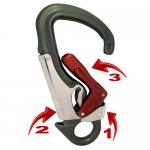
c. Key lock clips don't snag. The Kong Tango and ISC 903 (below), for example, are key lock.
isc-aluminum-snap-hook-triple-locking-6.jpg
 
TW, what would you think of using a 'Quickdraw' ( 6"-8" sewn webbing strap with a loop sewn in at each end ) with Rei-style Rap Rings instead of carabiners, and one or more of these on the jackstay, each side. Plus a triple-hook Kong type connector x 3 on one's personal tether....?

Would that, d'you think, be getting closer to a solution?

( I can't illustrate that )
 
^^ Please explain the purpose of the quick draws. Is it to prevent cross loading? It would do that, since the rings would not be appreciably weakened. In fact, as you probably know, one of the main reasons climbers use quick draws is to avoid these sorts of problems. But it feels complicated in use.

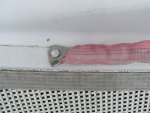
I've never terminated jacklines to cleats, so I've never faced the problem. If you end with a u-bolt or bolt hanger safely away from the bow and transom, this particular scenario does not exist. (The webbing is just a UV cover over a lashing. Yes, there is a backing plate underneath.) One more argument for dedicated anchor points. The real reason is to mount the jacklines where you want them. Since I can be thrown forward, I don't want jacklines that go clear to the bow.

(a large biner does not side load on this. It just wraps around and over it.)
1.%u00252Bbolt%u00252Bhanger%u00252Bmakes%u00252Bstrong%u00252Bno-drill%u00252Bjackline%u00252Ba.jpg
 
We use cleats because they are there, because they are immensely strong and the layup has been beefed up for the cleat. Lashing jacklines to the pillar of the cleat does not impose on the use of the cleat. I don't like 'U' bolts, at all - or not in this application. The 'U' bolts I see (and use) protrude too far (too high), they are 'U's with significant vertical portions and the possible lever effect, on the bolt, is huge - and this lever effect is not an issue with large cast alloy (or stainless) horn cleats. Lower profile 'U' bolts would be the answer, where only the top of the inverted 'U' protruded ( so a '(' rather than a 'U') - but I have never seen them here in chandlers. Now that I think about it - I suppose I could have further threaded the 'U' bolts! which would have allowed the 'top' of the 'U' to be more flush with the deck.

As a slight aside - 'U' bolts here come with a tiny backing plate, a bit like joined up halfpenny or farthing washers. We beefed ours up using large 5mm alloy plate.

Jonathan
 
Last edited:
We use cleats because they are there, because they are immensely strong and the layup has been beefed up for the cleat. Lashing jacklines to the pillar of the cleat does not impose on the use of the cleat. I don't like 'U' bolts, at all - or not in this application. The 'U' bolts I see (and use) protrude too far (too high), they are 'U's with significant vertical portions and the possible lever effect, on the bolt, is huge - and this lever effect is not an issue with large cast alloy (or stainless) horn cleats. Lower profile 'U' bolts would be the answer, where only the top of the inverted 'U' protruded ( so a '(' rather than a 'U') - but I have never seen them here in chandlers. Now that I think about it - I suppose I could have further threaded the 'U' bolts! which would have allowed the 'top' of the 'U' to be more flush with the deck.

As a slight aside - 'U' bolts here come with a tiny backing plate, a bit like joined up halfpenny or farthing washers. We beefed ours up using large 5mm alloy plate.

Jonathan

That makes for an interesting question. What would the best anchor point be from a structural perspective.
1. Cleats are strong, but they offer cross load potential (actually, I think it was the cleat farther aft that cause the mischief, not the cleat the jack line was anchored to, but I don't know if anyone knows). More to the point, I want to terminate my jacklines 5 feet aft and 3 feet inboard. Cleats don't help with that.
2. U-bolts. Assuming at least 9 mm bolts are used, the lever effect is not relevant. These are used extensively in rock climbing, have been hammered from every correction, and this has not proven to be a problem. Yup, they do stick up. Very little cross load potential.
3. Bolt hangers. Lower profile. A single 3/8" bolt is enough. No cross loading potential. You need to use a shackle or thimble because the edge radius is too small.
4. Folding pad eye. Depending on the size, a biner could jam up in their. Very low profile.
5. Other? A horizontal tang, like a chain plate? A Ropeye? Something custom, perhaps related to a bolt hanger, built for the purpose (rounded edges)?
 
I would have thought the market large enough to support a dedicated component as a jackstay securement point.

Thinwater - I'm not entirely sure why you condemn use of bow located securement points. If you are going to be knock down you are going to be washed aft, not forward. A following wave might catch you, but much less likely. I have similar questions about being swept aft - there are a whole host of things you will hit before you reach the transom and if you are moving at any speed hitting your head on a winch is likely to cause more damage than impact anything at the transom itself.

Jonathan
 
To some extent personal preference; on a cat if you get thrown forward from near the forestay you will be under the tramp and may die. If you get thrown aft you land on the tramp. No bruises. Also cats are prone to sudden stops when we stuff a wave. So I would rather have a restraint holding me back.

My second reason is that there is nothing to stop you from clipping a hard point at the bow. That is what I do. Keep the 6' tether on the jackline and clip a 3' tether to a hard point at the bow or where I am working. The jackline holds me back and the hard point braces me.

So yes, I believe that for most boats, ending the jacklines at least ~3-4 feet from the bow and transom is smart. This follows the same logic that suggests keeping jackline significantly inboard makes sense. But I'm sure it depends on the boat.

Yup, a pretty tiny market.
 
Top