Temperature overheat alarm not working on Volvo Penta MD2020

I wonder if you could gain access to the circuit board by dissolving the potting compound. I’ve got a 2010 and the parts look the same.
The potting compound is probably silicone, in which case Screwfix 88987 might remove it. If the part is £400 it could be worth a try.
Diodes are easy to test and cost pennies.
If you’ve got the time, patience and skill to unpot the board, find the faulty diode, replace it, repot the board - you probably have skill to just make a new board.
 
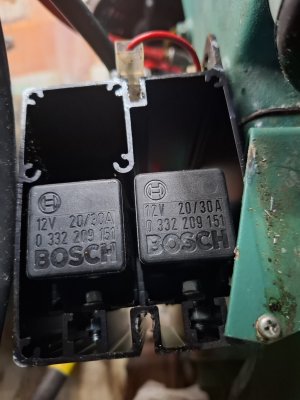
One other thought, the attached photo is of the fuse box on the side of the engine that tje brown and white wire frim the switch runs, along with many others, before heading off to the control panel etc. I've looked them up and they are a 5 pin relay, only about £10 on Amazon, I wonder if it might be worth replacing them to see if that is the issue?1000014302.jpg
 
The glow relay is the same as the starter one. Just swop them over to check the starter circuit using the glow relay.
I had 3 glow relays go in 5000 engine hours but never had a starter relay blow.
Halfords stock them as do most auto factors.
 
OK - so just so I am sure I understand - one of these is for glow plugs, and one is for starter - and the starter one is the one that has the temp warning alarm on as that is the alarm that sounds when I turn the ignition on (when working correctly then stops once engine has started) - so if I swap them over and alarm then functions properly then I just need to replace it. I guess I would need to get the engine started and warm first so I can then stop the engine and swap them over then start up again without needing the glow relay??
 
OK - so just so I am sure I understand - one of these is for glow plugs, and one is for starter - and the starter one is the one that has the temp warning alarm on as that is the alarm that sounds when I turn the ignition on (when working correctly then stops once engine has started) - so if I swap them over and alarm then functions properly then I just need to replace it. I guess I would need to get the engine started and warm first so I can then stop the engine and swap them over then start up again without needing the glow relay??
Once the engine is warm you will not need the glow relay so you could put it in the starter relay slot. How that affects the alarmis anybodies guess.
Have you really played with all the connections yet & given them a good check to ensure they are definitely engaging & not pushing any pins back?
 
OK - yes that's what I thought - will let engine run for a bit then turn off, switch relays and see what happens - thank you for the suggestion. The only connections I've really checked properly are on the alarm itself and the relay switch which the brown white wire runs to - and they are all fine. I've not checked any pins on these relays as they've not been touched in any way so can't have moved or shifted in any way. Will hopefully get to the boat later in the week and let you know if there's any joy. Thanks again.
 
How that affects the alarmis anybodies guess.
It’s not - the wiring diagram is quite clear - no need to guess: these are entirely separate from the alarms and not sure why the OP is looking at them.
Have you really played with all the connections yet & given them a good check to ensure they are definitely engaging & not pushing any pins back?
Whilst it’s always a good idea to try these things: the fault “switches” (temp and oil pressure) are “Normally Open” and close on detecting an issue so a “bad connection” would not cause a false alarm. Since the lights are not on but the alarm is - it very strongly suggests a blown diode.
 
It’s not - the wiring diagram is quite clear - no need to guess: these are entirely separate from the alarms and not sure why the OP is looking at them.

Whilst it’s always a good idea to try these things: the fault “switches” (temp and oil pressure) are “Normally Open” and close on detecting an issue so a “bad connection” would not cause a false alarm. Since the lights are not on but the alarm is - it very strongly suggests a blown diode.
OK - so where is that diode likely to be - in the 'light and control' module TSB240 mentioned earlier costing about £400...?
 
So having read back through the advice and suggestions, if the next stage would be to spend £400 on a new light and control module I think I'd rather leave the buzzer disconnected and install a new separate alarm as a few people have suggested - and it seems the best option is to fit one to the exhaust, such as the silicon Marine one that a few have mentioned, which will give a temperature display in the cockpit. Can I take it that this alarm, assuming I install it correctly, will be adequate on its own, and I can just leave the existing buzzer alarm disconnected - ie - is an exhaust alarm on its own adequate protection?
 
So having read back through the advice and suggestions, if the next stage would be to spend £400 on a new light and control module I think I'd rather leave the buzzer disconnected and install a new separate alarm as a few people have suggested - and it seems the best option is to fit one to the exhaust, such as the silicon Marine one that a few have mentioned, which will give a temperature display in the cockpit. Can I take it that this alarm, assuming I install it correctly, will be adequate on its own, and I can just leave the existing buzzer alarm disconnected - ie - is an exhaust alarm on its own adequate protection?
Then you will have no audible warning of an alternator or oil pressure issue. If you are lucky the lights will still function. If your panel is somewhere very obvious MAYBE that is ok. If it’s out of sight then it could be a bad idea. An exhaust alarm probably spots 90% of overheat issues, but I’m sure there will be circumstances (like a failed coolant pump) where the exhaust continues to get cooled below any trigger point whilst the coolant is boiling. If it was me I would make a replacement circuit - it’s probably <£15 in parts, although you might need to spend £50+ as stuff doesn’t come in ones and twos. Ammonite’s solution seems perfectly sensible for someone who doesn’t want to get a soldering iron out (although the circuit looks simple enough you could probably bodge something without even soldering)
 
Good morning! Thank you once again for taking the time to talk me through this - very much appreciated - I feel like I'm on a very steep learning curve - actually been on one since I bought the boat in September!
So, I last did soldering on mini circuit boards about 40 years ago at school - but despite eyesight having deteriorated since then I think I can give this a go using the wiring diagram TSB240 sent yesterday morning. If that fails then I'll look at buying one of the panels that Ammonite shared from 'Boat bits'.
A couple of questions - presumably I can just buy standard electronic components - they don't need to be 'marine grade' or purchased from anywhere specifically?
A secondly - the existing control unit - I've not spotted it yet - will go and positively ID it before I start - is it obvious what I'm looking for?
Many thanks once again
 
No such thing as marine grade components. If you get it working you may need to think about how you waterproof it all afterwards. When you find the old one you will see it has been encapsulated (basically placed in a sort of mould and then smothered in glue/sealant).

The old module should be obvious as it has the bulbs for the warning lights built in.
 
Thanks. Will try to get down to the boat in the next few days to have a look, then start investigating getting the bits together - thanks again for advice
 
"secondly - the existing control unit - I've not spotted it yet - will go and positively ID it before I start - is it obvious what I'm looking for?"

It is mounted inside your control panel behind the alarm light windows. It has plugs to connect to the wiring.

It is probably easiest to access it by removing your current control panel with the four retaining screws in each corner and carefully prising it from your cockpit fully assembled.

Good luck with that especially if it has been sika bonded.
If heavy with sika then see if you have access from behind without removing facia.

I think it has two screws or nuts on end of studs that hold it in place onto the panel facia.
 
Just had a look on ebay for a diesel engine monitor.

Diesel Engine Monitor and Control Panel DSE6110 for Reliable Operation | eBay UK

Much cheaper than a vp module and way more functionality than the entire basic vp control panel.

I put up with the intermittent alarm for two years.

To be honest the alarms on the basic vp panel are about as useful as a chocolate tea pot.

You can tell if your glow plugs are working as either the engine doesn't start straight away or the light in the tacho does or doesn't dim when you turn the key.

By the time the over temp alarm has gone off you can have boiled a lot of water into the bilges or even burnt a hole your exhaust. Gassing your pet dog or wife in the cabin can be prevented with gas alarm or an exhaust temp monitor.
The over temp alarm will never tell you if you have a blocked water cooling intake or blocked exhaust injection elbow unlike an exhaust monitor.

If you do get an oil pressure alarm you are probably in for an engine rebuild or replacement by the time it has gone off and you are able to react to it.

If your alternator stops charging then most modern chartplotters will give a low voltage alarm.

I would ask one question before you worry further about your temp alarm.
The greatest weakness on the VP 2000 series is the exhaust elbow.

When was the last time this was removed and checked for blockage or corrosion of the water injection point?

It is recommended minimum every two years but nothing in the user manual.
 
Just had a look on ebay for a diesel engine monitor.

Diesel Engine Monitor and Control Panel DSE6110 for Reliable Operation | eBay UK

Much cheaper than a vp module and way more functionality than the entire basic vp control panel.

I put up with the intermittent alarm for two years.

To be honest the alarms on the basic vp panel are about as useful as a chocolate tea pot.

You can tell if your glow plugs are working as either the engine doesn't start straight away or the light in the tacho does or doesn't dim when you turn the key.

By the time the over temp alarm has gone off you can have boiled a lot of water into the bilges or even burnt a hole your exhaust. Gassing your pet dog or wife in the cabin can be prevented with gas alarm or an exhaust temp monitor.
The over temp alarm will never tell you if you have a blocked water cooling intake or blocked exhaust injection elbow unlike an exhaust monitor.

If you do get an oil pressure alarm you are probably in for an engine rebuild or replacement by the time it has gone off and you are able to react to it.

If your alternator stops charging then most modern chartplotters will give a low voltage alarm.

I would ask one question before you worry further about your temp alarm.
The greatest weakness on the VP 2000 series is the exhaust elbow.

When was the last time this was removed and checked for blockage or corrosion of the water injection point?

It is recommended minimum every two years but nothing in the user manual.
OK - more to think about! 😂
Those monitors look interesting - but complicated...... not sure
I get the rationale for the existing alarms being of limited value, and I think it's certainly not worth spending a lot of money to get the existing alarm working again, so will see if making my own control panel is viable - at least that has limited outlay and it will be useful learning for me. I also think it will be worth getting an exhaust alarm - whether I get the buzzer alarm sorted or not, from what I've read they seem very worthwhile.
Thanks again for your time.
 
Top