Teak Decks - Remove, Restore or Replace?

neil1967

Well-Known Member
Joined
28 Nov 2007
Messages
1,149
Location
Tavira, Portugal
Visit site
We have 20 year old (I believe) teak decks on our Oyster 406. Although they are still pretty thick (8-10mm), they are showing their age, with screwheads showing and the caulking shrinking and coming adrift. I suspect they were around 15mm thick to start with. I believe I have 3 options (as per title) and would be grateful for thoughts on all of them. The current decks seem slightly odd in that the teak planks at the edges are all conventionally screwed down, with teak plugs, but the remaining planks have been attached with screws underneath the caulking. I don't know yet whether the planks are also stuck down. Grateful for any thoughts on the options:

Remove - I am aware that some owners have simply removed the teak and then either painted over with some form of antislip or have possibly glued antislip sheets. I suspect all the screwholes would need to be filled as well, so this would not be a quick task, but I think it would be feasible to DIY.

Restore - given the thickness of teak left, I could simply restore it. I would need to deepen the slots between the planks and decide whether to do it all insitu, or to remove the teak planks one at a time and restore them before using a modern glue to stick them back down (or on the conventional planks, deepening the screwholes and also screwing down) and re-caulk. I think this would be an awful lot of work, but it could be done in stages while the boat was still in use. My real concern is how long the refurbished teak would last - if it is only 5 years then it is probably not worth doing, but if it is 10-20 years then perhaps it is?

Replace - I think the only choice here is whether to go synthetic or real, but it is the cost that is the crippler - any ideas of the cost for doing a 12.3 m, 3.8m beam yacht ?

Any constructive thoughts and opinions welcome!
 
You have covered the options. The killer £35k+ for a strip and replace and not a lot difference between real and good fake the biggest single cost is labour (in UK, but you may find cheaper where you are)

The planks will be glued as well as screwed - the screws under the caulking are there to hold them down while the glue sets and is not a good method, but they have at least left them in rather than removing and filling as some did!

Suppose the basic decision is about how long you want to keep the boat. a new deck will obviously increase the value of the boat but probably not by the amount it costs. so short term, patching and letting next owner deal with it. Removing the teak and making good the deck (hoping water has not got into the deck if it is cored) is a hard and long job but doable DIY. suspect you have lots of fittings screwed through the teak and deck which will all have to be removed as well. Once clear and sound, with that age and value boat fairing and finishing with something like Kiwigrip is probably a viable choice - in fact is likely to enhance the value of the boat.

A new teak deck glued should certainly last 20+ years so if that is your time horizon then worth considering as who can predict the value of the boat at that point and you will get the pleasure (if you consider it a pleasure!) over that period.
 
Replace - I think the only choice here is whether to go synthetic or real, but it is the cost that is the crippler - any ideas of the cost for doing a 12.3 m, 3.8m beam yacht ?

In 2009 we replaced a teak deck on a 44' boat (flush deck).
Opted for Marinedeck 2000 (cork based) and paid €25K - but that included replacing the rotten marine ply which had been lurking underneath the teak.

In your shoes, I would go down the 'restore' route.
 
We have 20 year old (I believe) teak decks on our Oyster 406. Although they are still pretty thick (8-10mm), they are showing their age, with screwheads showing and the caulking shrinking and coming adrift. I suspect they were around 15mm thick to start with. I believe I have 3 options (as per title) and would be grateful for thoughts on all of them. The current decks seem slightly odd in that the teak planks at the edges are all conventionally screwed down, with teak plugs, but the remaining planks have been attached with screws underneath the caulking. I don't know yet whether the planks are also stuck down. Grateful for any thoughts on the options:

Remove - I am aware that some owners have simply removed the teak and then either painted over with some form of antislip or have possibly glued antislip sheets. I suspect all the screwholes would need to be filled as well, so this would not be a quick task, but I think it would be feasible to DIY.

Restore - given the thickness of teak left, I could simply restore it. I would need to deepen the slots between the planks and decide whether to do it all insitu, or to remove the teak planks one at a time and restore them before using a modern glue to stick them back down (or on the conventional planks, deepening the screwholes and also screwing down) and re-caulk. I think this would be an awful lot of work, but it could be done in stages while the boat was still in use. My real concern is how long the refurbished teak would last - if it is only 5 years then it is probably not worth doing, but if it is 10-20 years then perhaps it is?

Replace - I think the only choice here is whether to go synthetic or real, but it is the cost that is the crippler - any ideas of the cost for doing a 12.3 m, 3.8m beam yacht ?

Any constructive thoughts and opinions welcome!
We have 20 year old (I believe) teak decks on our Oyster 406. Although they are still pretty thick (8-10mm), they are showing their age, with screwheads showing and the caulking shrinking and coming adrift. I suspect they were around 15mm thick to start with. I believe I have 3 options (as per title) and would be grateful for thoughts on all of them. The current decks seem slightly odd in that the teak planks at the edges are all conventionally screwed down, with teak plugs, but the remaining planks have been attached with screws underneath the caulking. I don't know yet whether the planks are also stuck down. Grateful for any thoughts on the options:

Remove - I am aware that some owners have simply removed the teak and then either painted over with some form of antislip or have possibly glued antislip sheets. I suspect all the screwholes would need to be filled as well, so this would not be a quick task, but I think it would be feasible to DIY.

Restore - given the thickness of teak left, I could simply restore it. I would need to deepen the slots between the planks and decide whether to do it all insitu, or to remove the teak planks one at a time and restore them before using a modern glue to stick them back down (or on the conventional planks, deepening the screwholes and also screwing down) and re-caulk. I think this would be an awful lot of work, but it could be done in stages while the boat was still in use. My real concern is how long the refurbished teak would last - if it is only 5 years then it is probably not worth doing, but if it is 10-20 years then perhaps it is?

Replace - I think the only choice here is whether to go synthetic or real, but it is the cost that is the crippler - any ideas of the cost for doing a 12.3 m, 3.8m beam yacht ?

Any constructive thoughts and opinions welcome!
I recently bought a 30yr old boat with the same issue. Looking over the documented history, the decks had £3-4000 of repairs twice at 10 and 20 years. I opted to remove and had the work done by a yard although it is diy-able if you can keep water off the decks for several weeks. I don't know the exact cost but around £10k for 36ft. That is well uhder 1/2 the cost to replace the teak. I went for remove as I didn't want the risk of deck core damage looming into the future and because the cost to reinstate teak was better spent on other parts of the boat (engine, rigging, sails etc). No regrets over the loss of teak and I now know the core is OK and will stay that way. Consider all the deck fittings that need removed - some are simple but some may not be.
 
We are in the process of "improving" our even older teak decks. We know there is 10mm of teak left and, frankly, many new boats with teak have this depth to start with. So we've cut back the raised caulking, removed any screws showing, drilled down to the decks (so far we haven't found any wet/damp teak) with a 10mm Forstner bit, and then filled the holes with a fluid slow-curing epoxy that helps seal and bond to the deck. Once this has been in place for a few hours to soak in we then replace with a new Teak Plug and leave for a week. We do not replace the screws. We then knock off the plug and sand the decks lightly. I reckon we've replace around 20% of the screws/plugs so far and will continue to replace as and when they show. We are not replacing any caulking as it seems to have been put down very well and is not lifting, but if we did we would rout out and replace and sand.

It's not perfect, but it's so much better than it was before, it's cheap, it works and with 5mm of wear so far (based on 30 years), we'll still have 8mm left in 10 years.

If we ever do replace it would definitely be a "Teak" composite.

FWIW, this approach is a combination of several methods I've seen on the topic of replacing /maintaining/restoring teaks decks/plugs on YouTube. It's definitely worth googling this......

Our boat is a Trintella 45.....so very well built!
 
Last edited:
I recently bought a 30yr old boat with the same issue. Looking over the documented history, the decks had £3-4000 of repairs twice at 10 and 20 years. I opted to remove and had the work done by a yard although it is diy-able if you can keep water off the decks for several weeks. I don't know the exact cost but around £10k for 36ft. That is well uhder 1/2 the cost to replace the teak. I went for remove as I didn't want the risk of deck core damage looming into the future and because the cost to reinstate teak was better spent on other parts of the boat (engine, rigging, sails etc). No regrets over the loss of teak and I now know the core is OK and will stay that way. Consider all the deck fittings that need removed - some are simple but some may not be.
We did the same thing but we replaced the teak with new in the cockpit and coachroof area. The new teak is epoxied down and 25mm thick. By removing the teak from the deck we now have 2500 less holes in the boat and a far easier to maintain deck. Two layers of 300g cloth were laid then filled and fared.
I am sure we have also increase the value of the boat
 
Last edited:
My teak decks were badly worn, Having the opportunity of having the boat in a tent I decided to remove the teak. All the screw holes were countersunk and the the whole lot filled and faired several times. The advantage of being under cover and being able to work at waist height from a scaffold tower was considerable.
 
The elephant in the room is the prospect of water in the decks core.
I ‘think’ you could spend A some time removing each plug and screw and filing each hole and replugging . B Spend a lot more time doing A plus all that seam caulking
C Bite the bullet and spend even more time but once only and ..Remove it all , paint it .

The advantage with C is you get to remove all the chain plates and inspect them and their ageing fasteners AND rebed every deck fitting
You will have a leak free final deck in any colour of your choice . If you really like the boat ....

But, D you might also consider doing nothing and eventually discount the boat and sell it as is sometime upon the future .. time vs money , hmmm

In skill levels , A is easiest and you can carry on sailing ?
What you decide , only you can balance ..

Personally I have done B with proper wooden decks and C with what you have but don’t underestimate the commitment of resources and the need to see it through !
 
We are in the process of "improving" our even older teak decks. We know there is 10mm of teak left and, frankly, many new boats with teak have this depth to start with. So we've cut back the raised caulking, removed any screws showing, drilled down to the decks (so far we haven't found any wet/damp teak) with a 10mm Forstner bit, and then filled the holes with a fluid slow-curing epoxy that helps seal and bond to the deck. Once this has been in place for a few hours to soak in we then replace with a new Teak Plug and leave for a week. We do not replace the screws. We then knock off the plug and sand the decks lightly. I reckon we've replace around 20% of the screws/plugs so far and will continue to replace as and when they show. We are not replacing any caulking as it seems to have been put down very well and is not lifting, but if we did we would rout out and replace and sand.

It's not perfect, but it's so much better than it was before, it's cheap, it works and with 5mm of wear so far (based on 30 years), we'll still have 8mm left in 10 years.

If we ever do replace it would definitely be a "Teak" composite.

FWIW, this approach is a combination of several methods I've seen on the topic of replacing /maintaining/restoring teaks decks/plugs on YouTube. It's definitely worth googling this......

Our boat is a Trintella 45.....so very well built!
Our boat is a Trintella 44. Also very well built but minus the teak deck.
The problem with removing the teak deck on our boats is the teak goes under the aluminium toerail. We have just replaced our toerail as well.
It's a massive undertaking as you need to remove all headlining panels. Fortunately on the Trintella you can?
 
Thanks for all your thoughts. Fortunately the Oyster 406 doesn’t have a cored deck, just solid, thick fiberglass, and the teak doesn’t go under the toerail. I think I will probably trial a restoration of part of the deck that is worst affected and see how that goes. If successful I’ll carry on, in stages, and if not, I think I’ll remove the lot, but it is a big project, given that I now understand the deck is glued down, not just screwed down.
 
I restored mine by cutting the grooves deeper and re-caulked. I had less thickness than you have and I expect many years life yet. I used a plunge saw with two blades to do the grooves. I had no screws. Frankly though I would like to be rid of it and am only keeping it to preserve the boat value. It’s too hot. Next time it will be paint.
 
Our boat is a Trintella 44. Also very well built but minus the teak deck.
The problem with removing the teak deck on our boats is the teak goes under the aluminium toerail. We have just replaced our toerail as well.
It's a massive undertaking as you need to remove all headlining panels. Fortunately on the Trintella you can?


We had the same (Kalik 44).
Toerail and all deck fittings had to be removed.

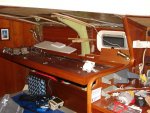
A picture is worth a thousand words...

starboard saloon.jpg

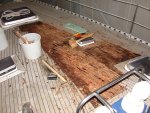
Also, this - fordeck.
Old teak and the marine ply lurking underneath.
Notice the dark patches where the ply was rotten to the core. Mainly around deck fittings, shrouds and hatches.

rot.jpg
 
I'll admit, I have no class - for me, a teak deck would pretty much be a deal breaker unless it was new and I'd seen it done with proper lumps of wood and not the thin rubbish that's often used, but it does seem to me that whether to remove or replace would depend on the boat. If teak was an option, by all means get rid of it, but for a boat of serious quality, where a future buyer would expect it, ISTM that not having it downgrades the boat from future classic to future old banger
 
New teak vs old teak . To paraphrase Dr Spock:
“It’s teak Jim, but not as we know it”

Plantation grown, certifiable and sustainable teak- is it really worth using at all? Tick box pulpwood ??

I think it would be kinder to leave it on the tree ?
 
I'll admit, I have no class - for me, a teak deck would pretty much be a deal breaker unless it was new and I'd seen it done with proper lumps of wood and not the thin rubbish that's often used, but it does seem to me that whether to remove or replace would depend on the boat. If teak was an option, by all means get rid of it, but for a boat of serious quality, where a future buyer would expect it, ISTM that not having it downgrades the boat from future classic to future old banger
The well informed future buyer is going to know that the teak will be a liability.
A teak deck has a limited life.
'Restore' it now, maybe it's good for ten years. How long do you intend to keep the boat? What's the surveyor going to say in say 7 years' time?

Don't forget that in the grand old days when teak decks were the norm, yachts were hauled out and covered up for 6 months of the year, not left out in Solent drizzle through the winter.

I am dubious about an Oyster 406 having a solid GRP deck under the teak. That would be appallingly heavy.
 
The well informed future buyer is going to know that the teak will be a liability.
A teak deck has a limited life.
'Restore' it now, maybe it's good for ten years. How long do you intend to keep the boat? What's the surveyor going to say in say 7 years' time?

Don't forget that in the grand old days when teak decks were the norm, yachts were hauled out and covered up for 6 months of the year, not left out in Solent drizzle through the winter.

I am dubious about an Oyster 406 having a solid GRP deck under the teak. That would be appallingly heavy.
I've just had mine done now on the finishing touches. The first replacement in 35 years. ?
 
A teak deck has a limited life.
'Restore' it now, maybe it's good for ten years. How long do you intend to keep the boat? What's the surveyor going to say in say 7 years' time?

After the 'adventures' with the previous boat I swore I would never again own a boat with a teak deck.
Yet, last year I bought a boat with... a teak deck.
The deck was laid new in 2003. And the survey I had carried out showed it was still at least 15mm thick.
With proper care, I expect to get at least another 10-15 years out of it.

When the time comes to sell (not any time soon), the boat will be over 50-60 years old (launched 1977).
She'll most likely appeal to the classic yacht crowd than the high internal volume AWB crowd (who will expect at least twin cabins/heads and shower).
Most classic yacht owners I know expect a teak deck.

I am dubious about an Oyster 406 having a solid GRP deck under the teak. That would be appallingly heavy.

+1
I would investigaste further before deciding on a course of action.
 
Top