Teak Deck Repair & Sanding

Dino

Well-Known Member
Joined
27 Apr 2009
Messages
1,069
Location
Ireland
Visit site
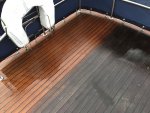
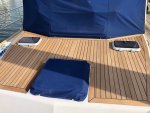
Hi folks, the teak decks on my boat were replaced by a previous owner around 13 or 14 years ago. They are in pretty good nick but need minor repairs.
What is the best caulking for doing small repairs? I have no intention of recalling the deck, I just want to repair a few loose pieces and one or two small areas that are missing. They are only a few inches long.
Also, the decks are a bit uneven in places and there seems to be a few areas that are gone a bit furry. I have purchased a upholsterers skiving tool to trim the caulking that is sitting proud of the deck. I am tempted to sand the decks to bring up the colour and then treat them with a sealant. I saw a Norwegian product called Hoveling Golden Teak Sealer. This was recommended on an owners club Facebook group and the results looked great.
Does anyone have any experience of this product or general deck sanding?
 
TDS is perhaps the most commonly used caulking, available from most chandlers. Worth considering how your deck was constructed and fitted - particularly the thickness of the planks. Generally if the planks are 9mm+ thick they tend to be caulked in such a way that the caulking adheres to the sides, achieved by laying a breaker tape in the bottom. This is to allow for movement of the planks relative to eachother. Thinner planks are usually caulked to the bottom. one of the advantages of thicker planks is that they can stand some sanding to deal with wear and unevenness. A light sanding is normally OK to level off.

Most people leave teak decks bare and keep clean by regular washing or use of Patio Magic if prone to mould formation. I clean my cockpit once a year with a teak cleaner and it comes up light grey. Not familiar with the sealer you mention, but it seems to be for decking and deck furniture. A sealer commonly used on decks is Semco which looks good if slightly artificial, but you need to sand right back to clean golden teak before applying and it it needs regular touching up.
 
When patching the caulking, remove the nearby caulking until you get to some that's firmly attached, then cut it off at a 45 degree angle using a craft knife. It's best to mask both sides of the groove with tape before applying the caulking, to minimise the need for sanding afterwards. Keep a cardboard box nearby the work area, with a brick in it, to put the discarded bits of tape in (the brick stops the box blowing away - don't ask how I know this!).

If you want to sand the decks, do it very gently. I used a lightweight cheap belt sander on mine, this sort of thing - Mac Allister MSBS900 3

Don't be tempted to try to sand out all the imperfections; you may remove too much teak. You'll need to use a small detail sander or a sanding block to do the awkward bits.

I've never been a fan of putting sealer on a teak deck. I think it's better to simply treat it a couple of times a year with an algaecide/fungicide. Tranona has suggested Patio Magic; in my experience Boracol is a better product. The deck will weather to a natural silvery-grey colour.

I've used Semco on a cockpit table, with good results, but I wouldn't use it on a deck.
 
Please don't sand the deck - this removes more good wood than dirt. Get it clean with Wessex two pack, then apply two coats of Semco clear.

Semco seals out moisture, which if allowed in then freezes in cold weather and this causes splitting and splintering of the surface. Keeping the water out reduces significantly the frost damage.
 
Please don't sand the deck - this removes more good wood than dirt. Get it clean with Wessex two pack, then apply two coats of Semco clear.
I would assume you have not read the link in post #2 as your advice is totally the opposite to what teakdecking.com say
 
We are in the process of "refreshing" our somewhat tired (30 year old!) decks. We know there is still 10mm left so there should be life left (otherwise replacing them is ££££££s squared).

Our approach is:

Clean with Boracol
Remove caulking that is proud above the deck with this tool (it's really easy to do this with the tool). - Mozart "2 in 1" trimming knife
Remove any screws where the plug has fallen out/is worn
Drill out plug hole to 5mm with this: - Bosch Professional 2608577000 Forstner Bit (for Wood, Ø 10 mm, Length 90 mm, Drill Accessories), Silver/Black: Amazon.co.uk: DIY & Tools
Put two part penetrating epoxy into the plug (we use this as it's liquid that cures slowly) Smiths CPES - Clear Penetrating Epoxy Sealer, UK and Europe
Replace Screw
Replace Plug
Wait for Epoxy to set (24hrs minimum)
Chisel off plug.
Lightly sand deck.

We are halfway through this, but it's taken a lot less time than we thought (hours rather than days), and it's 45 foot Trintella with large decks....
 
There are plenty of people who will disagree considerably with the advice in the link in Post 2 - which says to sand lightly EVERY YEAR. That advice come s from a US company that sells new decking, probably to people who can afford it and want to keep their teak looking perfect regardless of expense. Whilst a lot of what they say is true, I take issue with annual sanding unless you have deep pockets.

For most boats that are encumbered with teak decks (essentially a financial timebomb waiting to go off) Boracol or Patio Magic once or twice a year, regular washing down, and never using anything with stiffer bristles than a soft paintbrush on the teak is the key to delaying the bomb going off. Eventually you may have to sand lightly, but it should be thought of as maybe a once every 5 or 10 years job.

If you are prepared for the work, Semco is good, but it needs repeated applications starting with a freshly sanded and/or thoroughly cleaned deck.
 
We are in the process of "refreshing" our somewhat tired (30 year old!) decks. We know there is still 10mm left so there should be life left (otherwise replacing them is ££££££s squared).

Our approach is:

Clean with Boracol
Remove caulking that is proud above the deck with this tool (it's really easy to do this with the tool). - Mozart "2 in 1" trimming knife
Remove any screws where the plug has fallen out/is worn
Drill out plug hole to 5mm with this: - Bosch Professional 2608577000 Forstner Bit (for Wood, Ø 10 mm, Length 90 mm, Drill Accessories), Silver/Black: Amazon.co.uk: DIY & Tools
Put two part penetrating epoxy into the plug (we use this as it's liquid that cures slowly) Smiths CPES - Clear Penetrating Epoxy Sealer, UK and Europe
Replace Screw
Replace Plug
Wait for Epoxy to set (24hrs minimum)
Chisel off plug.
Lightly sand deck.

We are halfway through this, but it's taken a lot less time than we thought (hours rather than days), and it's 45 foot Trintella with large decks....

It's a joyless but satisfying job! I did the same thing on my old HR352. I hope you've got better kneepads than I had...
 
I think I’m going to sand the decks. I have good Dewalt kneepads, a brand new 150mm Erbaur variable speed random orbital sander and twenty Mirka Abranet discs in 80 grit and 120 grit. It looks like the decks have never been sanded and need a refresh. There’s plenty of wood to sand and I won’t need to take off much. There are a few areas that are gone a bit furry so i think it would be a good idea to smooth off the teak to prevent this happening. Also, there are a few areas that are uneven and have some ridges. Water seems to lie there and also in a few areas where the caulking is sitting proud. I’ll trim the caulk first and give it a light sand.
Thanks for the advice
 
I only have a modest amount of teak in the cockpit, but I find that over time the caulking looses grip on the teak. This is usually along the sides of the teak strip, but if left eventually the caulking will lift.

My simple solution when I see a gap between the teak and edge of the caulking is to mask up both the teak and caulking along the length in question, just leaving the gap exposed. I then use superglue to fill the gap. This flows into the gap and when it hardens the teak is stuck back to the caulking like new.

I've been doing this for twenty years and rarely do I have to seal the same strip of caulking again.

No doubt this is horribly wrong, but my goodness it works and avoids having to dig out and re-caulk the seams, as I did before discovering this approach.
 
My friends boat had a large split or shake in a large piece of teak where the winches mount.
He filled it with a hot glue gun. I must sat it's a very good colour match and looks good.
I had a sharp object punture my grp dingy hull right on the waterline.
I put a blob of hot glue either side as a temporary measure.... nearly 2.5 yrs ago !
 
I would assume you have not read the link in post #2 as your advice is totally the opposite to what teakdecking.com say
No, didn't click on the link.

Indeed I don't care what they may have said - this forum is a democracy and people reading can take the advice given or not as they may choose. If you do not like my advice the please do not take it.

What I did advise based upon real life experience of owning a teak deck I expected needed replacing when I bought my boat, and for which I had budgeted a spend within 5 years of purchase of ~£10k. I then found by cleaning the deck carefully and with a product designed to do this, under the crud was lurking a deck in excellent condition.

Since then I routinely re-clean every 2-3 years with Semco twice each year to keep it looking fresh and seal the moisture out.

The first two photos are before - note these are colour photos, then during where the crud lifting off is obvious, then after.

IMG_5207.jpgIMG_5209.jpgIMG_5713.jpgIMG_5725.jpgIMG_5727.jpgIMG_2182.jpg
 
Looks great Superheat. I think I’ll try a deep clean first to see how it turns out. Thanks for sharing your experiences
 
That really has come up well.
The link explains why they say you should or should not regarding teak.
 
We are in the process of "refreshing" our somewhat tired (30 year old!) decks. We know there is still 10mm left so there should be life left (otherwise replacing them is ££££££s squared).

Our approach is:

Clean with Boracol
Remove caulking that is proud above the deck with this tool (it's really easy to do this with the tool). - Mozart "2 in 1" trimming knife
Remove any screws where the plug has fallen out/is worn
Drill out plug hole to 5mm with this: - Bosch Professional 2608577000 Forstner Bit (for Wood, Ø 10 mm, Length 90 mm, Drill Accessories), Silver/Black: Amazon.co.uk: DIY & Tools
Put two part penetrating epoxy into the plug (we use this as it's liquid that cures slowly) Smiths CPES - Clear Penetrating Epoxy Sealer, UK and Europe
Replace Screw
Replace Plug
Wait for Epoxy to set (24hrs minimum)
Chisel off plug.
Lightly sand deck.

We are halfway through this, but it's taken a lot less time than we thought (hours rather than days), and it's 45 foot Trintella with large decks....
Our deck is 20 years old and looks good for many more years. I shaved off a little proud caulking last year and was surprised at how well it had adhered to the wood. I would just add to your list that low-profile screws can be useful when the plug depth is minimal. Mine are from HR's spares list.
 
Semco is very good and we use on our toe rails and capping cleaning with washing powder every year but it is quite time consuming without paid crew . If you have the time Seemcoing decks looks good as per photos above but it really depends on units of time available to fill . If I had old teak decks I would replace with Flexiteak in say bleached colour when the time comes.
 
  • Like
Reactions: pvb
Top