Taking a mould/template to fabricate stainless steel bracket

wonkywinch

Well-Known Member
Joined
30 Jul 2018
Messages
4,370
Location
Hamble, UK
Visit site
As I posted on another thread, I am concerned about the structural integrity of the shrouds on my AWB (Beneteau O38).

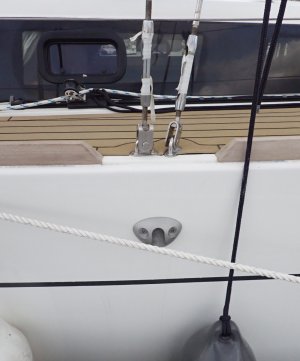
I was thinking of fabricating a stainless steel plate with c 90 angle that bolts to the hull using the two existing beaching leg bolts then four holes under the deck to accomodate the base of the two shrouds. I've had a chat with Ted at French's and we're trying to think of a way to get an accurate template. I wondered if a block of modelling clay might do it? I could press that in, carefully remove it and template from that. It would need to be about half a house brick size to cover that area.

Alternatively, just beef up the backing plate for the shroud bolts using two larger or one single plate? The idea of a right angled sheet is more appealing as it would be mechanically more secure.

I understand the manufacturers couldn't sell the boat if it wasn't tested to destruction (even via a computer model) but I'd sleep better if I knew it had beefier chain plates than the current offering which might just peel the topside off in a strong breeze!
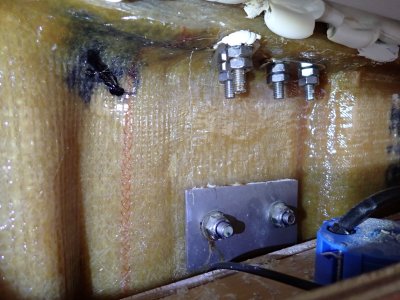
leg3_sm.jpg
 
Last edited:
As I posted on another thread, I am concerned about the structural integrity of the shrouds on my AWB (Beneteau O38).
Are there any signs of the deck being lifted or distorted by the upward pull on the chain plates? If so, I doubt that a inverted L-shaped bracket would make much difference, as this would also bend. Or is the worry rather that the backing plates are too small? Perhaps it would be easier to just make one large backing plate, filling the space between the two stringers?
 
Are there any signs of the deck being lifted or distorted by the upward pull on the chain plates? If so, I doubt that a inverted L-shaped bracket would make much difference, as this would also bend. Or is the worry rather that the backing plates are too small? Perhaps it would be easier to just make one large backing plate, filling the space between the two stringers?
No signs of any damage at all. Just an uneasy feeling looking at it through amateur engineering eyes. The single backing plate would be much easier to fabricate.
 
If there are no cracks or crazings on the deck around the chainplates and no visible movement when the boat is heeled over, I might be tempted to take that as a evidence of the laminate being strong enough. Difficult to imagine those backing plates suddenly being ripped out without any warning signs beforehand.
 
I don't think an 'L' shape will add much to the strength. An 'L' shape with a brace of stainless between the 2 parts of the 'L' would be significantly better.

Take an appropriately sized ribbon of stainless and bend it roughly in the middle - tweak the bend to get it right. The problem or advantage of stainless is that its quite easy to bend (which is why I don't think a simple 'L' is enough). Make a brace and mark carefully and weld the brace on. Bend the stainless in a decent vice and you will get a 'sharp' angle. When, if, you plan this make sure there is enough room to bolt the device into the hull.

If you don't think this is insufficiently professional. Carpenters had adjustable set squares (two arms and a nut and bolt for the angle)


I really don't think this is difficult and is the sort of thing done daily in most boat yards.

Jonathan
 
Find some one local to you who does Lazer cutting of steel and who can bend a 6 mm thick plate to the correct size

6 mm plate will not need bracing as recommended by Neeves

This is what I do, and it works out fine

Take a paper template to mark out the holes then mark then on the ss plate and drill in the correct position
 
It looks to me as if there is a substantial horizontal member ( in a wooden boat it would be called a 'gunwale') glassed into the corner between the topside and the deck, and the legs of the chain plates (actually U-bolts) pass through that member and the deck.

I would guess that is a length of hardwood, so pretty strong (unless it has rotted)

If I am correct, the chances of the U-bolts being torn up through that seem pretty slight. (Which would not be the case if the U-bolts passed through the thickness of the deck only.)
 
Last edited:
It looks to me as if there is a substantial horizontal member ( in a wooden boat it would be called a 'gunwale') glassed into the corner between the topside and the deck, and the legs of the chain plates (actually U-bolts) pass through that member and the deck.

I would guess that is a length of hardwood, so pretty strong (unless it has rotted)

If I am correct, the chances of the U-bolts being torn up through that seem pretty slight. (Which would not be the case if the U-bolts passed through the thickness of the deck only.)
You are quite right, and this is reassuring. It just looks so weak from below. This is the shrouds into the U bolts above decks and the other side of the beaching leg spigot that is the other two bolts that penetrate the hull there.

chainplates.jpg
 
Make a template out of plywood, then fabricate in stainless for the 'L' bracket.

However, I dint think you need to use stainless or an 'L' bracket. A sheet of G10 will do very well, at 10mm thick. Cut the G10 to fit the space with a big surface area, drill the holes. Then coat in thickened Epoxy such that when whipped the peaks stand up i.e. not runny. Then offer up to the area and secure in place with wax covered bolts (just rub a candle over them). Don't compress to much. Once set remove bolts, clean up. Use 3mm or 5 mm thick large OD washers, not penny washer as they will warp, when applying the nuts.

The gap might be too big to fill this way, if so build up with GRP cloth before final offering up with thickened epoxy.

To get the bolt centres I would use a big dob of plasticine and poke it into the studs sticking down and then make a cardboard templet for the G10. If the rigging is removed, then of course you can just drill through once the G10 is set and no need to worry about the centres.
 
If you think there is a design fault leaving a weakness then go ahead and fabricate a bracket.....personally I think it would be easy just to eyeball a piece of stainless bent at approximately 90 degrees....I would make a paper template to get the screw holes exactly right...and I would do exactly as Neeves says and weld on a small bracket to triangulate it for torsional, compression and tension strength
 
The OP's first picture is interesting. The bracket for the beaching legs has a chain plate but the 'U' bolts have, nothing. I would hope the beaching leg brackets takes very little load and I had imagined, in my ignorance, that the rigging could be heavily stressed.

I accept Roger's suggestion - except that his chain plates are in a steel yacht, where the whole yacht is a massive chain plate. The OP's yacht is fibre glass and the glass will flex. Stainless is not strong (at all), not tough, it has a very low yield. Welding a brace will cost peanuts.


But to re-assure the OP. I assume the yacht is a production yacht and if there were issues with the chain plates - someone, somewhere or a group of them would have reported same and it would be common knowledge. Having said that - I'd do what the OP is planning (and did similarly on our cat - added extra reinforcing).

Jonathan
 
If there are no cracks or crazings on the deck around the chainplates and no visible movement when the boat is heeled over, I might be tempted to take that as a evidence of the laminate being strong enough. Difficult to imagine those backing plates suddenly being ripped out without any warning signs beforehand.
a. What he (^^) said.

b. If you were going to reinforce the area laying up more glass would be much easier. It would conform perfectly and spread the load evenly, as well as match the stretch of the existing laminate (if tapered properly). Which brings us back to "a". The laminate may be enough.

Much is made of backing plates, but if the hardware is installed in a conservative area of solid glass using even a very small backing plate or even extra thick fender washers, sometimes a backing plate serves no purpose.
 
Looks well dodgy IMO.

That seems a good enough reason to me to fettle it, some hypothetical French geezers hypothetical computer model, and the observed lack of movement notwithstanding.

To record and transfer the spatial relationships of the bits I might try crumpled aluminium foil or papier mache as an alternative to bulk plasticene.

( I am, however, familiar with the engineering application of bulk plasticene, having used it as ''dummy''PE4 on bridge demolition training. It came in big boxes normally supplied to nursery schools, with picures of pink balloons and elephants . Mucho macho.)

I might, however, use a composite backing, probably glass/epoxy bonded to the hull and deck, rather than a steel fabrication, with a triangular gusset (knee) tying its upper and lower portions together. This gusset would probably go between the two existing shroud plate "big washer" backings, which I think I would want to replace or supplement with larger, though with more glass behind them they'd already be better.

Composite would give you a bit more flexible fudge factor, making precise modelling of the existing shape less critical, but since these fittings were evidently not originally designed to work together, some slight relocation of the leg support to line up (probably less involved than the shrouds) might be desirable and even worth the trouble.
 
The trouble with these threads is that we have no idea if the location was especially beefed up. One might assume it is, beefed up, originally but the OP has already expressed concerns and making assumptions is not going to allow him to relax.

If you removed the 'U' bolts you could measure the laminate thickness.

Personally I'd assume it did not receive any special attention when the hull was fabricated - because any of the recommendations to reduce the concerns are not particularly difficult nor expensive.

Adding extra glass is an excellent idea - provided the extra glass adheres securely to the underlying structure - and I'm not sure 'we' can guarantee secure adhesion ('we' are not doing the work). The stainless 'L' bracket/chain plate will be secure and add strength (if that area needs to be strengthened.)

This thread is about allaying the OP's concerns......as simply and cheaply as possible.

Jonathan
 
The OP has not mentioned how old the yacht is, the photos suggest new(ish) or new. There will be no stress cracks yet - if the chain plate aka 'U' bolts have not been used aggressively, yet. Crazing may develop later.

I'm not convinced that the absence, of crazing, means the arrangement is sufficient.

I left backing up the chain plates for our bob stays till the crazing occurred - I should have done it from the outset. Once I'd idenitified reinforcing was inadequate I then went through the whole yacht and added where I thought appropriate. Some of the horses had bolted but I saved the rest. :)

Jonathan
 
Leaving aside the question of whether it's necessary, you're never going to get a perfect fit between a steel bracket and GRP.

Steel is flat, and GRP just isn't so, when fitting, slather a good dollop of thickened epoxy between the bracket and the GRP to fill the irregularities. I'd be tempted to coat the bracket with PVA release agent (not the white glue!) so you've got a chance of getting it off if you ever need to.
 
Thank you for all your input. The boat was manufactured ten years ago in late 2015 and launched in 2016.

There is no other reason than I took the covers off to inspect the "chain plates" and slightly horrified that the construction looked more meccano than a CE Class A sea going vessel. I haven't heard any instances of the deck separating or other issues relating to this construction and I believe Beneteau transfer a lot of their "First" boat tech across to the Oceanis so I should relax knowing it's been well built and is safe.

But the engineer inside me keeps shouting.
 
Top