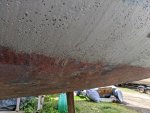
Tackling this hull post osmosis treatment

bmrn

New Member
Joined
3 May 2020
Messages
14
Visit site
Hi everyone,
Appreciate there's many threads on these kinds of things but given the pattern of it, I'd like to get some input on how people would tackle my hull.

This boat has been sat a while but was subject to a good blasting and osmosis treatment several years ago and has been out of the water since. I'm after some ideas on how to go about it a practical and reasonable way that's cost-effective for a project. I'd seen blisters before, but not this dense!

Would you get away with a good clean/solvent and then go over it with an epoxy fairing compound before priming/antifouling? Or would you be looking at a more complex approach?

Any advice, however obvious, is appreciated.

Thanks.

 

Attachments

  • hull.jpg
    hull.jpg
    475.1 KB · Views: 191
This boat has been sat a while but was subject to a good blasting and osmosis treatment several years ago and has been out of the water since. I'm after some ideas on how to go about it a practical and reasonable way that's cost-effective for a project. I'd seen blisters before, but not this dense!

Welcome to the forums!

What sort of "osmosis treatment" was it given?
 
Welcome to the forums!

What sort of "osmosis treatment" was it given?

I'm actually not fully sure! People will tell you anything. But I'm led to believe it would have at least been at least soda blasted and and dried out properly, however at this stage I'm unsure what £4k was spent on. it's a solid old hull though, I'm sure there's some life to be had out of it.
 
Can't see any osmosis treatment there. Looks like they were opened up and just left. Even looks like a drill may have been used given the shape of some. Simplest would have been to fill with epoxy filler when it was originally done. Now it looks like they all need cleaning out and filling so either blast it again or spend ages trying to clean them all up with a Dremel/drill.
 
That hull does not look as though any osmosis treatment has been done, it looks just like it has been blasted to open any bubbles.

If the bubbles are 2 to 3 mm in diameter, then you do not have osmosis but air bubbles in the gel coat. It is caused by poor brushing the gel coat in the mould to work the air bubbles out of the mix. My Westerly Fulmar has this problem and it is common in a lot of Westerlys and other makes until gel coat was sprayed into the mould. Usually the glassfibre layer is not affected. To solve the problem is time consuming as each hole must be cleaned with a s mall drill like a Dremel. Then scrape a waterproof filler, preferable epoxy based. Sand the hull smooth and antifoul. I should say you will probably have to do some further remedial work in future years.

If the bubbles are 10 to 15 mm in diameter and when burst have a vinegar smell, then you have osmosis. The hull should be dry enough after being out of water for several years. You can use a similar solution to above. Just remember no boat will sink due to osmosis as regular maintenance should spot any problem before any damage will become critical.

Please advise what type of boat this is and how large the bubbles are.
 
Last edited:
Welcome to the forums!

Welcome indeed.

I assume the red finish is the original gelcoat. If so, a good rub down, including in the holes, which will not be a small task, should get it ready for filling. You could use an epoxy filler, but it may be cheaper to use plain vanilla epoxy thickened with microballoons until it holds its shape. I'm quite happy to use car-type polyester filler for cosmetic work above the waterline, but I wouldn't use it below. The blue bits look like antifouling, which needs to come off.

I'd favour a few coats of epoxy coating before antifouling, but a expert will be along in a minute to tell you why you shouldn't.
 
Is the red color antifoul or the original gelcoat color? I would suggest measuring the humidity with a proper instrument that can scan water trapped under the outer fiberglass skin. Unfortunately with so much blistering, the most probable is that the hull will have lots of "vinegar" under the outer laminate which cannot dry even if the boat stays on the dry for years. In my occasion, I could feel the trapped water because the hull surface was swollen and each bad area could be felt on the fingertips. I scanned all osmosis by feel and ground of the bad laminate. I laminated around 80 osmosis areas on each side of the hull. That was a lot of work, but there was no other way than doing it myself as the boatyard would ask around 5000 euros. And to be honest i wouldn't do that job for less if i was asked to...
You can just fill the blistering with epoxy, but then if you trap water inside it won't be nice...On the other hand, you can live with osmosis if it's not very heavy. If the osmosis is heavy, delamination can occur at the keel hull joint where a lot of stress is happening.
 

Attachments

  • osmosis1.jpg
    osmosis1.jpg
    180.1 KB · Views: 58
Thanks for the replies. The holes are probably 4- 6mm.

The boat is a Verl 27 and the effect in that picture is a huge area, just too big to go into each hole on. I'd be at it for years.
 
I'm very puzzled, you say "This boat has been sat a while but was subject to a good blasting and osmosis treatment several years ago and has been out of the water since" but, looking at the photo that statement doesn't add up. All I see are lots of holes in what appears to be antifoul which may, or may not, be osmosis. Suggest you scrape through the antifoul using something like a Bahco 2 handed scraper and see what's below and what condition it's in. My guess would be the whole needs scraping.
 
I'm happy for it to not add up as antifoul would be good news. I only didn't jump to the conclusion of old paint because after all these years, I'd have expected the surface to show more visible worn away layers and this is fairly even.
 
I'm actually not fully sure! People will tell you anything. But I'm led to believe it would have at least been at least soda blasted and and dried out properly, however at this stage I'm unsure what £4k was spent on. it's a solid old hull though, I'm sure there's some life to be had out of it.

I think you may have been misled about £4K having been spent on it. From your photo, I don't think it's had much treatment of any kind, although it may have been shot-blasted. With the best will in the world, you need to realise that professional rectification will cost about what the boat is worth, so from an owner's point of view it's not worth doing. If you're a keen DIY enthusiast, by all means do some filling and fairing, and then antifoul it. If you're not, just enjoy the boat as it is - boats don't sink due to osmosis.
 
I think Concerto has it - blue is antifoul, red is gelcoat. Some cavities have not been fully opened and some don't go all the way down to the glass layup.
 
I think you may have been misled about £4K having been spent on it. From your photo, I don't think it's had much treatment of any kind, although it may have been shot-blasted. With the best will in the world, you need to realise that professional rectification will cost about what the boat is worth, so from an owner's point of view it's not worth doing. If you're a keen DIY enthusiast, by all means do some filling and fairing, and then antifoul it. If you're not, just enjoy the boat as it is - boats don't sink due to osmosis.

Yep, fully expect that. I wouldn't hand it over to anyone as I'll cost way too much for the price of the boat.

If it is just pitting from shot blasting, is it worth just fairing it with epoxy filler and giving it a good primer and get on with it?
 
Here's another view pvb. Around the centre of the photo where the white meets red, there's a good layer missing.

Makes me wonder if these are paint layers or if that's gelcoat etc? But it's still red underneath.
 

Attachments

  • IMG_20200502_130736_resize_0.jpg
    IMG_20200502_130736_resize_0.jpg
    685.9 KB · Views: 107
The white looks like paint. The red could also be paint. I presume the thge division line is roughly the waterline. It is most unusual for such holes to be above the waterline, which suggest moulding faults. To be quite honest this hull is looking a real mess and if you have not bought it, I would walk away as it will be a time and money pit. There are much better boats you can buy.
 
I would use a suitable filler that's cheap, not too hard to sand and go with what you first thought, fill it as it is , sand, prime ,antifoul and enjoy the boat ! Who knows ,the quick fill job may last a long time.
At least this way you have not invested much money or that much time.
 
I’d go with what Rappy said. The tiny holes are all a consistent size so would suggest man made like it’s been bead blasted to clear all the crap of. Just fill with epoxy filler sand it back a good primer undercoat then anti fouling. Then enjoy the sailing. If the guy had done it before you bought it you’d have paid a lot more for it. And been none the wiser
 
The white looks like paint. The red could also be paint. I presume the thge division line is roughly the waterline. It is most unusual for such holes to be above the waterline, which suggest moulding faults. To be quite honest this hull is looking a real mess and if you have not bought it, I would walk away as it will be a time and money pit. There are much better boats you can buy.

The photo doesn't give much context, it's all below the waterline. It's immaculate (albeit dirty) gelcoat above it.
 

Attachments

  • Screenshot_20200503-210339_compress66.jpg
    Screenshot_20200503-210339_compress66.jpg
    329.4 KB · Views: 66
Avoid sealing the whole hull in epoxy coats as that will make the current situation worse.
You will have to ask for advice as to which additive to thicken up the epoxy for filling and sanding would be best.
 
Top