Sync (ing) x2 chart plotters

Little Ricky

Well-Known Member
Joined
14 Jul 2025
Messages
183
Visit site
Hi everyone, Ive got a Simrad 9" chart plotter and am looking to add an additional 9 or 12" to my helm. I won't do the work myself but so I dont look completely bemused when talking to an engineer, can these two units sync together, or does each need its own transducer? Appreciate any info.
 
Hi everyone, Ive got a Simrad 9" chart plotter and am looking to add an additional 9 or 12" to my helm. I won't do the work myself but so I dont look completely bemused when talking to an engineer, can these two units sync together, or does each need its own transducer? Appreciate any info.
Need to know the model to be sure but Just connect them via NMEA 2000….easy job
 
OK. So just a matter of interconnecting cables, sounds quite practical.
I have no idea about Simrad units - but with Raymarine it is easy to share data such as depth, wind, position etc via NMEA2000.
But it is much trickier to share chart and or radar data, which needs extra cables and, in Raymarine case, identical software versions. Check if you can share chart data. If nit may need to buy two sets of chart cards.
 
I have no idea about Simrad units - but with Raymarine it is easy to share data such as depth, wind, position etc via NMEA2000.
But it is much trickier to share chart and or radar data, which needs extra cables and, in Raymarine case, identical software versions. Check if you can share chart data. If nit may need to buy two sets of chart cards.
There's always someone ready to rain on my parade :(
 
I had a Garmin Echomap already, and the boat we bought had a Simrad Go 9, the Echomap has no transducer on it, the Simrad does, they both sit on the N2000 backbone with GPS, VHF, and AIS on the backbone.
The Garmin gets the depth information from the Simrad via the N2000 and also the GPS and AIS data,
 
There's always someone ready to rain on my parade :(
Simrad are basically Navico/B&G. I'm afraid Mr Googler is wrong, it's not NMEA that does the syncing of chart plotters but a faster ethernet network.

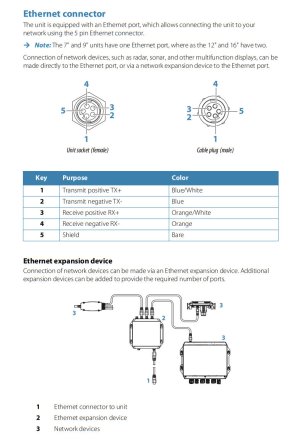
To sync, you need both NMEA and Ethernet networks, the latter can be as simple as a network cable plugged between the two plotters.

NMEA is a data bus, similar to CANBUS in a car. Think of it as a length of 4 core wire with a terminator (120 ohm resistor) across the data pair of wires at each end.

A 12v supply is connected to the +/- wires of the 4 core NMEA somewhere in the middle.

Now attach devices, chart plotters, wind instruments, depth transducer, displays etc. Some devices just listen (eg a display), some just talk (eg wind/depth) and others talk and listen at the same time (eg chart plotter, autopilot computer).

Chart plotters share some info by one of them talking (transmitting) info onto the bus, eg GPS position, SOG and the other listens to that info.

Chart data, waypoints, tracks etc are not sent over NMEA but by a faster ethernet network cable.

If you have more than two ethernet devices, the cables need to all go via a network switch/router so data can be shared, eg if you add a third plotter or a radar (radar data is too much & too fast for NMEA to handle).

Navico call their ethernet router an "expander".

Small devices like depth/wind/square displays can take their 12v power from the NMEA cable but chart plotters are power hungry so will have their own independant 12v supplies.

If you look at the first pages of the Evo installation manual, it shows how to connect the NMEA and network.

simrad.jpg
 
Last edited:
The 9" Evo only has a single Ethernet port, so can only connect two devices together, for 2 plotters and radar to need a network switch, as mentioned in post #12. The 12" Evo has 2 Ethernet ports, so this can cannot 2 plotters and radar together without the switch.

Worth considering for the OP if he does have radar.
 
Wifi, far from land?
Wifi is local, from a wireless access point (WAP), it is completely independent of distance from land. You may be confusing wifi with a 4G/5G mobile data signal.

You can be in the middle of the ocean all connected up to your local wifi set up sharing data without any need for connection to a phone mast. If your router is also a mobile data modem then yes, you will lose internet connectivity out of range of phone masts, unless of course, you have Starlink.
 
Wifi is local, from a wireless access point (WAP), it is completely independent of distance from land. You may be confusing wifi with a 4G/5G mobile data signal.

You can be in the middle of the ocean all connected up to your local wifi set up sharing data without any need for connection to a phone mast. If your router is also a mobile data modem then yes, you will lose internet connectivity out of range of phone masts, unless of course, you have Starlink.
Its starting to sound like I would need a sim in a tablet to go down that route. That could be 2 or ?300 per year for a sim contract.
 
Its starting to sound like I would need a sim in a tablet to go down that route. That could be 2 or ?300 per year for a sim contract.
Only if you need the internet, not an intranet (your private network with boat data). Your boat devices don't need the internet for normal operation. You only need it for chart and firmware updates, and those can be done in port and/or at home using SD cards/USB sticks.

I pay £1 a month for a Lebara (Vodaphone) sim with 50mb of data per month. Not sure where you get £200/300 a year for a simo contract from. Unless you're not in the UK.

Anyhow, why do you need an internet connection on your boat? If you need weather, pub reservations etc, just use your phone?

https://www.moneysavingexpert.com/cheap-mobile-finder/sim-only/
 
Top