SWR Meter

That back to back SO239 would allow you use the original antenna cable but also include the original patch between transponder and splitter within the path.

Another useful little patch cable is an SMA to SO239 like the example below (as long as your handheld VHF has a removable antenna with an SMA connection!).
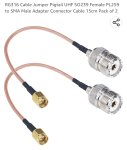
Screenshot_20230221-221754_Samsung Internet.jpg

With that you can then use your handheld to transmit at various points along the wire whilst using the power/SWR meter. Saves having to try and make a connection from your fixed VHF each time each time you need something to transmit with.
 
Based in Langstone Harbour, South Coast. The Albrecht one you link to is only rated to 150Mhz, would that be OK for Marine VHF as I understand Marine transmits at about 156Mhz?
I’m Manchester or Clyde based so a long way from south coast to offer the use of mine, I’m afraid 😩
Not wanting to be argumentative with more knowledgeable posters but the aged twin meter that I listed would be absolutely fine for your purpose. I’ve had exactly that model for many years and used it successfully from 80m HF to marine vhf. No point worrying about decimal point accuracy.
Good look in finding the issue.
 
The Power/SWR meter will be able to test out both paths through the active splitter that you have... It's what it's designed for.

It would only take a couple of minutes to test out at 25 Watts through the VHF input and then 5 or 6 Watts through the AIS input which will prove out both patch cables you have going into the splitter as well as the cable from there to the masthead antenna.

It's quicker to use it for all that than it is to describe... The offer is still there.

Thinking about it again.... the issue could be in the feed to the antenna or the antenna itself. It's only the fact that the AIS is pointing out that there is an issue that brings it to light.

Did you try the AIS transponder connected direct to the antenna cable to see if that's successful..? There may even be more than one issue hence the Icom reporting an issue at one point :(


As to the Albrecht meter. You don't know it's provenance and AIS uses channels 87 and 88 (161.975MHz and 162.025MHz) which is above its reliable range. You might get an indication of SWR but you really would be better off waiting and getting something that really covers the range you're always going to want to test.


MA-500TR | Products | Icom Inc.

The AIS unit OP has is only a Class B at 2W ... not a B+ at 5W ........
 
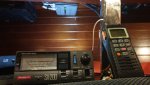
I popped over to the boat just now to check out the use of the simple power/SWR meter whilst putting 6Watts through the VHF port and then the AIS port on the splitter.

In preparation I unplugged the VHF and plugged a short patch lead into the splitter VHF input port. I also disconnected the patch lead from the transponder at the transponder end.

This gave me an easy way to transmit into VHF port and then the AIS port via the two patch leads.

I connected a handheld VHF to the input of the meter and then plugged the output of the meter into the each patch lead in turn.

20230222_225038.jpg

Video 1 shows four tests on VHF input
Amber led visible on splitter at top of view indicating Tx on VHF input
Forward power check - 6W
Reflected power check - minimal
Calibrate meter
VSWR check - about 1.2

Video 2 shows four tests on AIS input
Blue LED indicates Tx on AIS input
Forward power check - 6W
Reflected power check - minimal
Calibrate meter
VSWR check - about 1.2

It looks like each video was 23 seconds long and I was only in board ten minutes

At least it got me to check my patch leads and antenna status... VSWR about 1.2 Remembered to reconnect both and we're visible again on Marinetraffic.

Onedrive - Tx via splitter VHF input port

Onedrive - Tx via splitter AIS input port

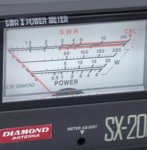
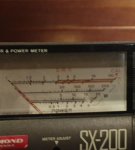
Close up of an SX-200meter dial
Screenshot_20230222-225719_Samsung Internet.jpg

(If the videos are not easy to see, let me know and I'll try YouTube or some other way).
 

Attachments

  • Screenshot_20230222-221737_OneDrive.jpg
    Screenshot_20230222-221737_OneDrive.jpg
    401.2 KB · Views: 4
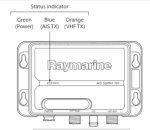
You can see in the first photo in post #24 that the grey Raymarine splitter at the top of the photo is showing the green power LED.

In case you wondered, it is that LED that changes colour to orange when input is seen on the VHF port and to blue when input is seen on the AIS port. It is just visible during transmission in the videos.

Screenshot_20230222-222955_Samsung Internet.jpg
 
Just another test the original poster could do...

If you are suspecting the AIS input port on the splitter as being faulty, then how about plugging the AIS transponder into the VHF input port on the splitter.

It should transmit fine through that port without the splitter even having to switch.
 
Just another test the original poster could do...

If you are suspecting the AIS input port on the splitter as being faulty, then how about plugging the AIS transponder into the VHF input port on the splitter.

It should transmit fine through that port without the splitter even having to switch.

Thats ok ....

Now just commenting - never put VHF to AIS input !
 
Next time I'll test the AIS input by plugging my spare AIS transponder into the AIS port..

I've got the spare transponder in the boot of the car in case the OP wants to test with a different transponder and use it's internal SWR report. .

Seriously though, the splitter manufacturer quotes maximum power input but doesn't make any statement about duty cycle.

We know an AIS is on Tx for about 26ms but this test wasn't at max power and for the sake of a few hundred milliseconds was really just meant to show (for someone who had not used one) how quick it can be to get results from that type of meter.
 
I should add..

Those test sequences were not meant to represent a normal troubleshooting path.

To save on transmitting, once the masthead antenna and its direct feed wire had been confirmed good, a dummy load could then be used in it's place.

The AIS patch cable could have been tested at 25 Watts (or 200 Watts perhaps) onto a dummy load in isolation and then the internal AIS diagnostics of the transponder finally used for the splitter AIS input test.
 
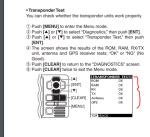
Looking at the manual for the MA-500TR transponder, it does have some diagnostics..

MA-500TR diagnostics.PNG

Unless I'm missing something, it's a shame it doesn't give similar diagnostics compared with other transceivers that use the ProAIS2 software..

PROAis software on many other transponders shows more information.PNG
 
Martin J, thanks for all of your efforts, really appreciate your taking the time to do various tests and demo's. New patch leads arrived today, so if weather and time allow this weekend, will go down and do some more testing. The MA500TR is an older AIS Transponder, but its been back to Icom recently for repair and pronounced as all good, no issues The image you show of the basic diagnostics is where I see the NG against the ANTENNA marker. The Distributor of teh AIS Splitter is of no help and has basically given me 2 options if I still have issues, return for refund or send back to Quark for diagnostics. They aren't fulfilling their obligations as supplying distributor in honouring warranty or handling a claim if its proved faulty.
 
So, changed the 2 x patch leads , one from AIS to Splitter and teh other from splitter to VHF radio and all seems to be good! No errors thrown up on the ICOM and VHF radio transmits and receives OK. So happy days! I may still look into a SWR meter if one comes up for not a lot of cash to keep onboard in case I run into any other issues in teh future.
Thank you to all that have contributed and offered assistance, appreciate your help.(y)(y)
 
They do help with fault finding.... and worth trying it out on your working system every so often to look for deterioration etc.

They're a lot better for reporting antenna issues than just asking sbdy the other end of the marina (or even a few miles away) what your transmission sounds like. The radio discrimination circuits are so good these days that they'd not be able to judge the power they were receiving from you by ear alone.
 
I don't want to start another thread so I will piggy back on this. After about 2 minutes my ais,newly and professionally installed a few weeks ago switches from green to a flashing red.
The electrician came down and put some sort of meter on it and said I need a new antenna as mine, at 17 years old was worn out.
It's a 1.5 meter fibreglass whip areal. How does an areal wear out?
 
I don't want to start another thread so I will piggy back on this. After about 2 minutes my ais,newly and professionally installed a few weeks ago switches from green to a flashing red.
The electrician came down and put some sort of meter on it and said I need a new antenna as mine, at 17 years old was worn out.
It's a 1.5 meter fibreglass whip areal. How does an areal wear out?
Ingress of water/moisture, general break down of insulation over time. Bit like us really. Old age!
 
I don't want to start another thread so I will piggy back on this. After about 2 minutes my ais,newly and professionally installed a few weeks ago switches from green to a flashing red.
The electrician came down and put some sort of meter on it and said I need a new antenna as mine, at 17 years old was worn out.
It's a 1.5 meter fibreglass whip areal. How does an areal wear out?
Corrosion in the coil at the base of the aerial plus the aerial. It was the problem for mine. Not to sure it even received let alone transmit for a very short distance.
 
Came to the forum to ask about similar concern about very high (3:1) SWR reading when transmitting through my new Quark-Elec QK-A015-TX Active VHF Splitter.

With SWR meter directly between VHF radio and Antenna, I get very very low SWR reading (hardly moves the needle) when transmitting on 25W.

With SWR meter in between VHF radio and the splitter, I get at least 3:1 SWR reading when doing a 25W transmission. Have tried a couple of different combinations of patch lead in the mix to rule those out.

Having read through the thread, I can see some suggestions (@Refueler in particular) that the SWR meter will not report reliably when used through the splitter due to the way the splitter works - but couldn't work out if that was just in the case of the short AIS transmissions or whether it might also explain my high SWR for a sustained (multiple seconds) 25W VHF radio transmission?

Thanks!

Kit Installed
Ocean Signal ATB1 AIS Transponder
ICOM MC-M330 radio
Quark-Elec QK-A015-TX splitter.

Using a Moonraker SWR-270 SWR meter - I bought it on the understanding it was suitable for marine VHF frequencies, but open to being told I'm wrong!
 
Top