
SWR figures

chris-s

Well-Known Member
Joined
24 Apr 2019
Messages
816
Visit site
Last season we fitted a fixed radio to the boat along with new coax and aerial. I’ve never used it to call anyone apart from my neighbour and a quick test with my son on the handheld set a few hundred meters away. Usually we just turn it on to see what we can hear which isn’t very much and so I’ve always wondered if it’s actually working properly.

I’m reluctant to trouble the local coastguard with a radio check.

It’s a B&G model with ais and we get plenty of ais targets.

So I bought an swr meter, followed the instructions and get readings of 2 to 2.5. Is that reasonable?
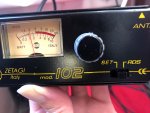
C86B86C6-021A-48C2-92EF-D3511E5B2E86.jpeg
 
  • Like
Reactions: RMC
I'm no expert on this, but I've always regarded a figure of 1.5 or less as excellent, and a figure of 2 as being just marginally acceptable.

Go over all your connections in the antenna lead, check they are clean & tight.
 
VSWR affects transmit power, it shouldn't affect reception. The higher the VSR the more of your transmitted signal is being reflected back to the source and the less range your transmissions will have. As per post #2, check all connections, make sure they are sound, fitted correctly and no odd strands of outer shielding making contact with the inner conducting. 2-2.5 is acceptable, but if you can get it lower, so much the better.
 
The measured VSWR can sometimes depend on the frequency (channel) you use. So try on a low channel then a high channel. The tuning of the antenna will be a compromise hopefully best around ch16. Operating range and strength of signal varies in a logarithmic manner with power. So with 1/3 of your power coming back not transmitted from your 25watts will barely make in difference to range in practice. But then again you might want it better. ol'will
 
I’m reluctant to trouble the local coastguard with a radio check.
Even if the SWR is perfect, you still need to do a radio check if you want to be sure it's working.

There's a difference between calling the coastguard once (or National Coastwatch - I think they have a dedicated channel?), and calling them every time you go out.
 
If you are concerned at the performance of your radio you should never, ever, be reluctant to call the Coastguard (or anyone tasked with marine safety) to check the performance of your communication device...That's why the Coastguard, or whoever is there.

Just don't make a habit of it - if you call and there is an issue - check your own installation, make any necessary adjustments and call again. If you do feel slightly embarrassed get the coastguard telephone number - explain the background and my guess is they will be more than willing to monitor the quality of the calls.

I know you will do this but - Just remember to thank the Coastguard, or whoever, for their patience.

They would rather you call than you , and the crew for whom you are exclusively responsible, were to become a statistic.

Somewhere some tax you pay filters its way to support the Coastguard.

Take care, stay safe and good luck

Jonathan
 
  • Like
Reactions: Bru
I’ve never used it to call anyone apart from my neighbour and a quick test with my son on the handheld set a few hundred meters away.
That's not a radio check!
There's a difference between calling the coastguard once (or National Coastwatch - I think they have a dedicated channel?), and calling them every time you go out.
Not sure what you mean in your post.

If you can call up NCI on Ch65 then do so else the CG on 16.

What the OP needs to do is find out where his local antenna is, CG or NCI, and then look at the distance he is being received from. A radio check of a few hundred meters is a complete waste of time. Two miles is better 10 miles is even better depending in the height of the antenna. If you have a local NCI call them on the telephone and ask if they would mot mind doing a few checks with you one day. Then call them at two miles, five miles, 10 miles and 20 miles just to see how far you can transmit. Doing the same with a pal in their boat is also useful.

Personally, I like to give Rame Head NCI a call everytime I leave Plymouth and they are on watch. They are always very enthusiastic and confirm if they can see you on AIS and Radar.
 
Last season we fitted a fixed radio to the boat along with new coax and aerial. I’ve never used it to call anyone apart from my neighbour and a quick test with my son on the handheld set a few hundred meters away. Usually we just turn it on to see what we can hear which isn’t very much and so I’ve always wondered if it’s actually working properly.

I’m reluctant to trouble the local coastguard with a radio check.

It’s a B&G model with ais and we get plenty of ais targets.

So I bought an swr meter, followed the instructions and get readings of 2 to 2.5. Is that reasonable?

View attachment 118838
Did you set it first? Beenthere done that
 
Thanks for the replies guys.

Yes, I set it before taking each reading and I performed the test on high and low channels as well as high and low power. The results were consistently 2 to 2.5.

Checking the cable connections, top and bottom, will be the next thing to do.

Cheers

Chris
 
I've recently renewed the antenna and coaxial cable between my VHF and the masthead antenna. I did a VHF check with NCI at Landguard Point and got a response of "Good and readable". The distance was about 4.5 nm (I'm at Titchmarsh). WOuld the experts here regard that as acceptable? I know the coaxial connector to the back of the VHF was badly wired, but I think it was OK, but it's possible the shield was making poor contact with the VHF. There is almost certainly room for improvement, but what should I be expecting at that sort of distance?
 
If you are concerned at the performance of your radio you should never, ever, be reluctant to call the Coastguard (or anyone tasked with marine safety) to check the performance of your communication device...That's why the Coastguard, or whoever is there.

Just don't make a habit of it - if you call and there is an issue - check your own installation, make any necessary adjustments and call again. If you do feel slightly embarrassed get the coastguard telephone number - explain the background and my guess is they will be more than willing to monitor the quality of the calls.

I know you will do this but - Just remember to thank the Coastguard, or whoever, for their patience.

They would rather you call than you , and the crew for whom you are exclusively responsible, were to become a statistic.

Somewhere some tax you pay filters its way to support the Coastguard.

Take care, stay safe and good luck

Jonathan
I disagree. No radio checks with the coastguard please, there's plenty of other ways of doing performance checks, like SWR.
 
I've recently renewed the antenna and coaxial cable between my VHF and the masthead antenna. I did a VHF check with NCI at Landguard Point and got a response of "Good and readable". The distance was about 4.5 nm (I'm at Titchmarsh). WOuld the experts here regard that as acceptable? I know the coaxial connector to the back of the VHF was badly wired, but I think it was OK, but it's possible the shield was making poor contact with the VHF. There is almost certainly room for improvement, but what should I be expecting at that sort of distance?
What power were you using, I would expect more
 
What power were you using, I would expect more
Good question - as I was on channel 65, it might not have been 25 watts. Didn't think of that, so didn't check. I think I also had an iffy connection to the antenna cable; the shield might well not have had a good connection (the core was ok). Also, I was in the marina, so I guess there might well be multipath issues with all the surrounding antennae, masts and rigging.

I'll try again when I've installed a better plug on the antenna cable.
 
I disagree. No radio checks with the coastguard please, there's plenty of other ways of doing performance checks, like SWR.
Another don't know question

What is, or are, SWR.

Here in Oz we have body in New South Wales, volunteers, who provide VHF radio coverage called Marine Rescue. They exist in the other States to a greater of lessor extent. Between them and repeaters they offer full VHF coverage right round Australia - though there are gaps in some places. We have other organs who provide similar or different services, like the Water Police and Customs. We don't have a body called 'Coastguard'. We also have HF or SSB nets - used by commercial fishermen in ocean locations (and by leisure sailors who have the kit and conducting ocean passages (we use them for Bass Strait and transmitting down the west coat of Tasmania).

Marine Rescue are volunteers but are funded by the individual Staes and by our famous sausage sizzles :)

Our Marine Rescue are used by those who use the sea for leisure and we are strongly encouraged to log on when we go out, and off when we come back and for long passages we are passed from one radio station to another. They hold our vessel details and contacts on computer and this information can be accessed by any of the radio stations - they also hold passage details POB, ETA etc. Some of the bases have rescue boats and these vessels may be tasked by the Water Police to effect a rescue, though the Water Police have fairly large ocean going vessels.

It is also demanded we carry EPIRBs offshore - which would be received by Canberra, directly or indirectly.

In my post above I had assumed that as the OP used the Coastguard to check his VHF then they performed the same sort of role as our Marine Rescue - seems not.

I have to ask what do your Coastguard do?

Or who monitors leisure sailors - if anyone.

Who might be tasked to provide a radio check service. Seems daft having a safety device (VHF) if there is no-one who can formally assess its competence.

Jonathan
 
Another don't know question

What is, or are, SWR.

Here in Oz we have body in New South Wales, volunteers, who provide VHF radio coverage called Marine Rescue. They exist in the other States to a greater of lessor extent. Between them and repeaters they offer full VHF coverage right round Australia - though there are gaps in some places. We have other organs who provide similar or different services, like the Water Police and Customs. We don't have a body called 'Coastguard'. We also have HF or SSB nets - used by commercial fishermen in ocean locations (and by leisure sailors who have the kit and conducting ocean passages (we use them for Bass Strait and transmitting down the west coat of Tasmania).

Marine Rescue are volunteers but are funded by the individual Staes and by our famous sausage sizzles :)

Our Marine Rescue are used by those who use the sea for leisure and we are strongly encouraged to log on when we go out, and off when we come back and for long passages we are passed from one radio station to another. They hold our vessel details and contacts on computer and this information can be accessed by any of the radio stations - they also hold passage details POB, ETA etc. Some of the bases have rescue boats and these vessels may be tasked by the Water Police to effect a rescue, though the Water Police have fairly large ocean going vessels.

It is also demanded we carry EPIRBs offshore - which would be received by Canberra, directly or indirectly.

In my post above I had assumed that as the OP used the Coastguard to check his VHF then they performed the same sort of role as our Marine Rescue - seems not.

I have to ask what do your Coastguard do?

Or who monitors leisure sailors - if anyone.

Who might be tasked to provide a radio check service. Seems daft having a safety device (VHF) if there is no-one who can formally assess its competence.

Jonathan

In certain areas of the UK at the weekend it can become a constant stream of people asking for radio checks on channel 16, to the extent that other traffic can't be heard.

It seems that a large amount of people feel it necessary to do a radio check whenever they go out for a day sail, hence the recommendation in the UK to use the National Coastwatch Institute (NCI) on Ch 65 for radio checks and leave Ch 16 clear.
 
In certain areas of the UK at the weekend it can become a constant stream of people asking for radio checks on channel 16, to the extent that other traffic can't be heard.

It seems that a large amount of people feel it necessary to do a radio check whenever they go out for a day sail, hence the recommendation in the UK to use the National Coastwatch Institute (NCI) on Ch 65 for radio checks and leave Ch 16 clear.

Thank you

Sounds good to me

But it does sound, from your first sentence, that the message is not getting through.

Jonathan
 
SWR, standing wave ratio, it’s the measurement of the transmit power to reflected back, 1:1 is optimal but not achievable in the real world, high SWR damages the radio output stages as it sends power backwards, simple answer as it’s a little complicated
 
Another don't know question

What is, or are, SWR.

Here in Oz we have body in New South Wales, volunteers, who provide VHF radio coverage called Marine Rescue. They exist in the other States to a greater of lessor extent. Between them and repeaters they offer full VHF coverage right round Australia - though there are gaps in some places. We have other organs who provide similar or different services, like the Water Police and Customs. We don't have a body called 'Coastguard'. We also have HF or SSB nets - used by commercial fishermen in ocean locations (and by leisure sailors who have the kit and conducting ocean passages (we use them for Bass Strait and transmitting down the west coat of Tasmania).

Marine Rescue are volunteers but are funded by the individual Staes and by our famous sausage sizzles :)

Our Marine Rescue are used by those who use the sea for leisure and we are strongly encouraged to log on when we go out, and off when we come back and for long passages we are passed from one radio station to another. They hold our vessel details and contacts on computer and this information can be accessed by any of the radio stations - they also hold passage details POB, ETA etc. Some of the bases have rescue boats and these vessels may be tasked by the Water Police to effect a rescue, though the Water Police have fairly large ocean going vessels.

It is also demanded we carry EPIRBs offshore - which would be received by Canberra, directly or indirectly.

In my post above I had assumed that as the OP used the Coastguard to check his VHF then they performed the same sort of role as our Marine Rescue - seems not.

I have to ask what do your Coastguard do?

Or who monitors leisure sailors - if anyone.

Who might be tasked to provide a radio check service. Seems daft having a safety device (VHF) if there is no-one who can formally assess its competence.

Jonathan
Here in Fremantle the Volunteer Sea Rescue group run, with government subsidies, the pleasure boating safety coverage. They have a working channel 73 used for setting up SAR coverage and general calling including radio checks. All works really well in fact as said there are a handfull of similar setups around west oz coast and a network of repeaters. Interesting that for after hours coverage the message is repeated back to the home of the person on duty. Also interesting is that they (Fremantle) have a waiting list of would be volunteers and strict vetting criteria. Each person does a shift about once per fortnight. They (Fremantle) also run 4 I think ocean going rescue boats and so work with water police and marine branch of government in a search and rescue.
You can join the group for about 20 squid per year gives you rescue tow back to home mooring but non members only get a guarantee rescue to safety.
ol'will
 
Top