Swollen galvanised chain

Irish Rover

Well-Known Member
Joined
5 Feb 2017
Messages
8,287
Location
Türkiye
Visit site
I bought 100m of new galvanised chain 3 years ago. I had a s/s hook made for the bridle which would easily slide into a chain link and was easy to remove - my wife found it difficult to attach or remove a victory hook. I had the boat out of the water recently for maintenance and i reversed the chain. What are now the first 20/30 metres had probably never been in the water before. They were also sitting forward in the locker away from the chain I was actually using so would not have been getting dripped on to any extent. My problem now is it's very difficult to connect the s/s hook to the links and when I do get it in it's even more difficult to unhook. It's as if the chain has swollen and closed the links somewhat. Is this usual? Any cure?
 
I can think of no credible mechanism other than corrosion that could cause a dimensional change like that. Are you sure the other end was not like this at first but has worn slightly with the other chain hooks?
It's possible what you say is correct that the other end was worn from repeated trips through the gypsy. It gets a lot of use probably at least 250 days per year [I swim year around). I usually anchor in around 2.5/3m so I always put the chain out to the 10m mark and the hook goes on a link just above there. There's certainly no sign of corrosion. I don't want the hook too loose on the link in case it pops off so maybe I'll just get another hook made up with slightly smaller diameter and keep the present one for when the end of the chain wears a bit.
 
It's possible what you say is correct that the other end was worn from repeated trips through the gypsy. It gets a lot of use probably at least 250 days per year [I swim year around). I usually anchor in around 2.5/3m so I always put the chain out to the 10m mark and the hook goes on a link just above there. There's certainly no sign of corrosion. I don't want the hook too loose on the link in case it pops off so maybe I'll just get another hook made up with slightly smaller diameter and keep the present one for when the end of the chain wears a bit.
My chain hook is relatively loose on the chain but it has never fallen off. With tension on the snubber and slack chain between hook and windlass it is difficult to see how it could.
 
I bought 100m of new galvanised chain 3 years ago. I had a s/s hook made for the bridle which would easily slide into a chain link and was easy to remove - my wife found it difficult to attach or remove a victory hook. I had the boat out of the water recently for maintenance and i reversed the chain. What are now the first 20/30 metres had probably never been in the water before. They were also sitting forward in the locker away from the chain I was actually using so would not have been getting dripped on to any extent. My problem now is it's very difficult to connect the s/s hook to the links and when I do get it in it's even more difficult to unhook. It's as if the chain has swollen and closed the links somewhat. Is this usual? Any cure?
Unusual? Impossible in fact. Steel and zinc cannot swell as you describe except by warmth and its highly unlikely that your hook would have been made that tight a fit. In any case that would have swollen too. Surface corrosion maybe? Or more likely variability in the size of wire used to make the chain.
 
I can think of no credible mechanism other than corrosion that could cause a dimensional change like that. Are you sure the other end was not like this at first but has worn slightly with the other chain hooks?


Unusual? Impossible in fact. Steel and zinc cannot swell as you describe except by warmth and its highly unlikely that your hook would have been made that tight a fit. In any case that would have swollen too. Surface corrosion maybe? Or more likely variability in the size of wire used to make the chain.


In Peter Hawards book "All Weather Yachtsman" he relate about being anchored in a severe Levanter. Unable to make progress he anchored behind a handy headland. The wind was later found to have exceeded 100 MPH in the Gibraltar Strait.

When he weighed anchor the galvanising flaked off the new chain which was now stiff on the gypsy. The links had distorted from the intense pressure causing the zinc to be shed in flakes.

Scary.............................................
 
In Peter Hawards book "All Weather Yachtsman" he relate about being anchored in a severe Levanter. Unable to make progress he anchored behind a handy headland. The wind was later found to have exceeded 100 MPH in the Gibraltar Strait.

When he weighed anchor the galvanising flaked off the new chain which was now stiff on the gypsy. The links had distorted from the intense pressure causing the zinc to be shed in flakes.

Scary.............................................
If the chain had been stretched by excessive load, which is demonstrably not the case here, the wire size would if anything be reduced.
I had my chain regalvanised about three years ago. The galvanising was quite thick, and a few links had to "persuaded" to behave. Cleaning out the base of the chain locker this Spring, I wasn't surprised to find quite a lot of small flakes of zinc.
 
It's possible what you say is correct that the other end was worn from repeated trips through the gypsy. It gets a lot of use probably at least 250 days per year [I swim year around). I usually anchor in around 2.5/3m so I always put the chain out to the 10m mark and the hook goes on a link just above there. There's certainly no sign of corrosion. I don't want the hook too loose on the link in case it pops off so maybe I'll just get another hook made up with slightly smaller diameter and keep the present one for when the end of the chain wears a bit.


Does your hook pass through a chain link then? Having one of a smaller diameter to make it fit suggests so.

The only chain hooks I have ever used slip onto a link, not through it.

Taking a file to the inside of such a hook would relieve the tightness, as NormanS suggests in post#3.
 
Take a micrometer to the (described as bigger) chain links and compare with links at the other end. Chain hooks do bend - but usually they get bigger, not smaller - what sort of chain hook are you using. Mantus, Oscalutti (which is a claw made from bent wire) and Witchard hooks are each reported to bend. The jaw of the hook could be narrowed - but if it was 'accidental' I'd expect them to to be bigger.

As Rotrax says - the link fits in the hook, the hook does NOT pass through the hole in the link. (I'd add a picture - but I am time short - ask if you want it)

I can believe there is more zinc on one end of the chain than the other. We are not talking much extra thickness to jamb a hook. I cannot believe chain hooks are precision components - if you were to buy a new hook, go for cast hooks, but cut of a couple of links off the reversed chain and take then with you for sizing at a chandler.

It is difficult to believe the wire size of the chain is larger (but I suppose possible) than the other end. The outer layer of galvanising is usually pure zinc and zinc is soft and soon abrades away. Galvanising should not fall off - its a metallurgical process and the zinc alloys with the underlying steel and the various layers should be metallurgically bonded. Gal does flake - usually because the raw chain was not cleaned properly or because too thick a layer of gal was applied. If it flakes - its rubbish. The zinc might be too thick but where you place the chain hook but this will commonly be areas that you don't 'use' they are not on the seabed - but you could deploy longer lengths of the rode to encourage abrasion. You do not want to file any of the links - you will remove the gal and have preferential corrosion. Vyv has a very simply test to check for gal bonding - use it! Though the zinc is soft the underlying alloys are harder than the base steel. Quite often the zinc corrodes as 'white rust' (google it).

The Witchard hook has a spring loaded pin to retain the chain. These are lethal as the pin bends, very, very easily and then you cannot disengage the hook. At time of urgency this is a disaster waiting (or actually) happening. You need a Mole wrench to free the pin, not something you normally carry to the bow when retrieving an anchor. You can make replacement pins - bicycle spokes are a better option as they are harder and don't bend so easily - but I would not bother.

As Vyv says - chain hooks will not fall off if the tension is maintained and your snubber is not so long as to touch the seabed, at low tide, with no wind. If your snubber is so long it can rub on the seabed - start your snubber at the amidships cleat, or at the transom - this gives you a snubber of half deck length, or full deck length (and the latter is a good length) plus whatever you add forward of the bow. Members here, and contributing to this thread use this technique to 'extend' their snubber but keep it off the seabed. We 'start' our snubbers at the transom. Long thin snubbers offer elasticity - short fat snubbers will offer no snubbing ability as they cannot stretch. Short fat snubbers protect the windlass but effectively offer no snubbing.

Check the Nov issue 2021 of YM there is an excellent :) article on snubbers on a monohull with images showing how you can route the snubber using LFRs. We leave our snubber permanently laid on deck (again read the article for ideas). Its not rocket science :)

Jonathan
 
Last edited:
Just re read the original post, he had a hook made not using normal chain hook, I think the one made is small enough to go through a link, not sure why you would do this as it’s asking for trouble and surfing will be weak and potentially bend under load
 
Rotrax and Daverw may have some of the key.

Though however you interpret it does not appear correct.

If the chain has been stretched then the links will be longer and the hole in the links smaller. Except this problem has occurred in the unused part of the chain.

I could not get my head around the idea that the OP would have a chain hook made from stainless such that the hook would pass through the hole in the link. I thought I was misunderstanding (and then forgot about it :( )

Stainless can be 'strong' it takes a lot to actually break it - but it has a low yield - and bends easily.

This is a shackle I tested. The stainless did not break, nor fracture. The stainless deformed and there was a break - the clevis pin has 'pulled' out. Note how one end of the clevis pin has been deformed a bit like toothpaste in a tube, the eye deformed and the clevis pin pulled out. At the other end of the clevis pin - the thread has deformed and the thread has simply deformed and part pulled out.

Its amazing the number of people who use 316 stainless shackles to attach anchor to chain (I have the pictures :) )..

IMG_7538.jpeg

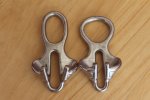
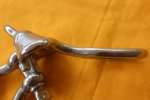
The second sample, same sort of test of a stainless 'claw' that was made by Oscalutti, I don't know if they still make it. Note, above, how the tested hook on the left has simply deformed, original hook on the right, The bottom picture shows that the hook has bent in all axis and the chain in the claw simply slipped out

IMG_5336.jpeg

Note that this 'hook' has in effect 2 hooks, that take the link in the claw or hooks. The OP had only one hook - through the link and would have had, about, half the strength of this Oscaluti claw.

These hooks failed below their ultimate tensile strength (commonly defined by fracture). They failed because of the low yield of stainless steel - they simply bent. They are not alone.


IMG_5327.jpeg

Vyv said in a previous thread - use a cast hook, not a fabricated hook or one cut from plate.

Jonathan
 
Until the OP gives us more information about his hook, we are all waffling. ?
As I said the hook is made from stainless steel - it's basically an S hook with one half of the S closed as if it was a circle [or half a figure 8]. I had it made up in a metal shop in the local "sanayi" and I just asked for it to fit through the link of an 8mm galvanised chain and it did fit until I reversed the chain. So it's possible the guy in the shop measured it against a worn chain and coincidentally my chain was worn and I'm now using fresh chain. I wasn't really thinking about the chain being worn until @vyv_cox mentioned this aspect.
Thanks to those concerned about the security of my through-link attachment but I only use this bridle in shallow sheltered areas where I swim. I have a Victory hook arrangement for less sheltered anchorages and a longer more secure snubbed for overnights.
 
As I said the hook is made from stainless steel - it's basically an S hook with one half of the S closed as if it was a circle [or half a figure 8]. I had it made up in a metal shop in the local "sanayi" and I just asked for it to fit through the link of an 8mm galvanised chain and it did fit until I reversed the chain. So it's possible the guy in the shop measured it against a worn chain and coincidentally my chain was worn and I'm now using fresh chain. I wasn't really thinking about the chain being worn until @vyv_cox mentioned this aspect.
Thanks to those concerned about the security of my through-link attachment but I only use this bridle in shallow sheltered areas where I swim. I have a Victory hook arrangement for less sheltered anchorages and a longer more secure snubbed for overnights.
OK, When I said to use a file, I had assumed that the hook was of the more normal type - basically a slot into which the link slots.
 
Top