Swansong for DGPS

Been announced ages ago - and most boating organisations raised no objections, as standard GPS so accurate that DGPS unnecessary for boats.
PS. The bigger issue is GPS signal vulnerability - GPS is a very weak signal so easy to be blocked, accidentally or maliciously. And a major technical failure in the satellite network could be hugely disruptive with the amount of blind reliance. But DGPS doesn’t help with these risks
 
When I used to work at the UK's national geological survey, someone came in wanting to sell us differential GPS tools for our field survey work. The idea was a unit on the car and a handheld unit that you wandered off with. The only advantage any of us could see was that if it told us we were moving at 50 miles an hour, we would know that somebody had nicked the car.
 
Any gps receiver with "WAAS" or more correctly "SBAS", is a differential receiver anyway and is good for <3m accuracy in areas with coverage. For Europe that's the EGNOS system and the area is:
PRN136_Map_Av_NPA.png
 
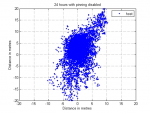
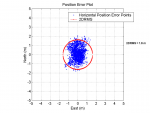
What Buck says is quite correct. What has been abandoned are terrestrial broadcasts of differences, since the space broadcasts which are picked up by the GPS sets themselves do that very job. I posted before results of with and without EGNOS on position errors on 24 hrs of stationary GPS (in Stockholm so reasonably far north, hence the poorer accuracy N-S than E-W):

GPS only
Picture 1.png
withe EGNOS turned on
Picture 2.png
 
Surely we still needed this for atmospheric corrections so the accuracy will be degraded without dGPS but everyone has decided it’s good enough. It’ll be interesting to see the accuracy difference as right now I have to set my plotter to use my AIS position to avoid seeing two boats on screen and they’re about 1.5m apart.
 
The SBAS satellite transmissions of DGPS use a network of land-based receivers which know their positions, and the differences are sent up from the ground to be disseminated by satellites. Thus atmospheric corrections are taken into account. Your AIS almost certainly already uses DGPS btw.
 
Ah that makes some sense, although I didn't think GPS signals had the bandwidth for such data?
 
Ah that makes some sense, although I didn't think GPS signals had the bandwidth for such data?

SBAS transmits on the same band but its message includes corrections for each GPS satellite and also an integrity message so your receiver knows which satellites to ignore rather than having to work it out itself (RAIM). The time correction is mostly due to ionospheric variations rather than atmospheric. These SBAS signals come from 2 of 3 geosynchronous satellites which are primarily used for TV broadcast and other communications. Free at the point of use to anyone with an SBAS enabled receiver. If you look at the list of received signals on your GPS unit, if you see PRN 123, 126 or 136 then you are receiving SBAS. It's a wide area correction so you should disable it if you are outside the area of coverage as it could make accuracy worse in that case.
We have a more localised system available to aircraft (GBAS) which is specific to each airport and even more accurate but this requires a second receiver rather like the maritime version.
 
Different satellites, just on same frequency. EGNOS is geo-stationary (pointing at Europe) and supports a down-link data rate of 250 bits per second (as opposed to 50 bits per second for GPS). Not blisteringly fast, but enough to give differences as these change over timescales measured in tens of minutes. Since it's on the same frequency as GPS, as is Gallileo, no more RF hardware is required (but the DSP and software has to be enabled for SBAS, which all modern ones are).

Edit: BT beat me to it.
 
Damn, I was just about to put a Phillips /Leica DGPS unit on the for sale forum.. at least I now don’t have to be perplexed as to why it wouldn’t sell ?
 
Top