Surely lifting keel boats have a much greater chance of getting unstuck from west coast mud than bilge keels?

Iliade

Well-Known Member
Joined
27 Apr 2005
Messages
2,286
Location
Shoreham - up the river without a paddle.
www.airworks.co.uk
Apropos of a forumite's hunt for a boat, surely lifting keeled boat, with their much greater chance of getting unstuck, are better than bilge keels for west coast mud?

I know I was caught out when I first moved to a bilge keeler by her tendency to veer suddenly and then get stuck when I first caught a keel on the mud of a rithe...
 
I’m biased as I own a lift keel boat, but I agree with you. Downside of course is cost of maintaining keel lifting mechanism and, in my case, a hoofing great centre board case in saloon!
 
If you dry out a lift keel boat on mud, the mud gets forced into the keel box and can stop the keel from dropping when you want it to. It helps to leave the keel down a few turns on the winch so that you can jiggle it 'up' first but lift keel boats have their problems too!
 
Our previous boat was lift keel and I'm in no hurry to get another. When we bought her the keel was jammed in the retracted position, it was a bit of a job to free it up.
 
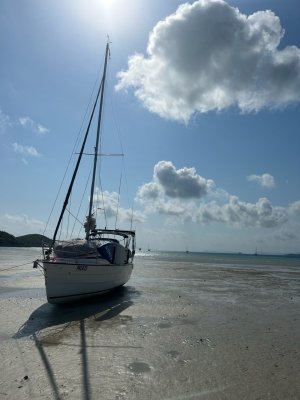
Us anchored in close with a swing keel due to a predicted several days of extremely strong winds.
The regular keel yachts can be seen out behind us and were already starting to rock and roll.
We have come in over the fringing reef which would still be way too shallow for most bilge keelers.
We have a bung on top of the keel case that can be opened and a rod used to give the swing keel an extra push if mud or a small rock jams the keel in its case.
To date it’s worked every time.
IMG_2187.jpeg
Hoofing great keel case in the centre of our yacht is our fold down sides dining table with integrated wine rack accessed via a lift up panel in the top.IMG_1635.jpeg
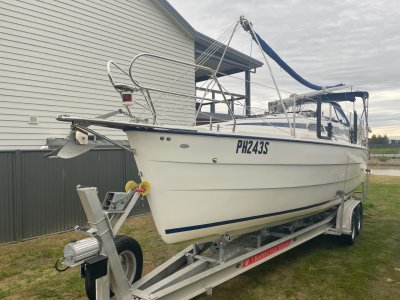
Our retracting keel has allowed us access to unique places denied regular and bilge keelers whilst also allowing easy trailering of our cruising oriented trailer sailer. IMG_6536.jpeg
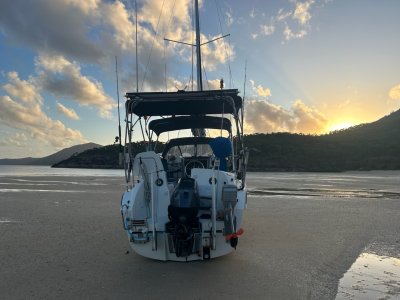
We love our swing keel yacht for cruising including skinny water exploring. I call our swing keel our reserve depth sounder.
 
Last edited:
Maybe the risk of a jam in mud depends on the design of the lifting keel. I’ve experienced no jams over the last 25 years in my lifting keel boat.

- you can get out of trouble easily when required
- the boat dries out flat
 
Like all these things, it is only useful if used to its advantages, otherwise it risks being a liability or an unnecessary complication. A swing keel could be very useful if I wanted to dry out on a beach or creep over shallows, just as bilge keels could be useful if I wanted to dry out on a level or have access to a cheaper mooring. Equally, a fin keel is only useful for someone who is prepared to sail to windward. All around me I see people with these various options who don’t use them for their intended purpose, but of course, having bought a boat it is often a case of - better the devil you know.
 
Us anchored in close with a swing keel due to a predicted several days of extremely strong winds.
The regular keel yachts can be seen out behind us and were already starting to rock and roll.
We have come in over the fringing reef which would still be way too shallow for most bilge keelers.
We have a bung on top of the keel case that can be opened and a rod used to give the swing keel an extra push if mud or a small rock jams the keel in its case.
To date it’s worked every time.
View attachment 164812
Hoofing great keel case in the centre of our yacht is our fold down sides dining table with integrated wine rack accessed via a lift up panel in the top.View attachment 164814
Our retracting keel has allowed us access to unique places denied regular and bilge keelers whilst also allowing easy trailering of our cruising oriented trailer sailer. View attachment 164816
We love our swing keel yacht for cruising including skinny water exploring. I call our swing keel our reserve depth sounder.
We used to call ours our “Get out of jail card”
 
We used to call ours our “Get out of jail card”
Hi Frayed Knot
We have a different thing on the back of our yacht that I call my “Get out of Jail free card” 😂
It’s also done duty a few times dragging other yachties out of jail one having run aground on a sandbar and another requiring a tow back to safe anchorage having lost a rudder.
IMG_2199.jpeg
Abomination to many and we rarely use it but on occasions it’s a great extra string to your capabilities bow especially in a cruising yacht not suited to being out in stormy weather. It makes for a quick dash to safe harbour.
 
Last edited:
Back to OP question. If sticky mud is a concern yes a lift keel can get you out of jail. The lift keel on my little boat 21ft is very much like a racing dinghy in that a foil shaped keel drops vertically out of a very flat bottom. This imho gives a superior keel performance to most fin keel yachts and results in very good windward performance. Of course a flat plate keel will not perform so well.
Yes you can lift the keel if you run aground. I keep keel locked down with a bolt. it averts damage when I run aground. Bolt goes across the top of the keel at the aft end to stop back kicking up so damaging fine trailing edge. I usally am able to heel the boat to sail away from a bump. I confess last time I got stuck tried to heel it and wind was so light current had an effect. I got a tow off. Completely forgot to lift keel. Yes in my little boat the CB case is a pain right in the middle of the cabin. The front is the mast support with a similar post about 60cms aft of that with CB in middle.
No I have never dried out on bottom keel up and I imagine debris could cause troubles. Lifting mechanism is simple 4 purchase tackle out through the cabin top to a halayard winch. Sometimes difficult to get keel to start falling if fore and aft trim is not good.
We never see bilge keel yachts here and lift keel are only used for the ability to trailer the boat and get into shallow water so no need for dinghy. ol'will
 
So going a little o/t again: If you added a Sadler style wing to the bottom of a vertically lifting keel, you could gain many of the advantages of bilge keels (fewer jams, sit upright on the keel on a poor bottom) whilst largely retaining those of the lift keel (shallower draft, not getting aggresively turned on hitting mud, better pointing.) Has this been tried anywhere?
 
I previously had a lifting keel boat, of a type where the keel retracted completely leaving a flat bottom.

I was not happy with the thought of drying out anywhere you had not previously inspected at low tide. My nightmare being a small rock or large stone just where you had dried out to grind into the bottom of your hull.

I would much rather dry out a bilge keel boat on an unknown surface.

Like others I am not sorry see the back of the worry of a lift keel mechanism. Only yesterday was I talking to someone about how difficulty it was to get to and maintain his lifting keel, and the time when it fell out, and he had to have a new one fabricated.
 
I previously had a lifting keel boat, of a type where the keel retracted completely leaving a flat bottom.

I was not happy with the thought of drying out anywhere you had not previously inspected at low tide. My nightmare being a small rock or large stone just where you had dried out to grind into the bottom of your hull.

I would much rather dry out a bilge keel boat on an unknown surface.

Like others I am not sorry see the back of the worry of a lift keel mechanism. Only yesterday was I talking to someone about how difficulty it was to get to and maintain his lifting keel, and the time when it fell out, and he had to have a new one fabricated.
My lifting keel boat got a large rock shaped hole in when an early autumn gale scoured the mud from the drying mooring. After going to a bulb keel Anderson 22 (fast but not the best thing since sliced bread), we went to bilge keels for the Bristol Channel.

Never had trouble with the lifting mechanism on either of two first boats
 
Top