Little Tern
Member
I get why you make single handed passages.
Ah, we're reduced to personal abuse, are we?
Thank you, I will take that as an admission that you realise you have argued yourself inextricably into a corner.

I get why you make single handed passages.

Bit of a joker too.....Ah, we're reduced to personal abuse, are we?
Thank you, I will take that as an admission that you realise you have argued yourself inextricably into a corner.

I think you are aground. Limited ability to manoeuvre isn't a term within the IRPCS. Three black balls in a vertical line, although if less than 12m not necessary. Keep a watch if you like, but being aground I doubt you'll be bothered by too many other vessels.


Sometimes there just has to be some common sense applied and if you are aground you aren't going anywhere and it's difficult to see why you would need to worry about obey any rule (apart from the balls maybe). Mind I think people on forums invent scenarios order to promote their particular themes on all this.(a) These Rules shall apply to all vessels upon the high seas and in all waters connected therewith navigable by seagoing vessels.
Obvs, once the tide drops and the boat is out of the water the IRPCS no longer apply.
I'd guess, unless a court defined a hovercraft or seaplane as a seagoing vessel for the purposes of Rule 1, the point where the IRPCS no longer apply occurs long before that. 10cm of water? Or, does it mean that if any portion of the water is navigable the rules apply all the way to the 'edge' even if that specific area isn't navigable by sea going vessels? Pros and cons to each interpretation and all the usual sources are silent on it.
There certainly has to be water.
EDIT: Which lead me to the pleasing wormhole, does the water have to be salt water or connected to salt water? I think it does. "High seas" seems unlikely to include fresh water and the great lakes follow inland waters rules, no IRPCS.
Sometimes there just has to be some common sense applied
I understand "high seas" to mean international waters, and I don't think there are any fresh international watersEDIT: Which lead me to the pleasing wormhole, does the water have to be salt water or connected to salt water? I think it does. "High seas" seems unlikely to include fresh water and the great lakes follow inland waters rules, no IRPCS.


Salinity varies - e.g. Black Sea is about half the salinity of the Med. Can't remember the IRPCS defining a limit on salinity. The Seine, Rhine, etc. are all navigable by seagoing vessels but 1b probably applies.I understand "high seas" to mean international waters, and I don't think there are any fresh international waters
Salinity varies - e.g. Black Sea is about half the salinity of the Med. Can't remember the IRPCS defining a limit on salinity. The Seine, Rhine, etc. are all navigable by seagoing vessels but 1b probably applies.
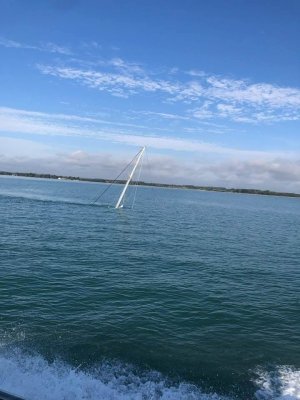
I bet the insurance company will be asking some probing questions - anchored in an odd spot, then left unattended, then sunk...

Sometimes they are taking the mick.Sometimes there just has to be some common sense applied and if you are aground you aren't going anywhere and it's difficult to see why you would need to worry about obey any rule (apart from the balls maybe). Mind I think people on forums invent scenarios order to promote their particular themes on all this.

Well surely if they don’t want everybody reporting a sunk vessel the accepted solution is to lay a temporary buoy marking the wreck.I bet the coastguard are starting to find fielding calls from well meaning yachtsmen rather tedious by now given the rate it was being called in this afternoon.
Occasionally people still call to report the motorboat wreck on the Isle of Wight shore


EDIT: Which lead me to the pleasing wormhole, does the water have to be salt water or connected to salt water? I think it does. "High seas" seems unlikely to include fresh water and the great lakes follow inland waters rules, no IRPCS.
Obvs, once the tide drops and the boat is out of the water the IRPCS no longer apply.
A stream may be navigable despite the existence of falls, rapids, sand bars, bridges, portages, shifting currents, or similar obstructions. Thus, a waterway in its original condition might have had substantial obstructions which were overcome by frontier boats and/or portages, and nevertheless be a “channel” of commerce, even though boats had to be removed from the water in some stretches, or logs be brought around an obstruction by means of artificial chutes. However, the question is ultimately a matter of degree, and it must be recognized that there is some point beyond which navigability could not be established.
The concept of a separate set of Inland Rules is just a particular US approach to implementing the IRPCS. The IRPCS generally extend inland so long as the waters remain "navigable", unless modified by local regulation within the scope of 1(b). For example, Canada simply has the IRPCS "with Canadian Modifications"[0] and no separate mention of boundary lines.
Let's not get ahead of ourselves!
"Navigable" is its own can of worms and will likely depend on each country's own laws. Referring to a US example, which has been heavily influenced by trade considerations, it covers "those waters that are subject to the ebb and flow of the tide and/or are presently used, or have been used in the past, or may be susceptible for use to transport interstate or foreign commerce." It also extends across the entire surface, with the edges being defined by the high water mark. For your amusement, I would also direct you to 33 CFR §329.10, "existence of obstructions":
This has been relevant in some cases for paddlers seeking to regain access to once-navigable waters that had been treated as non-navigable and thus private waterways, and they can sometimes extend quite far inland.
[0] Interestingly, one of those modifications is to Rule 10, specifically "A vessel making a transatlantic voyage shall, as far as practicable, avoid crossing the Grand Banks of Newfoundland and Labrador north of 43° north latitude." To me that's well beyond the scope of 1(b); presumably it would only apply to Canadian vessels?